 Bellingham Exterior
 Sudden Valley's Exterior Challenge: Shade, Moisture, and Time
Sudden Valley sits in a wooded, lake-adjacent setting on the shores of Lake Whatcom, southeast of Bellingham. It's a beautiful place to own a home — mature evergreens, a quiet lake, rolling terrain — but that same setting is hard on exterior building materials. Heavy tree canopy means less direct sun and wind to dry things out after a storm. Whatcom County's marine-influenced climate means storms roll through often, and the moisture that lands on a roof, siding wall, or deck board doesn't always get a chance to fully evaporate before the next system arrives.
Add in the broader Pacific Northwest coastal influence — salt-tinged air moving inland off Bellingham Bay and the Salish Sea on windy days — and you get a combination that ages exteriors faster than homeowners expect. None of this is unique to Sudden Valley, but the tree cover and lake humidity make it a more concentrated version of what the rest of Whatcom County deals with. We've worked on enough homes in this pocket of the county to know what actually fails first, and why.
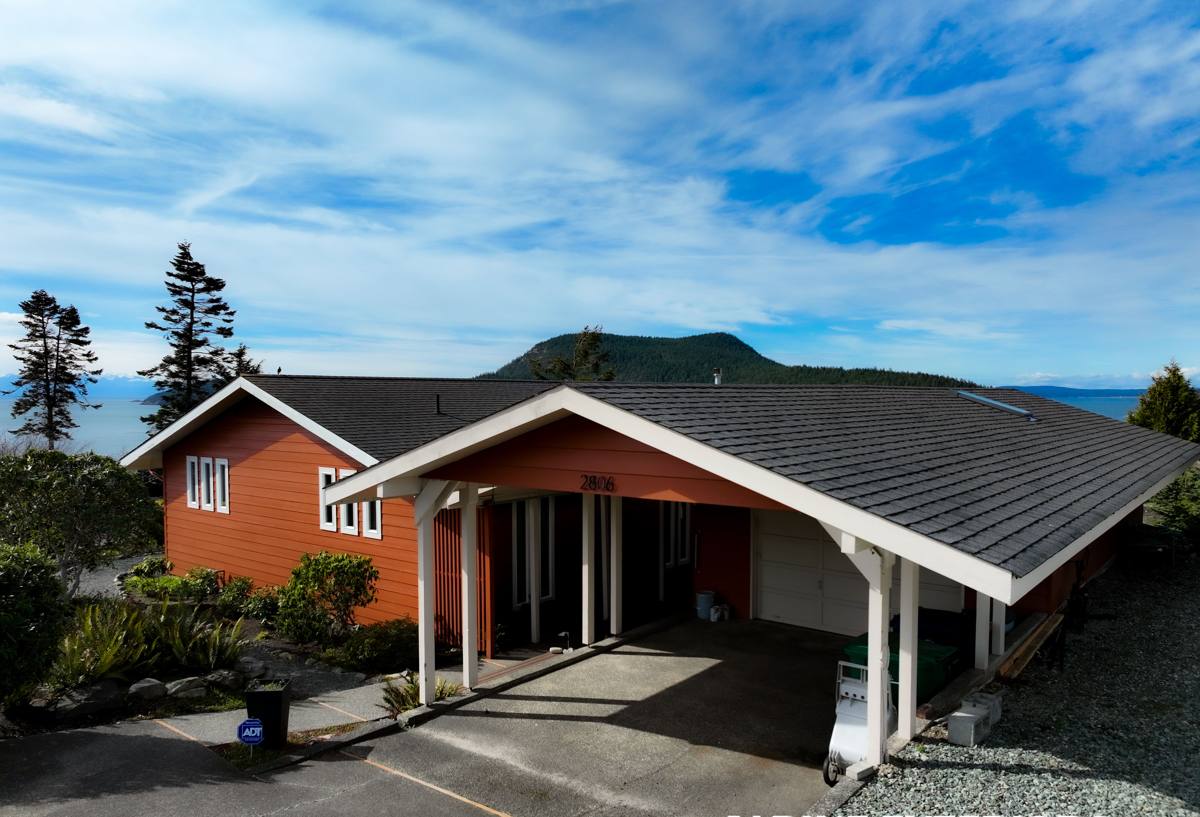
What Shade and Moisture Actually Do to a House
Moss and Algae Growth
A long moss season is the most visible sign of the problem. Moss doesn't just grow on roofs — it colonizes siding, deck boards, fence lines, and anywhere else moisture sits without enough sun or airflow to dry it. Left alone, moss holds water against a surface far longer than rain alone would, which accelerates rot in wood products and can work its way under poorly sealed siding joints.
Prolonged Dampness
Homes tucked under tree cover, or on the shaded side of a lot near the lake, stay damp longer after rain than homes in open, sunny areas. That extended dampness is what separates a material that shrugs off Northwest weather from one that slowly breaks down. It's also why the same product can perform differently on two homes just a few blocks apart, depending on how much sun and wind each lot actually gets.
Driving Rain and Wind-Driven Moisture
Storms off the Sound don't just fall straight down — wind pushes rain sideways into wall assemblies, window flashing, and deck ledger connections. Any gap in flashing, caulking, or siding overlap becomes an entry point, and once moisture gets behind a wall or under a deck surface, it's far more damaging than what lands on the visible face.
Siding: Why We Install Only James Hardie Fiber Cement
We do not install vinyl siding, LP SmartSide, Cemplank, Allura, or primed spruce and cedar. That's not a marketing position — it's a standard we hold because of what we've seen these products do over time in exactly this kind of climate, and what we've seen James Hardie fiber cement do instead.
Wood-based and engineered-wood siding products can perform well when installed to spec and maintained diligently, but they depend on that maintenance. In a shaded, moss-prone environment like Sudden Valley, engineered wood siding's weak point is moisture intrusion at cut edges and seams — if water gets in and doesn't dry quickly, swelling and eventual rot follow. Vinyl siding doesn't rot, but it isn't rigid, it can warp or crack in temperature swings, and it doesn't hold paint if a homeowner ever wants to change the look. Cedar is a genuinely beautiful material, but it's an ongoing commitment: re-staining, re-sealing, and watching for the exact moss and moisture buildup we described above.
James Hardie fiber cement is non-combustible, dimensionally stable, and engineered specifically for climates like ours through its HZ10 product line, which is formulated for the Pacific Northwest's wet weather cycle. Its factory-applied ColorPlus finish resists fading and doesn't require the repainting schedule that wood siding does. It holds its shape and its seams over decades rather than seasons. That's why it's the only siding system we put on homes — not because every alternative is worthless, but because we've standardized on the one product we can stand behind fully in this specific climate.
Roofing for a Wet, Wooded Community
Roofs in Sudden Valley take a different kind of abuse than roofs in open, sunny parts of Whatcom County. Shade from surrounding trees keeps roof surfaces damp longer, which is exactly the condition moss needs to establish. Moss growth on a roof isn't just cosmetic — as it spreads under shingle tabs and around flashing, it lifts material and creates channels for water to travel where it shouldn't.
A well-installed roof in this setting needs proper ventilation to help the deck dry out between storms, correctly detailed flashing at every valley and penetration, and gutter systems sized and maintained to handle both rain volume and the needle and leaf debris that comes with heavy tree cover. We install and repair roofing with those local realities in mind — not a generic specification pulled from a drier region.
Windows: Comfort, Condensation, and Moisture Control
Older or poorly sealed windows show their age quickly in a humid, shaded environment. Condensation between panes, fogged glass, and drafts around frames are common complaints we hear from homeowners in this area, and they usually trace back to failed seals or flashing installed without enough attention to wind-driven rain. Replacing windows here isn't just about energy efficiency, though that matters — it's about stopping water from tracking behind trim and siding at the window opening, which is one of the most common places we find hidden rot during siding replacement.
Correct flashing integration between new windows and Hardie siding is one of the most important details in the entire installation. A window that leaks at the flange, even slightly, can undermine an otherwise excellent siding job.
Decks: Built for Shade and Standing Moisture
Decks in wooded, lakeside settings deal with the same shade-and-moisture cycle as siding and roofing, but with the added stress of foot traffic and, often, ground-level moisture rising from below. Ledger board connections, joist hangers, and any wood-to-wood contact point are where we look first when evaluating an aging deck in this area — those are the spots where trapped moisture does its damage out of sight.
Whether a deck is built with wood, composite, or a mix of materials, the details that matter most in Sudden Valley are proper ledger flashing, adequate gaps between boards for drainage and airflow, and enough clearance from grade to keep the structure from sitting in standing water after a heavy rain.
Seasonal Exterior Checklist for Sudden Valley Homes
- Clear gutters and downspouts before the fall rains set in — tree debris backs up fast under this much canopy
- Check roof valleys and north-facing slopes for early moss growth each spring
- Inspect deck ledger boards and joist connections annually for softness or discoloration
- Look at window flashing and caulking for cracks after freeze-thaw cycles
- Walk the siding line looking for staining, bubbling paint, or soft spots near grade
- Trim back tree limbs and brush that keep siding or roof sections in constant shade
Cost Factors to Understand Before You Budget
Every exterior project is priced around a handful of real variables, not a flat per-square-foot number. Here's what actually moves the cost on a typical Sudden Valley home:
| Factor | Why It Matters |
|---|---|
| Existing siding removal | Tear-off and disposal of old material, plus any rot repair discovered underneath, adds labor before new material goes up |
| Home height and access | Multi-story homes and steep lots near the lake require more staging and safety equipment |
| Trim and architectural detail | Homes with more windows, dormers, or trim transitions take longer to flash and finish correctly |
| Roof pitch and complexity | Steeper roofs and more valleys mean more flashing detail and longer install time |
| Deck size and structural condition | Rebuilding a compromised substructure costs more than replacing decking boards alone |
Why a Local Crew Matters Here
A crew that mostly works in drier, sunnier parts of the region can miss the details that matter most in a place like Sudden Valley. Knowing how much longer a north-facing wall stays wet, how aggressively moss establishes under this tree cover, and where wind-driven rain tends to find weak flashing on lakeside lots isn't something you get from a manual — it comes from working in Whatcom County, on homes like these, season after season. We're a Bellingham-based crew, and this community is part of our regular service area, not an occasional stop.
Ready for a Straight Answer About Your Home's Exterior?
If you're noticing moss buildup, soft spots, drafty windows, or a deck that's starting to feel less solid, it's worth having someone look at it before a small issue becomes a structural one. Fill out the form below for a free, no-pressure estimate — we'll walk your property, tell you honestly what we see, and explain what it would take to fix it right.