 Bellingham Exterior
 Building an Exterior That Can Handle Blaine's Coastline
Blaine sits at the far northwest corner of Whatcom County, wrapped by Semiahmoo Bay, Drayton Harbor, and the open Salish Sea just beyond. That waterfront setting is part of what makes the area beautiful, and it's also exactly why exteriors here take more abuse than homes even a few miles inland. Salt-laden air moves off the water, driving rain comes in sideways during winter storms, and the shaded, damp corners of a lot stay wet long enough to grow moss on almost anything that will hold it. A roof, a wall of siding, or a set of window frames in Blaine is doing more work every year than the same materials would in a drier, more sheltered part of the county.
We're a local exterior contractor working throughout Whatcom County, and we treat Blaine as its own case, not a smaller copy of Bellingham. The wind exposure, the salt, and the moisture patterns are specific to homes near the bay, and the way we spec and install siding, roofing, and windows reflects that.
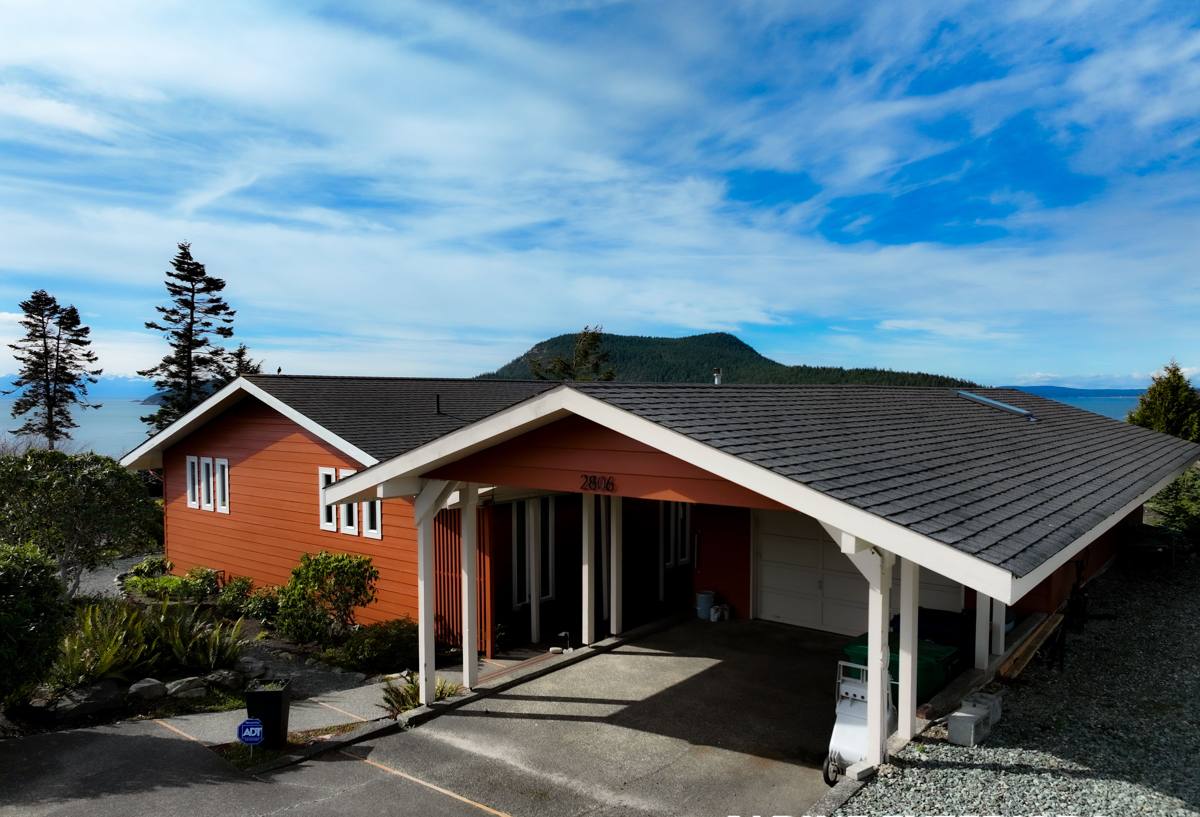
What Blaine's Climate Actually Does to a House
Salt Air and Coastal Wind
Homes close to Semiahmoo Bay and Drayton Harbor sit in a mild but persistent salt-air environment. Airborne salt doesn't just affect metal — it accelerates the breakdown of paint films, degrades caulking and sealants faster, and speeds up corrosion on fasteners, flashing, and hardware that aren't rated for coastal exposure. Wind off the water also drives rain into siding laps and window edges that would stay dry on a more sheltered inland lot, which is why water management at every joint matters more here than the material choice alone.
Driving Rain
Whatcom County gets a lot of rain overall, but Blaine's exposure to Pacific storm systems means that rain often arrives with real wind behind it. Driving rain finds weak points — poorly lapped siding, undersized roof overhangs, window flashing that was installed out of sequence — and pushes moisture into places it wouldn't reach in a light, straight-down rain. Over years, that's how rot starts behind siding that looks fine from the curb.
Moss and Shade
Tree cover, marine humidity, and long stretches of overcast weather add up to prime moss conditions. Moss holds moisture against roofing and siding surfaces far longer than open air would, and on wood-based products it can trap enough dampness to start decay underneath before it's visible from the ground. North-facing walls and roof planes that stay shaded most of the day are usually where we see the earliest wear on any exterior in this area.
Siding for Blaine Homes
We install James Hardie fiber cement siding exclusively. It's not the only siding product on the market, but for a coastal, moss-prone, high-moisture area like Blaine, it's the one we're willing to put our name behind.
Why We Standardized on James Hardie
- Non-combustible core. Fiber cement doesn't feed a fire the way wood-based products can — a real consideration anywhere in Whatcom County given regional wildfire seasons.
- Doesn't rot. Because it's cement-based rather than wood-based, it isn't a food source for the rot fungi that thrive in Blaine's damp, shaded conditions.
- Factory-applied ColorPlus finish. The color is baked on at the factory under controlled conditions, which holds up better against UV and salt air than field-applied paint, and it's backed by its own finish warranty.
- Engineered for this climate. Hardie's HZ10 product line is specifically formulated for the wetter, more humid conditions found in the Pacific Northwest, as opposed to the HZ5 line built for drier, freeze-prone regions.
- Long track record. Fiber cement has been used in wet coastal climates for decades with a well-documented performance history, not a marketing claim.
We don't install vinyl, LP SmartSide, Cemplank, Allura, or primed wood siding, and we're upfront about why. Vinyl can warp and fade under sustained UV and temperature swings and offers limited protection where wind-driven rain is common. Engineered wood products like LP SmartSide use a wood-strand core that, if the factory coating is ever compromised at a cut edge, fastener hole, or joint, gives moisture a path into a material that can swell and deteriorate — a real risk in a climate that stays wet as long as Blaine's does. Primed spruce and cedar are attractive but demand a repainting and caulking schedule that most homeowners underestimate, and any lapse in that maintenance shows up fast in salt air. Cemplank and Allura are also fiber cement and address the rot issue, but we've chosen to standardize on one manufacturer, one warranty structure, and one installation system we know inside and out, rather than juggle products with different specs and coverage terms.
Siding Comparison for Coastal Whatcom County
| Factor | James Hardie Fiber Cement | Vinyl | Engineered Wood (e.g. LP SmartSide) | Cedar / Primed Wood |
|---|---|---|---|---|
| Rot resistance | Not a food source for rot fungi | Doesn't rot, but can warp/crack | Vulnerable if the coating is breached | Requires ongoing maintenance to resist rot |
| Salt air / coastal exposure | Built for it (HZ10 line) | Fades and becomes brittle over time | Coating wear speeds up in salt air | Finish breaks down faster near the water |
| Fire resistance | Non-combustible | Melts/deforms under heat | Combustible wood-based core | Combustible |
| Maintenance | Occasional wash, no repainting needed for years | Low, but limited repair options | Moderate to high | High — regular paint/stain cycle |
| Typical lifespan before major work | Decades, with proper install | 15–25 years | Varies with maintenance | Highly maintenance-dependent |
Roofing That Handles Moss and Wind-Driven Rain
A roof in Blaine has to do two jobs at once: shed a lot of water fast, and resist moss and algae growth that thrives in the shaded, moist microclimate near the bay. We look at ventilation, underlayment, and flashing details as closely as the roofing material itself, because most roof leaks in this area start at a valley, a penetration, or an edge detail rather than in the middle of an open field of shingles. Proper attic and roof ventilation also matters more here than in drier climates — poor airflow traps moisture under the roof deck and accelerates both moss growth on top and rot underneath.
We also pay attention to overhang length and gutter sizing during roofing work, since the two-way problem of driving rain and heavy moss load means undersized gutters clog faster and back water up under the roof edge.
Windows for a Wet, Windy Coastal Lot
Windows are one of the most common places water finds its way into a Blaine home, not because the window unit itself fails, but because flashing and sealant around it were installed out of sequence or skipped a step. Wind off the bay pushes rain into any gap at a window edge, so we install with a proper flashing sequence — water-resistive barrier, sill pan, and step flashing integrated correctly with the siding — rather than relying on caulk alone to keep water out. We also talk with homeowners about glass and frame options that handle the area's temperature swings and condensation tendencies, since a well-sealed, poorly-vented home can end up with interior moisture problems even after the exterior leak risk is solved.
Decks in a Marine Climate
Outdoor living space near the water takes its own kind of punishment — salt air, standing moisture, and shade from mature trees common on Blaine lots. We build decks with attention to proper drainage, fastener selection that won't corrode in salt air, and ledger flashing that keeps water from tracking back into the house framing, which is one of the more serious and preventable failure points on older decks in this region.
Why a Local Crew Matters Here
A crew that mostly works drier, inland jobs can install a technically correct product the wrong way for Blaine's conditions — wrong flashing sequence, wrong nailing pattern for wind exposure, wrong clearance from grade near the water. We work throughout Whatcom County and treat coastal exposure, salt air, and moss-prone shade as design factors, not afterthoughts. That shows up in details like fastener choice, lap and gap spacing on siding, and how much overhang and ventilation a roof gets — decisions that matter more in Blaine than they would a few miles inland in Bellingham.
What to Expect From an Estimate
Every home on the Blaine waterfront and further inland faces a slightly different mix of wind exposure, shade, and moisture. A useful estimate starts with a look at your specific exposure — which walls take the weather, where moss is already established, how the roof is ventilated — rather than a generic quote based on square footage alone.
Questions Worth Asking Any Contractor Before You Hire
- Are you licensed and insured to work in Washington, and can you provide proof?
- What siding, roofing, and window products do you install, and why did you choose them?
- How do you handle flashing at windows, doors, and roof penetrations?
- What does your warranty actually cover — labor, materials, or both — and for how long?
- Can you explain how salt air and moisture in this specific area affect your material and installation choices?
If you're weighing a siding, roofing, window, or deck project on a Blaine property, we're happy to walk the exterior with you, point out what the climate has already done to it, and put together a straightforward, no-pressure estimate. There's a form below to get that conversation started.