 Bellingham Exterior
 Why Blaine Homes Wear Out Siding Faster
Blaine sits right on Semiahmoo Bay and Drayton Harbor, which means homes here take on a combination of stresses that inland Whatcom County properties simply don't deal with in the same intensity. Salt-laden air off the water accelerates the breakdown of paint films and fastener finishes. Wind-driven rain off the Strait of Georgia hits siding at an angle instead of falling straight down, which pushes moisture into laps, seams, and trim joints that a calmer climate would never test. And like most of Northwest Washington, Blaine gets a long stretch of grey, damp months where moss and algae get every advantage they need to take hold on north-facing and shaded walls.
None of that is unusual for the region — it's the same basic climate pattern we deal with across Whatcom County. But the marine exposure in Blaine specifically pushes the timeline up. Siding systems that might get 20 solid years out of them in a drier inland spot often start showing real trouble a decade or more sooner along the water.
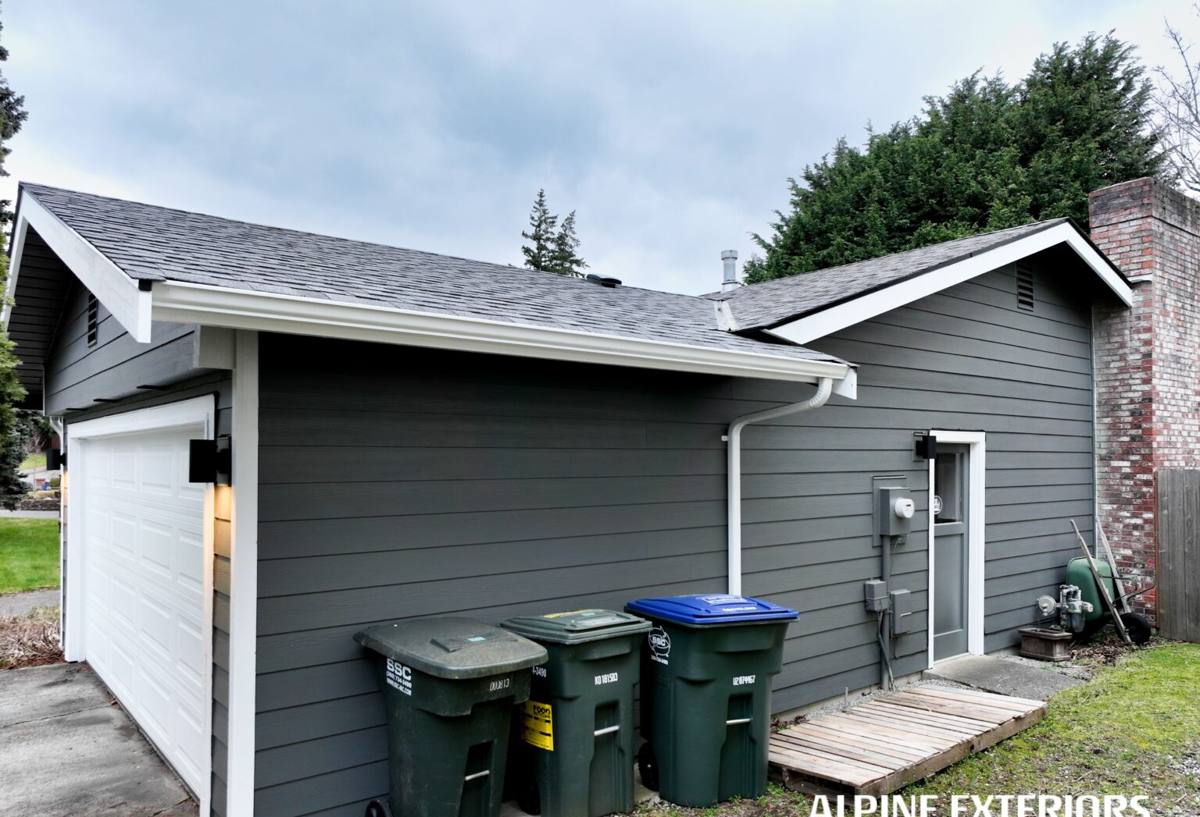
What Salt Air, Driving Rain, and Moss Actually Do to Siding
Salt Air
Airborne salt is hygroscopic — it pulls moisture out of the air and holds it against whatever surface it lands on. On wood-based siding, that means the surface stays damp longer than it should, which speeds up paint failure, checking, and eventually rot at the cellular level. On fasteners and trim hardware, salt exposure accelerates corrosion, and a corroding nail head under a paint film is one of the more common hidden causes of an early siding failure.
Driving Rain
Wind off open water doesn't just add volume to a rainstorm — it changes the direction water travels. Horizontal or upward-driven rain finds its way behind poorly lapped courses, under caulked joints that were never meant to be a primary water seal, and into end cuts that weren't sealed at installation. Once water gets behind siding, the damage happens where you can't see it until it's expensive.
Moss and Algae
Blaine's overcast, wet season runs long, and shaded north and east walls rarely get enough direct sun to dry out between storms. That's exactly the environment moss and algae need. On porous or textured siding surfaces, growth gets a foothold in the surface itself, not just sitting on top of it, which makes it harder to clean off without damaging the material underneath.
Why We Install Only James Hardie Fiber Cement
We made a decision as a company to install James Hardie fiber cement siding exclusively — we don't install vinyl, LP SmartSide, Cemplank, Allura, primed spruce, or cedar. That's not a marketing position, it's a standard we hold ourselves to because of what we've seen happen to each of those products in exactly this kind of marine, high-moisture climate.
| Material | What it does well | Why it struggles in Blaine's climate |
|---|---|---|
| Vinyl | Low upfront cost, minimal maintenance | Can warp or become brittle with temperature swings; seams and butt joints are common water entry points in driving rain |
| Cedar | Natural appearance, renewable material | Wood fiber absorbs moisture readily; needs regular refinishing to resist rot and moss, which is a real ongoing cost near salt air |
| Primed spruce/wood composites | Lower material cost than fiber cement | Factory primer is a base coat, not a finish system; edges and cuts are vulnerable to moisture intrusion if not fully sealed |
| OSB-based products (LP SmartSide) | Engineered strength, workable cost | Relies on a treated strand board core — performance depends heavily on installation and maintaining the factory seal at every cut and joint |
| James Hardie fiber cement | Non-combustible, engineered for moisture and climate, factory-cured finish | Higher material and install cost than vinyl; requires correct fastening and joint treatment to perform to spec |
James Hardie is cement-based rather than wood- or resin-based, so it doesn't absorb and swell with moisture the way organic materials do, and it won't feed rot. It's also non-combustible, which matters more every year as wildfire smoke and dry-season fire risk become a bigger part of the conversation in Washington. Hardie's HZ5 product line is specifically engineered for climates with more moisture cycling and freeze-thaw exposure — a good fit for a coastal county like Whatcom. The factory-applied ColorPlus finish is baked on under controlled conditions, which gives it more consistent, longer-lasting color and weather resistance than a field-applied paint job can match, and it comes with a real transferable warranty backing it.
What a Correct Siding Replacement Involves
Replacing siding isn't just swapping old boards for new ones. In a marine climate like Blaine's, the work that happens before and around the siding matters as much as the siding itself.
- Full tear-off and inspection: Old siding comes off completely so the sheathing underneath can be checked for rot, soft spots, or prior water damage — problems that are common on water-facing and shaded walls.
- Sheathing repair: Any damaged sheathing gets replaced before anything new goes on. Installing new siding over compromised sheathing just hides a problem that will keep getting worse.
- Weather-resistive barrier: A proper house wrap or building paper goes on as the primary drainage plane, installed with correct laps and taped seams so wind-driven rain has a path to shed rather than a path to travel inward.
- Flashing at every penetration: Windows, doors, vents, and any wall penetrations get flashed correctly so water is directed out and down, not into the wall cavity.
- Rainscreen or drainage gap where called for: A ventilated gap behind the siding lets any moisture that does get through dry out instead of sitting against the wall assembly — especially valuable on the north and west-facing walls that take the brunt of driving rain here.
- Correct fastening per Hardie spec: Fiber cement has specific nailing patterns, fastener types, and clearances. Getting this wrong is one of the most common causes of premature siding failure and voided warranties, regardless of how good the material itself is.
- Sealed and caulked joints, trim, and penetrations: Every cut edge and joint gets treated correctly rather than relying on caulk alone as the water barrier.
Our Process, Start to Finish
We keep the process straightforward because homeowners deserve to know what's happening to their house and when.
- On-site assessment: We walk the exterior with you, look at current siding condition, note any problem areas (especially water-facing walls and anywhere moss has taken hold), and check the state of trim, flashing, and sheathing where visible.
- Written estimate: You get a clear scope of work and pricing before anything is scheduled — no surprise add-ons buried in fine print.
- Material selection: We help you choose the right Hardie product line, profile, and color for your home and exposure, including HZ5 where the site conditions call for it.
- Tear-off and inspection: Old material comes off, sheathing gets inspected and repaired as needed, and we flag anything unexpected before moving forward.
- Weather barrier and flashing installation: The drainage plane and flashing details go in correctly, since this is the layer that does the real water management work.
- Hardie installation to manufacturer spec: Fastening, clearances, and joint treatment follow James Hardie's published installation requirements, which keeps both the material warranty and the workmanship intact.
- Final walkthrough: We go over the finished work with you so you know what was done and what to expect going forward.
Signs Your Blaine Home's Siding Needs Replacing
- Visible warping, cracking, or buckling in siding boards, especially on water-facing walls
- Persistent moss or algae growth that returns quickly after cleaning
- Soft or spongy spots when you press on the siding
- Paint that's peeling, bubbling, or failing faster than a normal repaint cycle would suggest
- Visible gaps at seams, corners, or trim where daylight or drafts get through
- Rising energy bills that don't match any other change in the home
- Interior signs like musty smells or discoloration on exterior-facing walls, which can point to moisture getting through from outside
Why a Crew That Already Works This Area Matters
Blaine's exposure isn't uniform — a wall facing Drayton Harbor takes different punishment than a wall tucked on the leeward side of the same house. A crew that already works siding jobs up and down the Whatcom County coastline recognizes those patterns quickly: where the driving rain hits hardest, which walls need extra attention at flashing and joints, and where moss is going to be a recurring problem no matter what material goes up. That local pattern recognition shows up in the details — nailing schedules that account for real wind exposure, drainage details sized for how much water this coastline actually sees, and material choices matched to a specific wall's sun and moisture exposure rather than a one-size-fits-all approach.
It also means a shorter learning curve on permitting and inspection expectations in Whatcom County, and a crew that isn't guessing at how the Pacific Northwest's wet season behaves on a real job site.
What to Expect for Cost
| Factor | How it affects cost |
|---|---|
| Home size and wall complexity | More square footage and more corners, gables, or dormers increase labor and material |
| Sheathing condition | Rot or water damage found during tear-off adds repair cost before new siding goes on |
| Hardie product line chosen | Lap siding, panel systems, and specialty trim carry different material costs |
| Trim and detail work | Window and door trim, corner boards, and fascia detailing add labor time |
| Access and site conditions | Steep lots, limited access, or extensive scaffolding needs affect labor time |
We don't publish blanket price lists because every home's condition and scope is different — the honest answer only comes from actually looking at the house. That's what the estimate is for.
If your Blaine home's siding is showing wear from salt air, driving rain, or moss, we're happy to take a look and give you a straightforward, no-pressure assessment of what's going on and what it would take to fix it right. Use the form below to request a free estimate.