 Bellingham Exterior
 Why Blaine Homes Are Hard on Siding
Blaine sits at the far northwest corner of Whatcom County, right where Semiahmoo Bay and the Strait of Georgia meet the mainland. That location is part of what makes the area beautiful, and it's also exactly why siding here fails faster than it does twenty miles inland. Salt-laden air off the water accelerates corrosion on fasteners and trim, wind-driven rain gets pushed sideways into laps and seams during winter storms, and the long, gray, low-sun stretch from November through April keeps exterior walls damp for days at a time. Add in the moss and algae that thrive in that shade and moisture, and you have a climate that punishes any siding product with a weak point.
Homeowners in Blaine aren't dealing with a generic "Pacific Northwest" climate — they're dealing with a coastal microclimate on top of it. That distinction matters when you're choosing a siding material and a crew to install it.
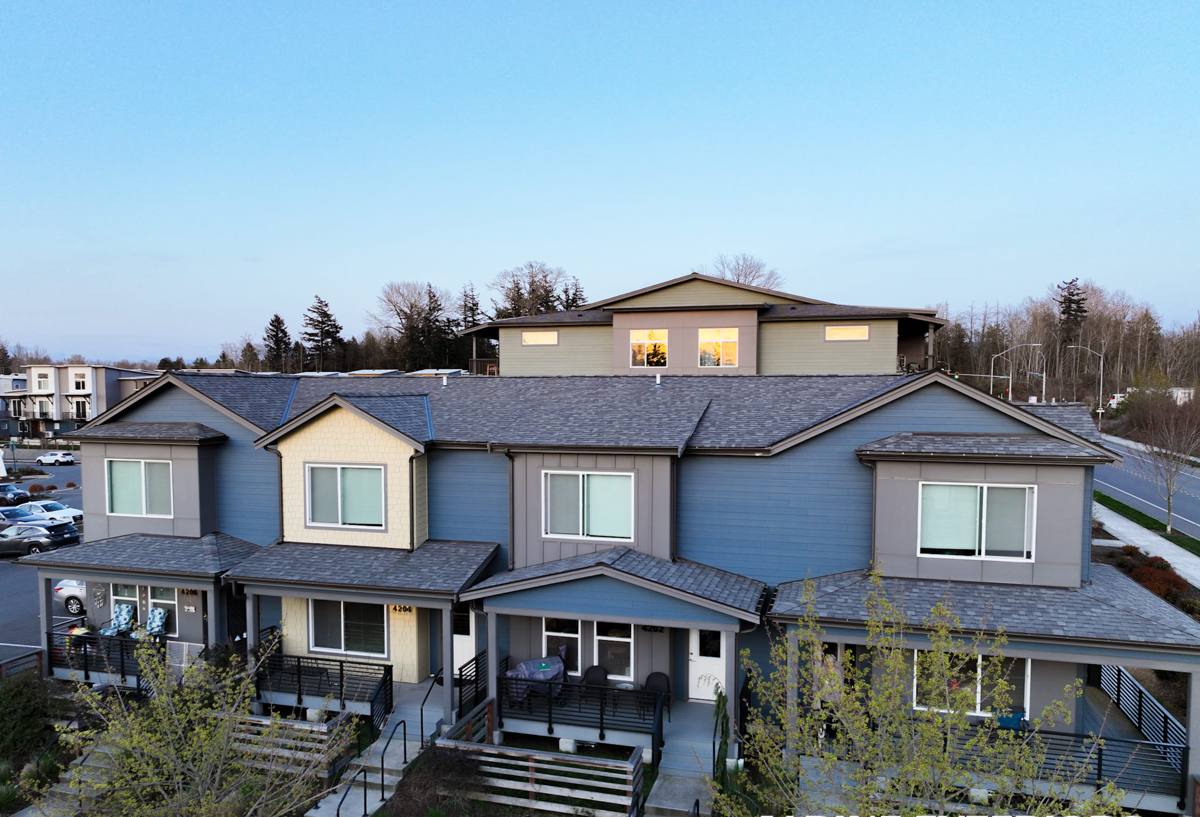
What Coastal Whatcom County Siding Actually Needs to Survive
A siding system that holds up in Blaine has to do several things well at once, not just look good on install day:
- Resist moisture absorption — wood-based products swell, cup, and rot when they stay wet; the material itself needs to be dimensionally stable.
- Shed wind-driven rain — panel laps, joints, and butt seams need enough overlap and the right flashing detail to keep water from being pushed uphill by gusts off the water.
- Handle prolonged shade and dampness — many Blaine lots are treed or oriented away from direct afternoon sun, so a north or west wall can stay damp for extended periods; the material and finish need to resist moss and mildew growth rather than feed it.
- Tolerate salt exposure — fasteners, trim, and any exposed metal need corrosion resistance, and the siding's paint or factory finish needs to hold color and adhesion despite the salt film that settles on exterior surfaces near the water.
- Stay stable through freeze-thaw swings — Blaine doesn't get deep cold often, but it does get sharp temperature swings in winter storms, and repeated expansion and contraction opens gaps in poorly fitted siding over time.
This is the checklist we run every Blaine siding job against, and it's why we standardized on one product system instead of offering several.
Why We Install Only James Hardie Fiber Cement
We don't install vinyl, LP SmartSide, primed spruce, cedar, or other fiber cement brands. That's a deliberate decision, not a sales pitch. James Hardie's fiber cement is non-combustible, dimensionally stable, and manufactured with HZ5 formulations specifically engineered for wetter, harsher climates — which describes Blaine and the rest of coastal Whatcom County well. The ColorPlus factory finish is baked on under controlled conditions rather than field-applied, which means better adhesion and more consistent resistance to fading and moss staining than most site-painted materials achieve.
None of that makes fiber cement maintenance-free — it still needs to be installed correctly, caulked correctly, and painted (if not ColorPlus) on a normal cycle. But it gives a coastal home the best starting point: a material that doesn't rot, doesn't feed mold the way wood substrates can, and holds a factory finish through salt exposure and constant damp far better than the alternatives we chose not to carry.
How Hardie Compares to What We Won't Install
| Factor | James Hardie Fiber Cement | Vinyl | Wood / Engineered Wood |
|---|---|---|---|
| Moisture behavior | Dimensionally stable, won't rot | Won't rot, but can warp and gap in temperature swings | Absorbs moisture; rot risk if finish fails |
| Salt air resistance | Factory finish holds up well; non-combustible core | Can chalk and become brittle over time | Finish degrades faster; substrate vulnerable once compromised |
| Moss/algae resistance | Finish resists staining better than raw or site-painted wood | Can trap moisture behind panels in poor installs | Prone to moss growth in shaded, damp conditions |
| Fire rating | Non-combustible | Combustible | Combustible |
| Warranty structure | Long, transferable manufacturer warranty when installed to spec | Varies by manufacturer, often shorter | Varies; finish warranties often separate from material |
What Correct Installation Looks Like on a Blaine Home
The product only performs as well as the install. In a coastal wind-and-rain environment, the details that get skipped on a rushed job are exactly the ones that cause failures two or three winters later.
Water Management Comes First
Before any siding goes up, the wall needs a correctly lapped weather-resistive barrier, properly flashed windows and doors, and rainscreen or furring where the wall assembly calls for it. On a site exposed to wind-driven rain off the strait, we pay particular attention to head flashing above windows and any horizontal trim, since that's where water gets pushed up and behind if the lap sequence is wrong.
Fastening and Fit
Hardie panels and lap siding need to be fastened per the manufacturer's specification — correct nail type, spacing, and depth — and butt joints need to be properly flashed or caulked, not just butted together. In a salt-air environment, we also pay attention to fastener material so corrosion doesn't create staining or loosening at the fastener points over the life of the siding.
Clearances and Gaps
Siding needs proper clearance from grade, roofing, and decks so water doesn't wick up into the bottom edge. On coastal lots with heavy rain volume, that clearance is one of the first things we check on an older home before deciding whether it's a straightforward re-side or needs additional drainage work first.
Caulking and Sealant
Every penetration, joint, and trim intersection gets sealed with a sealant rated for exterior movement and UV exposure — and we don't rely on caulk to cover for a poor flashing detail underneath it. Caulk is a backstop, not the primary water management strategy.
Our Process for a Blaine Siding Project
- On-site assessment — we look at your current siding, wall assembly, moisture staining patterns, and any rot or damage, and check how exposed the home is to wind and salt spray based on its orientation and surroundings.
- Scope and product selection — we walk you through the relevant Hardie lines, textures, and ColorPlus colors, and explain what's driving the recommendation for your specific walls (a north-facing shaded wall may need different attention than a south wall in full sun).
- Written estimate — a clear scope of work and cost, with no pressure to sign on the spot.
- Prep and water management — removal of old siding, inspection and repair of sheathing, correct weather barrier and flashing installation before a single piece of new siding goes up.
- Installation to manufacturer spec — proper fastening, clearances, joint treatment, and trim detailing.
- Final walkthrough — we go over the finished work with you before we consider the job done.
Why a Crew That Already Works Blaine Matters
Coastal Whatcom County installs aren't identical to inland Bellingham jobs. A crew that regularly works this stretch of coastline already knows to check for the wind exposure patterns typical of open lots near the water, understands how moss establishes on shaded north and west walls in this specific climate, and has seen firsthand what happens when flashing details are skipped on a house that takes direct wind-driven rain. That experience shows up in the small decisions made on-site — where to add extra flashing, how tight to run a joint, which walls need closer attention — that don't show up in a generic spec sheet.
It also matters for accountability. A local crew is easy to reach if a question comes up after the job, and stands behind both the installation work and the manufacturer's warranty on the product itself.
Signs Your Blaine Home May Need New Siding
- Persistent moss or dark staining that returns shortly after cleaning, especially on shaded or north-facing walls
- Soft spots, bubbling, or visible warping in existing siding panels
- Paint that's peeling or failing faster than the normal repaint cycle would suggest
- Visible gaps at joints, corners, or trim that let daylight or drafts through
- Rising energy bills that point to a wall assembly no longer doing its job
- Siding that's simply reached the end of its practical service life and is due for replacement
If any of that sounds familiar, it's worth having someone look at the wall assembly, not just the surface — because in a coastal climate like Blaine's, the damage that matters most is often the part you can't see from the yard.
If you're weighing a siding project on a Blaine home, we're happy to take a look and give you a straightforward, no-pressure estimate — including an honest read on whether it's time to re-side now or whether targeted repairs will hold for a while longer.