 Bellingham Exterior
 Our Standard: One Product, Installed Correctly
Walk around Bellingham long enough and you'll notice something about the siding on homes that have held up well over the last fifteen or twenty years: a lot of it is fiber cement. That's not an accident. We made the decision years ago to install only James Hardie fiber cement siding on the homes we work on, and we don't deviate from that for vinyl, LP SmartSide, cedar, primed spruce, or any of the other fiber cement brands on the market. This page explains why, in plain terms, without the marketing gloss.
Whatcom County throws a specific combination of conditions at exterior materials: salt-laden air moving in off Bellingham Bay and the Salish Sea, driving rain that comes in sideways during fall and winter storms, and a moss and algae season that runs longer here than almost anywhere else in the state because of our humidity and tree cover. Siding on a Bellingham home isn't just decorative — it's doing real defensive work, year-round.
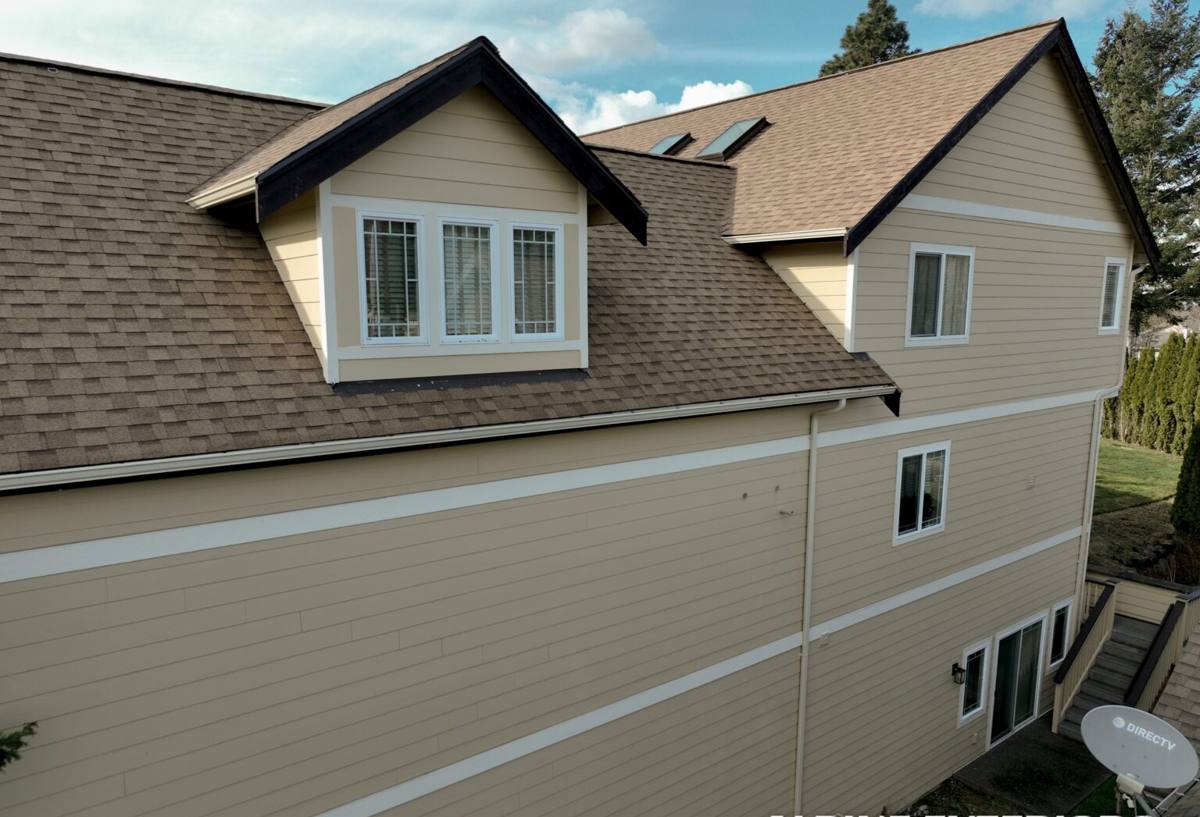
What James Hardie Siding Actually Is
James Hardie fiber cement siding is manufactured from a mixture of Portland cement, sand, cellulose fiber, and water, cured under pressure and heat. The result is a rigid, dense board that behaves nothing like wood or vinyl. It doesn't absorb water the way wood does, it doesn't soften or sag in heat, and it doesn't become brittle in cold the way some plastics can. It's also non-combustible, which matters more every year as wildfire smoke and ember exposure become part of the conversation even west of the Cascades.
The HZ5 Climate Engineering
Hardie makes region-specific formulations under what it calls the HZ (HardieZone) system. HZ5 is engineered for the wetter, colder, freeze-thaw climates found across the Pacific Northwest, and it's the formulation we specify for jobs in Bellingham and the rest of Whatcom County. It's not a marketing label — the moisture resistance and freeze-thaw performance are tuned differently than the HZ10 formulation sold in the Southeast and Southwest.
ColorPlus Factory Finish
Most of what we install is finished with Hardie's ColorPlus coating, which is baked on in a factory environment under controlled conditions rather than sprayed or brushed on site after installation. That matters for two practical reasons: the finish is more uniform, and it carries its own separate finish warranty on top of the product warranty. A field-applied paint job, by contrast, is only as good as the weather conditions and prep work on the day it went on.
Why We Don't Install the Alternatives
We get asked fairly often why we won't quote vinyl or LP SmartSide alongside Hardie. It's a fair question, and homeowners deserve a straight answer instead of a shrug.
Vinyl Siding
Vinyl is inexpensive and low-maintenance in the sense that it never needs painting. But it's a thin plastic product that expands and contracts significantly with temperature swings, which over time opens gaps at seams and trim. In a marine climate with constant moisture cycling, those gaps become entry points for water working its way behind the panels. Vinyl also has a lower heat tolerance than most people expect, and it doesn't hold up structurally to impact the way fiber cement does. We're not saying vinyl fails on every home — we're saying we've seen enough of it fail in this specific climate that we stopped installing it.
LP SmartSide and Other Engineered Wood
LP SmartSide is a strand-based engineered wood product with a resin-and-wax treatment meant to resist moisture. It performs reasonably well in drier climates. In Whatcom County's sustained wet season, though, any wood-based product is fundamentally vulnerable at cut edges, fastener penetrations, and butt joints if the factory seal is compromised during installation — and job-site cuts happen on every install. Water intrusion at those points can lead to swelling and, eventually, rot. Fiber cement doesn't have that failure mode because it isn't wood.
Cedar and Primed Spruce
Real wood siding has a genuine aesthetic appeal that we understand — it's a classic Pacific Northwest look. But it demands a maintenance schedule most homeowners underestimate: recaulking, repainting or restaining on a multi-year cycle, and vigilant moss and mildew control, especially on north-facing walls that stay damp longest under our tree cover. Skip a cycle or two and the deterioration accelerates fast. We'll install cedar accents in limited architectural applications on request, but we won't put a whole home in wood siding and tell a client it's low-maintenance, because it isn't.
Other Fiber Cement Brands (Cemplank, Allura)
These are legitimate fiber cement products manufactured on the same basic principle as Hardie. Our decision to stick with one brand isn't a claim that the others are defective — it's a practical standardization choice. We know Hardie's product lines, fastening specs, and warranty terms cold, our crews are trained specifically on Hardie installation detailing, and we can back every job with a manufacturer relationship built on years of installs. Splitting that focus across multiple brands would mean less depth of expertise in any one system.
Comparing the Options Honestly
| Material | Moisture Behavior in Wet Climate | Maintenance Burden | Typical Lifespan |
|---|---|---|---|
| James Hardie Fiber Cement | Dense, non-wood composition resists water absorption; engineered HZ5 formulation for PNW | Low — occasional wash, repaint on ColorPlus cycle if ever needed | 30+ years with proper installation |
| Vinyl | Panels don't absorb water, but seams and gaps widen with thermal cycling | Low but prone to hidden moisture issues behind panels | 20-30 years, variable |
| LP SmartSide | Wood-based; vulnerable at cut edges and fastener points if seal is compromised | Moderate — inspect edges and caulk lines regularly | 15-30 years depending on exposure |
| Cedar / Primed Spruce | Natural wood; absorbs moisture without diligent finish maintenance | High — recoating, caulking, moss treatment on a recurring cycle | 15-25 years with active maintenance |
What Correct Hardie Installation Actually Involves
Fiber cement siding is only as good as the installation behind it. Hardie publishes detailed installation specifications, and deviating from them is the single biggest reason a fiber cement job underperforms — not the material itself.
- A drainage plane and weather-resistant barrier installed behind the siding, not just the siding itself
- Proper clearance gaps at grade, roofline, and any horizontal trim to allow water to shed rather than wick upward
- Correct nail placement and fastener depth — over-driven or under-driven fasteners are a common source of cracking
- Caulking only at specified joints, using a sealant compatible with the ColorPlus finish
- Proper flashing integration at windows, doors, and any wall penetrations before a single board goes up
- Field-cut edges sealed per manufacturer spec to protect the cut face from moisture
Any of these steps done wrong can undercut the material's inherent durability. This is part of why we standardized on one product line — our crews install Hardie's spec the same way, every time, rather than juggling different flashing and clearance details across multiple siding systems.
Hardie Product Lines We Install
James Hardie makes several distinct product lines, and matching the right one to a home's architecture matters as much as the brand decision itself.
- HardiePlank lap siding — the most common choice, available in several exposure widths and textures including smooth and cedarmill
- HardiePanel vertical siding — used for board-and-batten looks and modern facades
- HardieShingle — a shingle-profile option for homes wanting a traditional coastal or craftsman look without real wood's maintenance
- HardieTrim — matching trim boards for a consistent, integrated finish system
Color selection through the ColorPlus palette is broad enough to match nearly any design direction, from traditional Craftsman tones common in older Bellingham neighborhoods to more contemporary, muted palettes on newer builds.
Warranty Structure
James Hardie backs its fiber cement products with a non-prorated limited warranty, and ColorPlus finishes carry a separate finish warranty covering fading and coating integrity. Warranty terms are transferable to a subsequent homeowner within the coverage period, which is a meaningful factor for anyone thinking about resale value — a documented, transferable warranty on the siding is something a buyer's inspector and agent will both notice.
We register installations with Hardie where applicable and keep documentation on file, since warranty claims are far smoother when installation records exist rather than relying on memory years later.
Why This Matters More in Bellingham Specifically
Every point above is more pronounced here than in a drier, more temperate part of the country. Salt air off the bay accelerates corrosion on fasteners and metal trim if they aren't properly rated and installed. Driving rain during our fall and winter storm systems tests every seam, joint, and flashing detail on a home's exterior multiple times a season. And our long moss and algae season means any surface that holds moisture — whether that's a wood board that's absorbed water or a vinyl seam trapping condensation behind it — becomes a growth site faster than it would in a drier climate. Fiber cement's density and factory finish give it a real, practical edge under these specific conditions, which is the whole reason we built our business around one product instead of offering a menu of options.
If you're weighing a siding replacement or new build in Bellingham or anywhere in Whatcom County, we're happy to walk your home, talk through what HZ5 Hardie siding would look like on your specific house, and give you a straightforward estimate — no pressure, no hard sell.