 Bellingham Exterior
 Exterior Work in Edgemoor: What the Climate Actually Does to a House
Edgemoor sits close to the water and under heavy tree cover, which is a big part of why people love living there — and also why homes in this part of Bellingham take a particular kind of beating. You get salt-laden air drifting up off Bellingham Bay, long stretches of driving rain that comes in sideways off the water, and shade from mature conifers that keeps roofs, siding, and decks damp far longer than homes out in open, sunny lots. Add in Whatcom County's mild but relentlessly wet winters, and you have a recipe for moss, mildew, and slow moisture intrusion that a lot of exterior products simply aren't built to handle over the long run.
We're not describing a worst-case scenario here — this is just what ordinary weather does to an ordinary house in Edgemoor, year after year, if the siding, roofing, windows, and trim aren't matched to the conditions. The good news is that none of it is mysterious. Once you understand what's actually working against your home's exterior, the right materials and the right installation choices become pretty obvious.
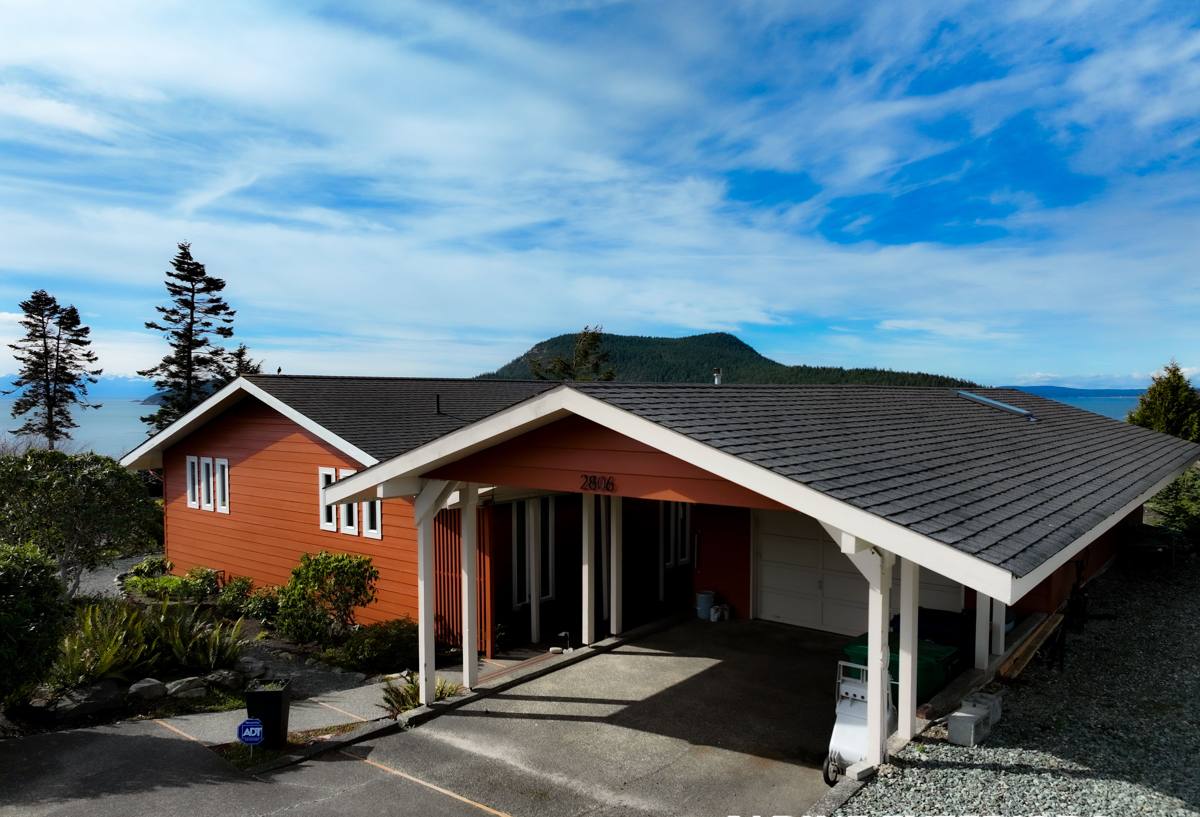
Salt Air and Siding: Why the Product Choice Matters More Here
Salt air is corrosive to metal fasteners and flashing, and it's hard on organic and composite materials that weren't engineered with coastal exposure in mind. It also tends to hold moisture against a wall longer than dry inland air does, which matters a lot when you're talking about siding that can swell, delaminate, or rot if water gets past the surface.
This is exactly why we install James Hardie fiber cement siding exclusively and don't offer vinyl, LP SmartSide, Cemplank, Allura, primed spruce, or cedar as alternatives. It's not that every one of those products is bad — some of them have real strengths in the right application. But we've made a professional call, based on what we see fail on homes in this climate, that fiber cement is the only siding category we're willing to stand behind here.
What Fiber Cement Does Differently
James Hardie siding is non-combustible and dimensionally stable, meaning it doesn't expand and contract the way wood and some engineered wood products do when they cycle between wet and dry. That matters in Edgemoor because tree-shaded siding rarely gets a chance to fully dry out between rain events during our wet season. Hardie's HZ5 product line is specifically engineered for climates with significant moisture exposure, and the ColorPlus factory-applied finish is baked on under controlled conditions rather than painted on-site, which gives it much more consistent, long-term resistance to fading and moisture-related failure than field-applied paint.
Why We Don't Install the Alternatives
- Vinyl siding can warp or distort in temperature swings and doesn't offer the same fire resistance or rigidity; seams and panels can also trap moisture behind them in a wet, shaded environment.
- LP SmartSide and similar engineered wood products use wood strand cores that are vulnerable at cut edges and fastener penetrations if the factory sealant isn't maintained perfectly — a real risk in a neighborhood where siding stays damp for days at a stretch.
- Cemplank and Allura are also fiber cement, and they're not bad products, but we've standardized on Hardie for its factory finish consistency, product engineering for our specific climate zone, and the strength of its transferable warranty.
- Primed spruce or raw cedar siding looks great initially but requires an ongoing paint and maintenance cycle to keep water out — a cycle that's much harder to stay ahead of under heavy tree cover and salt air than in a drier, more exposed location.
We'd rather install one product exceptionally well and be honest about why than offer a menu of options we don't fully trust in this environment.
Moss Season and Your Roof
If your home is under tree cover in Edgemoor, moss isn't a maybe — it's a when. Moss holds moisture against roofing material, works its way under shingle tabs and around flashing, and accelerates granule loss on asphalt shingles. Left unaddressed for a few seasons, that moisture retention can lead to soft decking, leaks at valleys and penetrations, and premature replacement.
Good roofing work in this neighborhood isn't just about the shingle brand — it's about the details that keep water and moss from getting a foothold in the first place:
- Proper underlayment and ice-and-water shield at eaves, valleys, and any low-slope transitions
- Flashing detail at chimneys, skylights, and wall intersections that accounts for wind-driven rain, not just straight-down rain
- Ventilation that lets the roof deck dry out between storms instead of staying saturated
- Gutter and downspout capacity sized for the volume of water coming off a steep, tree-shaded roof
Zinc or copper strips near the ridge can help slow moss regrowth on an existing roof, but they're a supplement to good maintenance, not a substitute for it. Homeowners in shaded parts of Edgemoor should expect to have moss physically removed and gutters cleared more often than a home out in the open — that's just the reality of the tree cover that makes the neighborhood what it is.
Windows: The Overlooked Weak Point
Old or poorly flashed windows are one of the most common sources of hidden water damage we find on Edgemoor homes, and it's rarely the glass that's the problem — it's the flashing and sealant around the frame. Driving rain off the bay finds any gap in the weather barrier and works its way in behind the trim, often for years before it shows up as a soft spot on an interior wall or a stain on a ceiling below.
When we replace windows, the flashing and integration with the surrounding wall assembly matters as much as the window unit itself. A high-quality window installed with a poor water management detail will still leak; a modest window installed correctly will outperform it. We pay particular attention to sill pan flashing, head flashing, and how the window ties into the siding's weather-resistive barrier, because that's where failures actually start.
Decks: Built for Standing Water and Shade
Decks in Edgemoor deal with two compounding problems: they're often shaded, so they dry slowly, and they're exposed to the same salt-tinged, moisture-heavy air as the rest of the house. Wood decking in constant shade is prone to mildew, slippery moss growth, and rot at fastener points and ledger boards if drainage isn't handled well.
Whether you're going with a composite decking product or maintaining a wood deck, the details that matter most in this environment are the ones you don't see once the project is done: proper ledger board flashing where the deck meets the house, gapping between boards for drainage and airflow, and joist protection that keeps water from sitting against structural framing. A deck that looks fine on day one can still be setting up for rot underneath if those details are skipped.
Comparing Siding Options for a Neighborhood Like Edgemoor
| Material | Moisture Behavior in Shade/Salt Air | Maintenance Cycle | Our Position |
|---|---|---|---|
| James Hardie fiber cement | Dimensionally stable, engineered HZ5 line for wet climates, factory-cured finish | Low; periodic cleaning and caulk checks | What we install exclusively |
| Vinyl | Can trap moisture behind panels; can warp with temperature swings | Low labor, but limited repair options if damaged | Not offered |
| LP SmartSide (engineered wood) | Vulnerable at cut edges and fasteners if sealant isn't maintained | Moderate; edge sealing and caulk maintenance matter | Not offered |
| Cedar / primed spruce | Natural material, absorbs and releases moisture readily | High; regular painting/staining required | Not offered |
| Cemplank / Allura fiber cement | Similar core material to Hardie | Low | Not our standardized product; we've chosen Hardie for finish and warranty consistency |
Signs Your Edgemoor Home's Exterior Needs Attention
- Visible moss or dark streaking on the roof, especially on north-facing or shaded slopes
- Soft or spongy siding, or paint that's bubbling and peeling in patches
- Gutters overflowing during moderate rain, not just heavy storms
- Window sills or interior trim that feel damp or show staining
- Deck boards that stay wet long after rain has stopped elsewhere in the yard
- Gaps or cracking caulk around window and door trim
Any one of these on its own isn't an emergency, but they're worth having looked at before the next wet season sets in, since problems that start small in a shaded, humid environment tend to progress faster than they would on a drier, sunnier lot.
Why a Local Crew Matters in a Neighborhood Like This
Edgemoor isn't a typical suburban tract with identical lots — it's a mix of mature trees, sloped sites, and homes of varying age and construction style, many with significant water and wind exposure off the bay. A crew that works across Bellingham and Whatcom County regularly sees how these conditions play out over years, not just on install day. That shows up in small decisions: how much roof ventilation a shaded home actually needs, where extra flashing is worth the cost, how deck framing should be protected given how slowly things dry in that setting.
It also means being reachable and accountable locally — not a crew that installed something once and moved on to the next region. Warranty support, follow-up questions, and honest assessments of what's actually needed (versus what's being upsold) matter more when you're dealing with a company that's still going to be in Bellingham next year and the year after.
What to Expect When You Reach Out
For most Edgemoor projects, the process starts with a walk-around assessment — looking at siding condition, roof age and moss load, window flashing, and deck structure, not just the areas the homeowner flagged. From there we'll give you a straightforward read on what's urgent, what can wait, and what your realistic options are, with cost factors like square footage, roof pitch and complexity, tree cover, and existing damage all playing into the estimate.
| Cost Factor | Why It Matters in Edgemoor |
|---|---|
| Tree cover / shade | Slower drying times increase moisture-related prep work and can affect material choice |
| Roof pitch and access | Steeper, taller rooflines common on view lots increase labor and safety staging |
| Existing moisture damage | Hidden rot behind siding or at window openings adds repair scope once uncovered |
| Proximity to water | Salt air exposure factors into fastener and flashing material choices |
| Home age | Older homes may have outdated flashing details that need updating during replacement |
Get an Honest Look at Your Exterior
If you're not sure whether your siding, roof, windows, or deck are keeping up with what Edgemoor's climate throws at them, we're happy to take a look and give you a straight answer — including telling you if something can wait. Reach out for a free, no-pressure estimate using the form below.