 Bellingham Exterior
 Sehome's Exteriors Face a Specific Kind of Wear
Sehome sits close enough to Bellingham Bay that homes here deal with a combination most inland neighborhoods don't: salt-tinged air moving in off the water, long stretches of driving rain pushed sideways by wind, and the deep shade from mature trees that keeps north- and west-facing walls damp for days after a storm passes. None of these things ruins a house on its own. Together, over years, they wear down whatever is on the outside of it faster than most homeowners expect.
We've worked on enough homes in this part of Whatcom County to know the pattern. It's rarely one dramatic failure — a roof leak, a rotted board, a window that suddenly won't seal. It's usually a slow accumulation: caulk that gave up two winters ago, paint that's been trapping moisture instead of shedding it, moss that's been working its way under shingles since a wet fall nobody got around to addressing. By the time it's visible, the underlying material has often already taken damage.
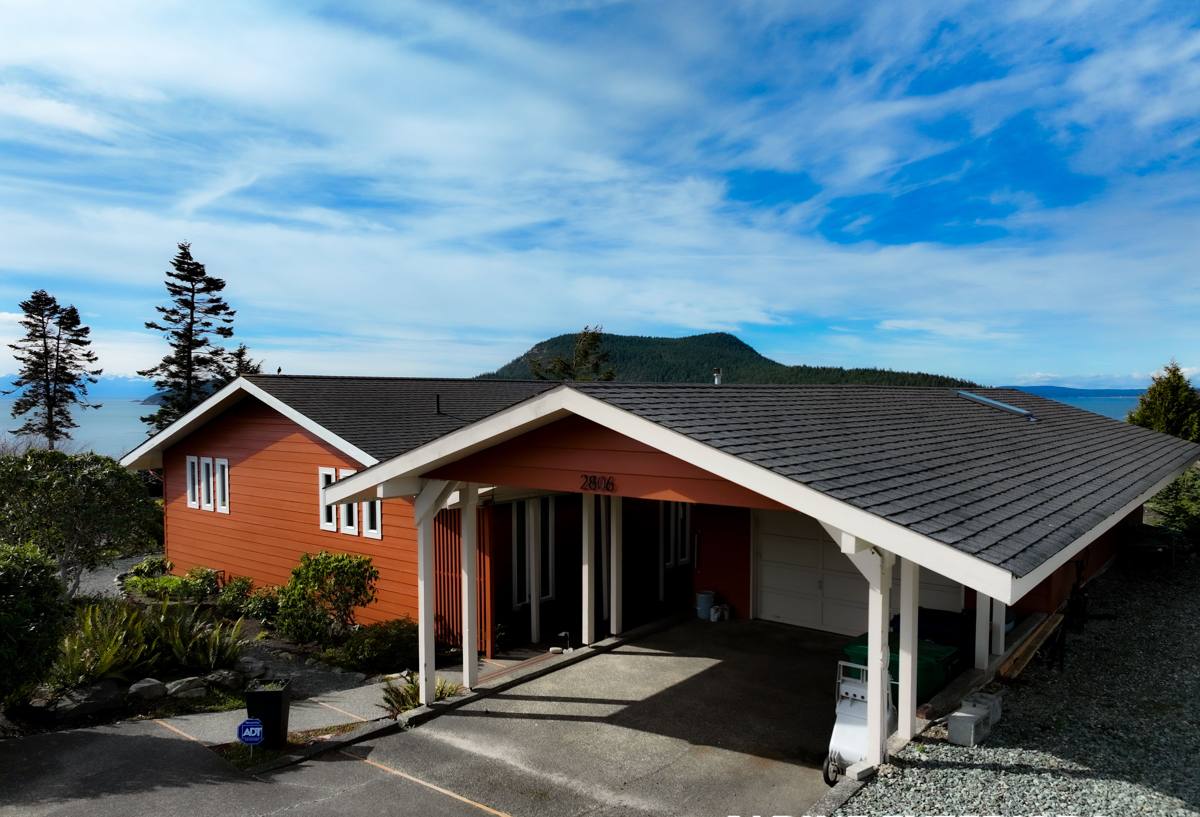
Salt Air, Driving Rain, and Moss: What Each One Actually Does
Salt Air
Even a few miles from saltwater, airborne salt accelerates corrosion on fasteners, flashing, and any exposed metal trim. It also draws moisture — salt is hygroscopic, meaning it pulls humidity out of the air and holds it against whatever surface it's settled on. For siding and roofing, that translates to more time spent damp, which matters more than most people realize, because sustained moisture contact is what breaks down wood fiber, rusts fasteners from the inside out, and lets mold and mildew get a foothold.
Driving Rain
Bellingham doesn't just get rain — it gets rain pushed horizontally by wind off the Sound often enough that vertical surfaces take a real beating. Driving rain finds every gap in caulking, every under-lapped seam, every spot where flashing was cut short. A roof and wall system can be watertight against straight-down rain and still leak under wind-driven rain if the details weren't built for it.
Moss Season
The wet, mild stretch from fall through spring is moss season, and it's long here. Moss holds moisture against roofing and siding for extended periods, works into seams and under shingle edges, and — left alone — can lift roofing material and hold standing dampness against wood trim and fascia. It's more of a slow, structural issue than a cosmetic one.
Why We Only Install James Hardie Siding
We made a decision a while back to install one siding system: James Hardie fiber cement, in its climate-engineered HZ product lines. It's not the only siding on the market, and it's not always the cheapest option a homeowner will be quoted. But for a neighborhood dealing with salt air, driving rain, and a long moss season, it's the one we're willing to stand behind.
Fiber cement is non-combustible, doesn't rot the way wood-based products can, and holds its factory-applied ColorPlus finish far longer than field-applied paint holds up on wood or composite siding. It's also dimensionally stable — it doesn't swell and contract with moisture the way wood-based products do, which matters a lot in a climate that cycles between soaked and dry constantly. That stability is what keeps caulk joints and seams intact longer, which in turn is what keeps water out.
What We Don't Install, and Why
We don't install LP SmartSide, vinyl siding, Cemplank, Allura, or primed spruce or cedar siding. Each of these products has legitimate uses and each has genuine strengths — this isn't a claim that they're defective. But in our experience, they carry real trade-offs in exactly the conditions Sehome sees:
- LP SmartSide is engineered wood — strand-based, with a resin binder. It performs well when installation and maintenance are followed to the letter, but any wood-based product is more sensitive to sustained moisture exposure than fiber cement, and that sensitivity shows up faster in a wet, salt-air climate.
- Vinyl siding is affordable and low-maintenance in mild conditions, but it can warp or become brittle with UV and temperature swings, and its seams and J-channels give wind-driven rain more opportunities to get behind the cladding.
- Cemplank and Allura are also fiber cement, and reasonable products in their own right — but we've standardized on one manufacturer's system, warranty structure, and factory finish rather than mixing suppliers, and Hardie's HZ5 line is specifically engineered for climates like ours.
- Primed spruce or cedar looks great fresh, but it's wood — it needs ongoing repainting and caulking to keep moisture out, and in a neighborhood with this much sustained dampness, that maintenance window closes faster than most homeowners plan for.
Hardie's ColorPlus finish also carries a stronger, transferable warranty than field-painted alternatives, and correctly installed HZ5 siding is built around exactly the moisture-management details — rainscreen gaps, proper flashing, sealed joints — that matter most where wind-driven rain is routine.
Roofing: Where Moss and Rain Meet
Roofing and siding aren't separate problems on a house like this — they meet at the same flashing details, the same fascia and trim, the same drainage paths. A roof that's shedding water properly but dumping it against poorly flashed siding just moves the problem down the wall. We look at the whole exterior system together, not the roof and the siding as two unrelated jobs.
For roofing specifically in Sehome's conditions, the things that matter most are moss resistance and management, properly lapped and sealed flashing at every penetration and wall intersection, and ventilation that keeps the roof deck dry from underneath, not just the surface dry from above. A roof that looks fine from the street can still be holding moisture in the deck if ventilation was shorted during a prior installation.
Windows: Sealing Out Wind-Driven Rain
Old or poorly installed windows are one of the most common places we find water intrusion on homes in this area — not because the glass fails, but because the flashing and sealant around the frame weren't detailed for wind-driven rain. A window can be a good product and still leak if it wasn't installed with the right flashing sequence underneath the siding.
| Factor | What It Affects | Why It Matters in Sehome |
|---|---|---|
| Frame material | Longevity, thermal performance | Sustained damp conditions favor materials resistant to swelling and corrosion |
| Flashing detail | Water intrusion at the frame | Wind-driven rain exploits any gap in the flashing sequence |
| Glazing/seal quality | Energy efficiency, condensation | Consistent humidity makes seal failure show up faster as fogging or drafts |
| Installation sequencing with siding | Overall wall drainage plane | Windows and siding need to be integrated as one water-managed system |
When we replace windows alongside siding, we treat the flashing and the drainage plane as one continuous system rather than two separate trades working past each other — that's often where leaks that have been blamed on "bad windows" actually originate.
Decks: Salt Air and Standing Moisture
Decks take a different kind of abuse in this climate. Fasteners and hardware are exposed to salt air year-round, and horizontal or near-horizontal surfaces hold rain and moss longer than vertical siding does. Ledger board connections, joist hangers, and any wood-to-wood contact points are where we look first, because that's where trapped moisture does the most damage before it's visible from the surface.
Why a Local Crew Matters Here
A crew that mostly works drier inland climates tends to under-detail flashing and rainscreen gaps, because they haven't had to chase the callbacks that show up two winters later in a place like Whatcom County. Working in and around Bellingham day in and day out means we're building for the wind-driven rain and moss season we actually see here, not for a generic installation spec. It also means we're not far away if a question comes up after the job is done.
What to Expect From Us
Whether the job is a full siding replacement, a re-roof, new windows, or a deck rebuild, our approach on a Sehome home generally includes:
- An on-site assessment that looks at the whole exterior system — siding, roofline, flashing, and drainage together, not one component in isolation
- An honest read on what's actually failing versus what's just cosmetic wear
- A written scope that specifies materials, flashing details, and ventilation — not just a square-footage price
- James Hardie fiber cement for any siding work, installed to manufacturer spec with proper rainscreen and flashing detail
- Cleanup and a final walkthrough before we consider the job done
Getting Started
If you're noticing moss buildup, a draft around a window, siding that's holding paint poorly, or you just want an honest read on how your home's exterior is holding up against Bellingham's weather, we're glad to take a look. We offer free, no-pressure estimates for homeowners in Sehome and the surrounding Bellingham area — use the form below to get started.