 Bellingham Exterior
 Siding Repair in Sehome: What This Neighborhood's Homes Are Up Against
Sehome sits close enough to Bellingham Bay to catch the salt air rolling in off the water, and close enough to the hill and its tree cover to stay shaded and damp longer than more open parts of the city. That combination is hard on siding. Salt-laden moisture accelerates corrosion on fasteners and trim, shade slows down drying time after every storm, and Whatcom County's long, low-intensity rain season means siding here rarely gets a real chance to dry out between wet spells. Add in the moss and algae bloom that shows up every fall and hangs around into spring, and you've got a set of conditions that will find every weak point in a siding system faster than they would in a drier climate.
We repair siding across Bellingham, but Sehome's mix of older homes near the hill and newer infill construction means we see a wider range of siding problems here than in some of the more uniform neighborhoods — old cedar and hardboard next to newer fiber cement and vinyl, all dealing with the same wet, shaded conditions in different ways.
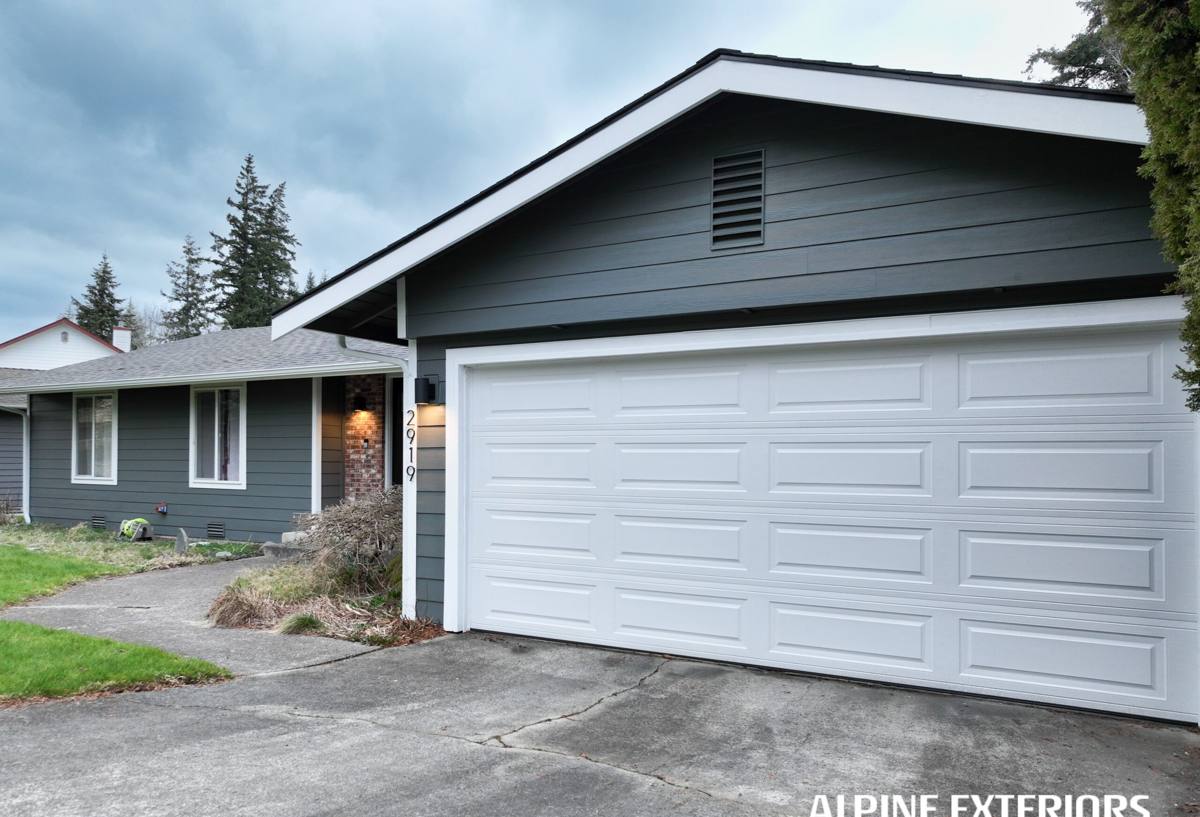
What Actually Causes Siding Damage in a Climate Like This
Moisture That Doesn't Get a Chance to Leave
Siding is designed to shed water, not sit wet indefinitely. In a yard with heavy tree cover or a north-facing wall that rarely sees direct sun, boards and panels can stay damp for days after a rain event. Over time that constant moisture works its way into seams, nail holes, and any spot where caulk or paint has failed, and it starts to break down whatever is underneath — sheathing, house wrap, and the siding material itself.
Moss, Algae, and Organic Growth
Moss doesn't just sit on the surface. Once it establishes itself in a seam or at a butt joint, it holds moisture directly against the siding and, on wood-based products, against exposed edges that were never meant to stay wet. Algae staining is mostly cosmetic, but it's usually a sign that a section of wall doesn't dry out well — which means it's also a candidate for the moisture problems above.
Salt Air and Fastener Corrosion
Homes closer to the water deal with an added factor: airborne salt that accelerates corrosion on nails, screws, and metal trim. Once fasteners start to rust, they lose holding power and can streak the siding around them. This shows up as small rust spots working their way out of nail heads, usually years before the siding panel itself is actually failing.
Age and Original Material
A lot of what we repair in Sehome isn't failing because of one dramatic event — it's failing because it's reaching the end of what its original material could reasonably be expected to handle in this climate. Older wood siding, hardboard products, and some early fiber cement installs weren't always installed or finished to hold up to decades of Pacific Northwest moisture cycling.
Signs You Need Siding Repair (Not Just Paint)
- Soft or spongy spots when you press on a board or panel, especially near the bottom of walls or below windows
- Visible cracking, splitting, or buckling in individual boards or panels
- Paint that's peeling or bubbling in a localized area rather than across the whole wall
- Dark staining, streaking, or a musty smell near an exterior wall on the interior side
- Gaps opening up at seams, corners, or where siding meets trim, windows, or doors
- Persistent moss or algae growth that keeps coming back in the same spots after cleaning
- Nail heads popping out, streaking with rust, or siding that feels loose when you push on it
- Warping or wave patterns in a wall that used to look flat
Any one of these on its own might be minor. Several showing up in the same area, or the same problem recurring after a previous patch, usually means there's a moisture source that hasn't actually been addressed yet.
What a Correct Siding Repair Actually Involves
A lot of siding "repair" in this region is really just replacing the visible damaged piece and moving on. That approach can work for isolated, one-off damage — a cracked panel from a fallen branch, for instance — but it's the wrong approach when the damage is a symptom of an ongoing moisture or ventilation problem. A repair that doesn't find and correct the underlying cause just buys you a few more years before the same spot fails again.
Here's what we actually check before we call anything a complete repair:
| Step | What We're Checking |
|---|---|
| Surface diagnosis | Extent of visible damage — cracking, staining, soft spots, growth patterns |
| Moisture source | Whether water is getting in from a failed seam, bad flashing, missing caulk, or a gutter/roof issue above the siding |
| Underlying sheathing | Whether the wall sheathing or house wrap behind the damaged siding has also been compromised |
| Fastener condition | Whether nails or screws in the surrounding area are corroded and need replacing, not just the ones in the damaged section |
| Material match | Whether a patch can reasonably match existing siding, or whether the section needs a broader replacement to look right and perform right |
| Trim and flashing | Condition of window, door, and corner trim around the repair area, since these are common failure points |
Skipping the moisture-source check is the single most common shortcut in siding repair, and it's the reason so many homeowners end up paying for the same repair twice.
Repair or Replace: How We Make That Call
Not every damaged section needs a full re-side, and we're not going to tell you it does. But there's a point where patch repairs stop making financial sense and a broader replacement becomes the better investment. Some of what factors into that decision:
| Repair usually makes sense when... | Replacement usually makes sense when... |
|---|---|
| Damage is isolated to one or two sections | Damage is showing up in multiple, unrelated areas of the house |
| The rest of the siding is structurally sound | Underlying sheathing shows signs of rot or moisture damage in several spots |
| The siding material is still within its useful life | The original material is old, discontinued, or was never well-suited to this climate |
| A patch can realistically match the existing look | Color and texture matching would be obvious and unattractive |
| The cause of damage was a one-time event | The cause is an ongoing condition (shade, drainage, moisture) affecting the whole wall |
Why We Repair With James Hardie Fiber Cement
When a repair calls for new material — whether that's a handful of replacement boards or a full section — we use James Hardie fiber cement, and we don't install anything else. This isn't a marketing preference; it's a standard we hold because of what we see when we're out repairing siding in a climate like this one.
Fiber cement doesn't absorb moisture the way wood-based and hardboard products can, which matters enormously in a neighborhood dealing with shade, salt air, and a long wet season. It's non-combustible, holds its factory-applied ColorPlus finish far longer than field-painted materials, and Hardie's HZ5 product line is engineered specifically for climates with sustained moisture exposure — which describes Whatcom County for a good chunk of the year. When we replace a damaged section with Hardie, we're not just patching today's problem; we're removing that section as a future callback.
We won't install LP SmartSide, vinyl, Cemplank, Allura, or unfinished cedar or spruce as repair material, even as a quick fix. Mixing in a lesser product to save a step on a repair just relocates the next failure a few years down the road, and we'd rather tell you that up front than let you find out later.
Our Repair Process
- On-site inspection. We look at the damaged area and the surrounding wall, not just the spot you called about, since siding problems in this climate rarely stay isolated.
- Moisture and cause assessment. We identify whether the damage is from a one-time event or an ongoing source — bad flashing, a gutter issue, shade and drainage, or aging material.
- Honest scope recommendation. We tell you plainly whether this is a repair, a partial replacement, or something bigger, and why.
- Material and color matching. For repairs, we work to match existing siding as closely as possible; where an exact match isn't realistic, we'll say so before starting.
- Correct installation. Proper flashing, fastening, and sealing at every seam and penetration — the details that determine whether a repair lasts five years or twenty.
- Final walkthrough. We show you what was done and why, so you understand the condition of your siding going forward.
What to Ask Before Hiring Anyone for Siding Repair in Sehome
- Will you check for the underlying cause of the damage, or just replace what's visibly broken?
- What siding material will you use for the repair, and why?
- Are you licensed and insured to do exterior work in Washington?
- Will the repaired section be flashed and sealed to current best practice, not just nailed back into place?
- Do you have experience with this specific neighborhood's conditions — shade, moisture, older housing stock?
- Will you give me a written scope before starting, including what happens if you find additional damage once the siding is opened up?
Why Local Experience in Sehome Actually Matters
Siding repair looks straightforward from the outside, but the right fix depends heavily on knowing how a specific neighborhood's conditions behave over time. A crew that regularly works in and around Sehome has already seen how shade patterns, tree cover, and proximity to the bay play out on real houses here — which walls tend to hold moisture longest, which older materials are common in the area and how they fail, and what a "typical" repair actually needs to include to hold up through another wet Whatcom County winter. That local pattern recognition is the difference between a repair that solves the problem and one that just delays it.
If you're seeing damage, staining, or recurring moss on your siding, we're happy to come take a look and give you a straight answer about what it actually needs. Reach out for a free, no-pressure estimate — we'll walk the exterior with you, explain what we find, and lay out your options before any work begins.