 Bellingham Exterior
 Why South Hill Decks Wear Out Faster Than People Expect
South Hill sits up above downtown Bellingham with some of the best exposure in the city — which is exactly why decks up here take a beating. Elevation means more open exposure to wind-driven rain off Bellingham Bay, and that salt-tinged air works into fasteners, hardware, and end grain in ways a homeowner rarely sees until a board finally gives way underfoot. Add Whatcom County's long, damp stretch from fall through spring, and you've got months at a time where a deck simply doesn't get a chance to fully dry out between rain events.
That combination — salt air, driving rain, and a moss season that can run half the year on shaded or north-facing decks — is harder on wood and hardware than most manufacturers' care instructions assume. A deck built to a generic national spec often shows problems here five to ten years earlier than it would in a drier inland climate. That's not a knock on any particular product; it's just the reality of building on a hill above tidewater in the Pacific Northwest.
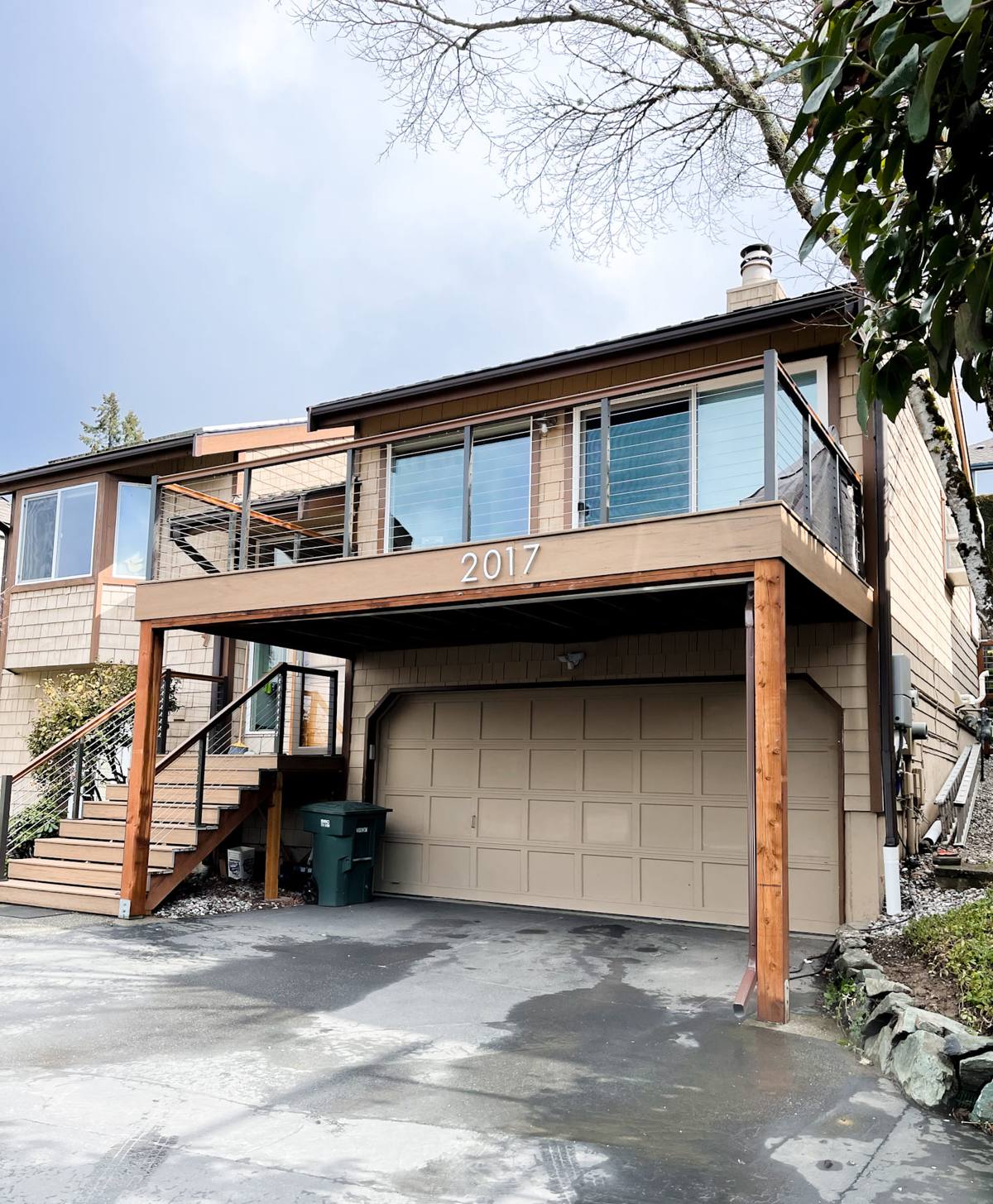
Signs Your Deck Needs Replacing, Not Patching
A lot of South Hill homeowners call us after a few years of small repairs — a board here, a railing tightened there — and want to know if it's finally time for a full replacement instead of another patch. These are the signs that tell us "replace" rather than "repair":
- Soft, spongy, or bouncy spots in the decking, especially near the house or in shaded corners where moss holds moisture
- Rust streaking below fastener heads or joist hangers — a sign the hardware itself is breaking down, not just staining the wood
- Visible gap or dark staining where the deck ledger board meets the house siding (a common water-entry point)
- Wobble or give in the railing posts when you lean on them
- Persistent moss or algae film that returns within weeks of cleaning, even after pressure washing
- Boards that have cupped, crowned, or split along their length rather than just at the ends
- A deck older than 15–20 years that has never had the substructure (joists, beams, footings) inspected
Any one of these can sometimes be handled with a repair. Two or three together, especially involving the ledger board or framing, usually mean the structure has been compromised long enough that a rebuild is the honest recommendation.
What a Correct Deck Replacement Actually Involves
A deck replacement done right is a structural project, not a cosmetic one. The visible decking boards are the last thing installed, not the first thing considered. Here's what we treat as non-negotiable on every tear-off and rebuild:
Ledger Board and Flashing
The ledger — the board that attaches the deck to the house — is the single most common failure point on decks in this climate. It has to be properly flashed so water sheds away from the house framing rather than tracking behind the siding and rotting the rim joist. We inspect this connection on every job, because a beautiful new deck built on a rotten ledger is a problem waiting to reappear.
Framing and Footings
Joist spacing, beam sizing, and footing depth all need to match current code for the actual load the deck will carry — not just match what was there before. Older South Hill decks were sometimes built to whatever spec was standard decades ago, which may not hold up to today's snow load and guardrail requirements.
Fasteners and Hardware
Given the salt air exposure this side of the bay, we use corrosion-resistant fasteners and connectors rated for exterior and coastal-adjacent use, not the cheapest galvanized option. This is one of the areas where cutting corners doesn't show up for a few years — and then shows up all at once.
Drainage and Airflow
Decks that sit low, or that have any enclosed skirting underneath, need real airflow and drainage planning so moisture doesn't sit trapped against the framing. This is also where moss gets its foothold — anywhere air and sun can't reach, moss and algae will.
Choosing the Right Decking Material for This Microclimate
There's no single "best" decking material for every home — the right choice depends on how much shade the deck gets, how much maintenance you want to do, and your budget. Here's how the common options actually perform under South Hill's rain-and-moss conditions:
| Material | Moss/Algae Resistance | Maintenance | Notes for This Climate |
|---|---|---|---|
| Pressure-treated wood | Low — needs regular cleaning and sealing | Annual cleaning, periodic re-sealing | Lowest upfront cost; most sensitive to moss if shaded or under trees |
| Cedar | Moderate — natural oils help, but fade and weather | Regular sealing to maintain color and resistance | Popular for looks; needs upkeep to keep its natural resistance working |
| Capped composite | High — sealed cap resists moisture absorption | Occasional washing, no sealing/staining | Best fit for shaded, north-facing, or heavily rain-exposed decks |
| PVC decking | High — fully synthetic, minimal water absorption | Low; occasional washing | Strong option near salt air; higher upfront cost |
For decks that sit under tree cover or on the shadier north and east-facing sides of a South Hill lot, we usually steer homeowners toward capped composite or PVC — the maintenance savings over a wet, mossy decade often outweigh the higher material cost. For sunnier, more exposed decks, a well-sealed wood deck can still make sense, especially if you're comfortable with annual upkeep.
Permits, Code, and South Hill's Terrain
Most deck replacements in Bellingham require a permit, especially when framing, footings, or guardrails are being rebuilt rather than just the surface boards. We handle the permit application and inspections as part of the job so you're not the one tracking down the city — a rebuilt deck that skips permitting can complicate a future home sale or insurance claim.
South Hill's terrain adds a few practical wrinkles that flatter neighborhoods don't have to think about:
- Sloped and terraced lots often mean taller footings or additional support posts to reach stable ground
- Guardrail height and stair rise/run requirements get scrutinized more closely on elevated decks with a drop-off below
- Material and debris staging has to account for narrower driveways or steeper access common on hillside streets
- View decks — a big draw on South Hill — often need railing designs that meet code without blocking the view they were built for
None of this is a reason to avoid a deck replacement on a hillside lot. It just means the crew doing the work needs to plan for it up front instead of discovering it mid-project.
Our Deck Replacement Process
- On-site assessment: We inspect the ledger, framing, footings, and drainage — not just the surface boards — before quoting anything.
- Honest scope and estimate: You get a clear breakdown of what's failing, what's salvageable, and what the replacement will involve.
- Permit and code review: We pull the necessary permit and confirm the design meets current guardrail, stair, and structural requirements.
- Tear-off and disposal: Old decking, railing, and any compromised framing are removed and hauled away.
- Structural rebuild: Ledger flashing, framing, footings, and hardware are addressed to current code before a single new board goes down.
- Decking, railing, and finish: Your chosen material is installed, along with railings, stairs, and any trim details.
- Final inspection and walkthrough: We confirm everything passes inspection and walk the finished deck with you before calling the job done.
What Drives the Cost of a Deck Replacement
Every deck is different, so we won't quote a number without seeing the site — but these are the factors that move the price up or down the most:
| Factor | Impact on Cost |
|---|---|
| Deck size and number of levels | High — larger and multi-level decks require more material and labor |
| Framing and ledger condition | High — hidden rot found during tear-off can add structural repair work |
| Decking material choice | Medium to high — composite and PVC cost more upfront than wood |
| Railing style and code requirements | Medium — custom or view-preserving railing designs add cost |
| Site access and slope | Medium — steep or narrow-access lots increase labor time |
| Permit and inspection requirements | Low to medium — larger structural changes trigger more inspection steps |
Why a Crew That Already Works South Hill Makes a Difference
Every deck replacement contractor will tell you they do good work. What actually matters on South Hill is whether the crew standing in front of you understands this specific setting: hillside footing depth, how the City of Bellingham's permitting process handles elevated and view decks, which decking products actually hold up against bay-adjacent salt air instead of just performing well in a catalog photo, and how to stage a tear-off on a sloped lot without turning your yard into a mess for weeks.
We're a Bellingham-based crew, and South Hill is part of our regular service area — not a neighborhood we occasionally drive up to. That familiarity means fewer surprises during the estimate, a design that accounts for your lot's slope and exposure from the start, and a finished deck built for Whatcom County's actual weather rather than a generic national spec.
Get a Free, No-Pressure Estimate
If your South Hill deck is showing soft spots, rust stains, stubborn moss, or just years of wear, we're happy to take a look and give you an honest read on repair versus replacement — no pressure either way. Use the form below to request a free estimate and we'll get back to you to schedule a time to come out.