 Bellingham Exterior
 Ferndale's Climate Puts Real Stress on Siding
Ferndale sits close enough to Bellingham Bay and the Strait of Georgia that salt-laden air is a fact of life here, not an occasional nuisance. Combine that with Whatcom County's long wet season, driving rain that comes in sideways off the water, and months of shade and dampness that let moss and algae take hold on north- and west-facing walls, and you've got one of the more demanding siding environments in Western Washington. Siding on a Ferndale home isn't just decorative — it's the first line of defense against moisture intrusion, wood rot, and the slow surface breakdown that salt air causes on lesser materials.
We install siding across Whatcom County, and Ferndale homes consistently show a specific pattern of wear: caulk failure at trim joints, moss buildup at ground-level courses and under eaves, and paint that chalks and fades faster on the coastal-facing sides of the house. None of that is a flaw in the homeowner's maintenance — it's what happens when a marine climate meets a siding product that wasn't built to handle it.
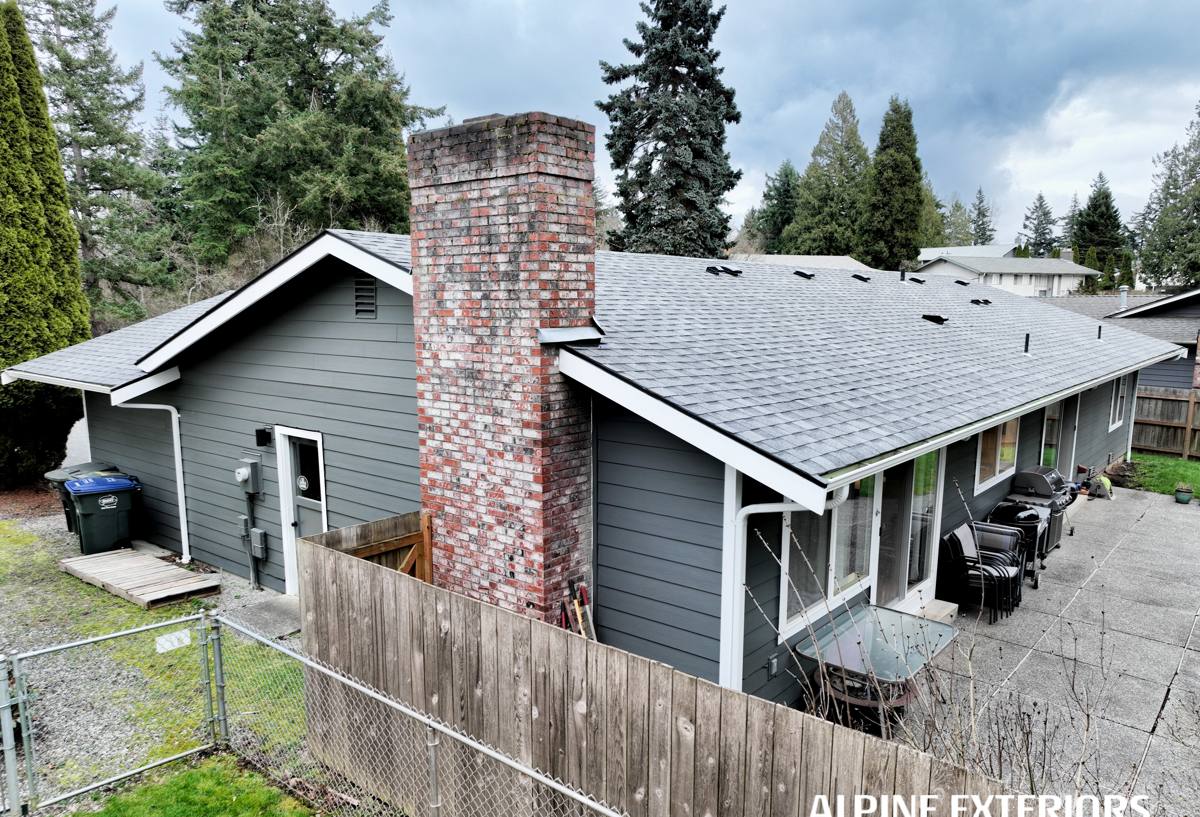
Signs Ferndale Homeowners Should Watch For
Most siding failures don't show up as a dramatic problem — they show up as small signs that get worse over a wet season or two. In our experience working on homes throughout the Ferndale area, the most common early warnings are:
- Soft or spongy spots when you press on siding near the bottom of the wall or under windows
- Persistent green or black staining that returns within weeks of cleaning, especially on shaded walls
- Paint that's peeling, bubbling, or chalking well before it should
- Visible gaps or separation at seams, corners, and trim joints
- Warping, cupping, or bowing boards, particularly on the sides of the house that face prevailing wind and rain
- A musty smell in an interior room that shares a wall with a suspect section of siding
Any one of these on its own might just mean a maintenance visit. Several at once, or moisture damage that's made it to the sheathing, usually means it's time to talk about full replacement rather than another round of patching.
Why We Only Install James Hardie Fiber Cement
We made a decision a long time ago to install one siding system, not a menu of options: James Hardie fiber cement. That's not a marketing gimmick — it's a standard we hold to because we've seen what happens to other products in exactly this climate. We don't install vinyl, LP SmartSide, primed wood, or cedar, and we're upfront with Ferndale homeowners about why.
Vinyl siding can crack in cold snaps and warp under prolonged sun and heat cycling, and its seams and J-channels give moisture more opportunities to work behind the panel over time — not ideal in a climate where wind-driven rain is routine. Engineered wood products like LP SmartSide perform well in many climates, but they rely on an intact factory coating and careful field sealing of every cut edge; any breach in that coating in a wet, salt-exposed environment shortens their working life. Primed wood and cedar are honest, traditional materials, but they demand a maintenance schedule — repainting, caulking, moisture checks — that most homeowners underestimate, and that gets harder to keep up with in a climate this consistently wet.
James Hardie fiber cement is cement, sand, and cellulose fiber. It doesn't rot, it isn't a food source for moss and mildew the way wood is, it holds paint dramatically longer than wood siding, and Hardie's ColorPlus factory finish is baked on and warrantied against fading and chipping — which matters on a coastal property where UV and salt both work against a painted surface. It's also non-combustible, which is a real consideration as wildfire smoke seasons have become a normal part of Pacific Northwest summers.
Built for This Climate Specifically
Hardie engineers its siding in climate-specific formulations — HZ5 for the colder, wetter regions that includes Western Washington. That's not a marketing label; it's a different manufacturing formulation designed around freeze-thaw cycling and sustained moisture exposure, which is exactly the stress profile a Ferndale home deals with for a good chunk of the year.
How Our Installation Process Works
A siding job is only as good as the water management system underneath it — the siding itself is the visible layer, but the flashing, house wrap, and gaps are what actually keep a home dry. Here's how we approach every Ferndale installation:
- On-site assessment. We inspect the existing siding, sheathing, and trim to identify hidden moisture damage before we ever quote the job — this matters more in a wet climate where damage can hide behind sound-looking siding.
- Tear-off and sheathing check. Once old siding is removed, we inspect the sheathing underneath. Any soft, rotted, or damaged sheathing gets replaced before anything new goes up — covering damaged sheathing with new siding just hides a problem.
- Weather-resistive barrier installation. A correctly lapped and sealed house wrap goes on next, giving the wall a secondary drainage plane behind the siding.
- Flashing at every penetration. Windows, doors, vents, and roof-to-wall intersections all get properly integrated flashing — this is where most siding failures actually originate, not in the field of the siding itself.
- James Hardie installation to manufacturer spec. Correct fastener type and placement, proper board gaps, and manufacturer-specified clearances from grade, roofing, and decks.
- Caulking and touch-up. Factory-finished ColorPlus boards need minimal field painting, but cut edges and joints get properly sealed with compatible caulk.
- Final walkthrough. We go over the finished job with the homeowner before calling it complete.
What "Correct Installation" Actually Means
Hardie siding's long track record depends heavily on correct installation — it's one of the more installation-sensitive products on the market, and a rushed or careless crew can undercut a good product's performance. The details that matter most in a climate like Ferndale's:
- Clearance from grade and hard surfaces: Hardie specifies minimum clearances from soil, decking, and roofing to keep the bottom edge of the siding from sitting in standing water or splashback.
- Proper board gaps: Fiber cement needs small gaps at butt joints and trim to allow for expansion — tight-fit joints trap moisture and can cause cracking.
- Fastener placement: Nails or screws driven at the wrong height or spacing can void the warranty and lead to boards working loose in high wind.
- Flashing integration, not just caulk: Caulk is a backup, not a substitute for flashing that physically directs water away from the wall assembly.
- Cut-edge sealing: Any field-cut edge needs to be sealed per manufacturer instructions to preserve the product's moisture resistance.
These aren't optional refinements — they're the difference between siding that performs for decades and siding that develops problems in five to seven years despite looking fine from the curb.
Choosing Colors and Style for a Ferndale Home
James Hardie's ColorPlus line includes a range of factory-baked finishes, along with lap siding, board-and-batten, and shingle-style panels that suit everything from a traditional farmhouse look to a more modern coastal exterior. Because the color coat is applied and cured at the factory under controlled conditions, it resists fading and chipping far better than a field-applied paint job — which matters on homes facing sustained sun exposure or salt-laden wind off the water. We'll walk through the current color and style options with you and talk through what tends to hold up best given your home's sun exposure and orientation.
What Drives the Cost of a Siding Project
| Factor | Why It Matters |
|---|---|
| Home size and wall complexity | More square footage and more corners, dormers, and trim details increase material and labor time |
| Existing sheathing condition | Rotted sheathing found during tear-off adds repair work before new siding can go up |
| Siding profile chosen | Lap, board-and-batten, and shingle-style panels differ in material and installation labor |
| Trim and accent work | Window and door trim, fascia, and accent bands add both material and precision labor |
| Removal and disposal | Tear-off and hauling of old siding is part of nearly every replacement project |
| Access and site conditions | Multi-story sections, tight lot lines, or landscaping can affect scaffolding and staging needs |
We give every Ferndale homeowner a detailed, written estimate after an in-person assessment — we don't quote sight unseen, because the condition of the sheathing underneath the old siding is often the biggest variable in the final cost.
What to Look For When Hiring a Siding Contractor
Ferndale homeowners have plenty of contractor options, and it's worth being deliberate about who you hire for a job this consequential to your home's long-term protection. A few things worth checking before you sign anything:
- Proper Washington contractor licensing and current liability insurance
- A written estimate that spells out materials, scope, and timeline — not a verbal ballpark
- Manufacturer training or certification specific to the siding product being installed
- A clear plan for sheathing and moisture inspection, not just siding replacement
- References or a portfolio of completed local work you can actually see
- A warranty that covers both material and workmanship, explained in plain terms
Why Local Experience in Ferndale Matters
A crew that's worked homes throughout Ferndale and greater Whatcom County already understands how this specific stretch of coastline behaves — which wall orientations take the worst of the wind-driven rain, how aggressively moss establishes itself in the shaded, damp corners typical of this area, and where salt exposure tends to concentrate on a home. That local pattern recognition shows up in the details: where we pay extra attention to flashing, which clearances we won't compromise on, and how we talk homeowners through color and profile choices that hold up here specifically, not just in a generic Pacific Northwest sense. It's the difference between a crew that installs siding and a crew that installs siding that's built for this particular climate.
If your Ferndale home's siding is showing wear, or you're planning ahead for a replacement, we're happy to take a look and walk you through what we're seeing. Reach out for a free, no-pressure estimate using the form below.