 Bellingham Exterior
 Why Birch Bay Asks More of Your Windows
Birch Bay sits right on the water, and that changes what "good windows" means. A few miles inland in Bellingham, a window mainly has to deal with rain and cold. Out on the bay, you add salt-laden air off the Strait of Georgia, near-constant wind, and long stretches of driving rain that hits window walls at an angle instead of falling straight down. Add Whatcom County's mild, damp winters and you get a moss and mildew season that runs longer than most homeowners expect — moss doesn't just grow on roofs, it colonizes window sills, cladding, and any spot where moisture sits instead of shedding.
None of that is a reason to panic about your windows. It's a reason to be specific about what you install and how it's installed. A window that's rated well on paper can still underperform on this coastline if the flashing details, the frame material, or the hardware weren't chosen with salt exposure in mind.
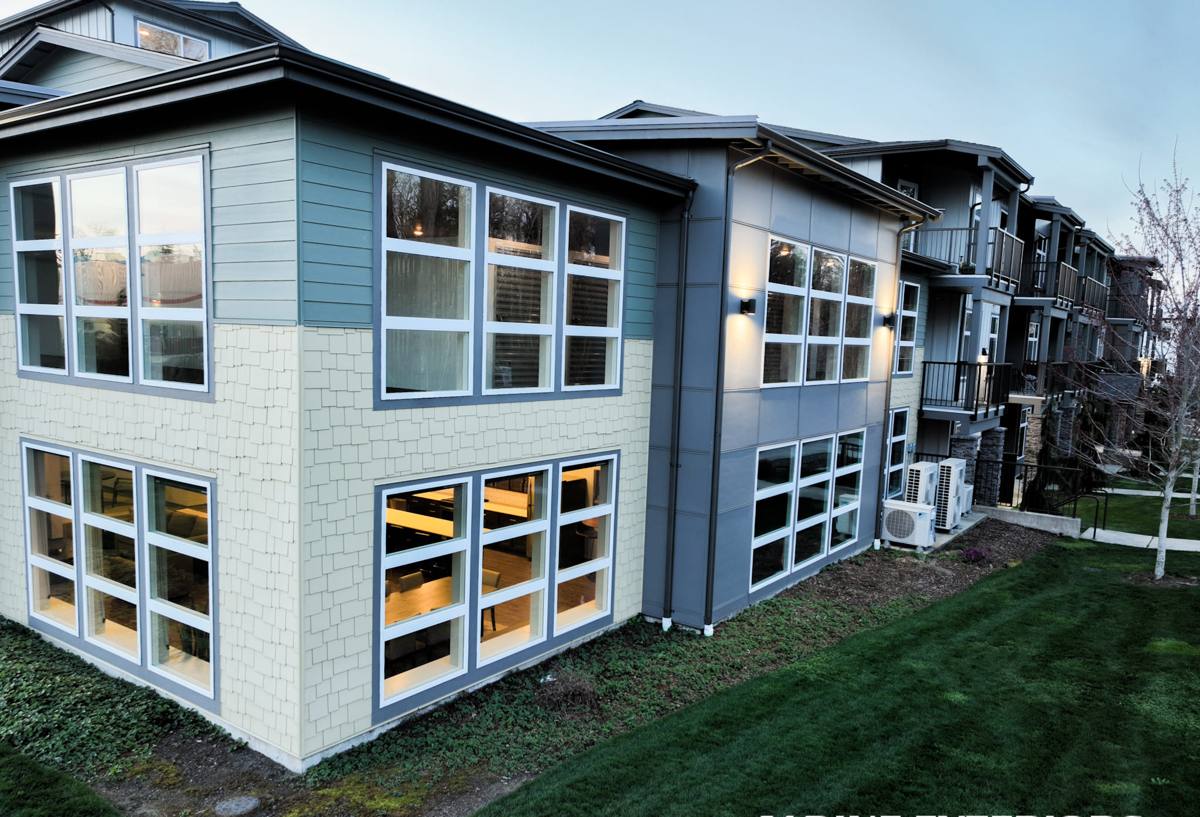
What "Energy-Efficient" Actually Means Here
The phrase gets used loosely. On a real project it comes down to three numbers and one installation practice, all of which matter more on an exposed coastal lot than they would elsewhere.
U-Factor
This measures how much heat escapes through the window — lower is better. In our climate, with heating season running most of the year, U-factor is usually the number that affects your utility bill the most. For Birch Bay homes we generally recommend staying at or below what Northwest ENERGY STAR guidelines call for; the marine layer keeps things cool and damp enough that a poorly insulated window is a year-round draft, not just a winter one.
Solar Heat Gain Coefficient (SHGC)
This measures how much solar heat passes through the glass. Bellingham's overcast, low-sun climate means we're rarely fighting overheating the way homes further south or east are. We don't push homeowners toward aggressively low-SHGC glass here just because a spec sheet says lower is "better" — on this coast it can mean giving up free winter warmth you'd actually want.
Air Infiltration
This is the one that gets overlooked and matters most on windy, exposed lots. It measures how much air leaks around the sash and frame under pressure, not just through the glass. A window with excellent glass but a poor air-infiltration rating will still whistle and draft in a Birch Bay wind event. This is as much about the installation as the product — a well-rated window installed with gaps in the sealant or backer rod will leak air regardless of what the label says.
Materials and Hardware: What Holds Up to Salt Air
Salt air corrodes metal hardware — hinges, locks, cranks, and screws — faster near open water than it does even a short distance inland. This is a real, physical wear factor, not a brand issue, and it affects every manufacturer's products to some degree depending on the hardware finish and how exposed the home is.
Our standard approach for Birch Bay installs:
- Vinyl and fiberglass frames are generally lower-maintenance in salt air than bare wood, since they don't require repainting or refinishing to keep moisture out once the finish is compromised.
- Where clients want a wood-look interior, we favor wood-clad units with a durable exterior cladding rather than exposed painted wood facing the weather side.
- We ask about hardware finish and corrosion resistance up front rather than defaulting to whatever's cheapest — stainless or coated hardware costs a little more but saves you from seized locks and cranks within a few years.
- Darker exterior frame colors absorb more heat and can accelerate wear on some vinyl formulations; we'll talk through this honestly if you're set on a dark exterior facing full sun and salt spray.
We're not going to tell you one brand is superior to another — most reputable manufacturers make a coastal-appropriate product line. The mistake we see most often isn't a bad brand, it's the wrong hardware or frame choice for the exposure the home actually has.
What a Correct Installation Involves
The window itself is maybe half the job. The other half is how it's sealed into the wall, and that's where driving rain either sheds off or finds its way in.
Flashing and Water Management
Every opening needs a flashing system that directs water down and out, not just caulk around the trim. On wind-driven rain exposures like Birch Bay, we pay particular attention to the sill pan and head flashing — these are the details that fail quietly for years before you see a stain or soft spot inside.
Sealing and Insulation
Gaps between the window frame and the rough opening need to be filled with proper low-expansion foam or backer rod and sealant — not just stuffed with fiberglass insulation, which does nothing to stop air movement. This is where a lot of the air-infiltration performance actually comes from, regardless of the window's rating.
Exterior Sealant Maintenance
Exterior caulking has a service life, and salt air, UV, and constant moisture cycling shorten it compared to a sheltered inland home. We'll walk you through what to expect for recaulking timelines so it's not a surprise.
| Installation Element | Why It Matters More in Birch Bay |
|---|---|
| Sill pan flashing | Driving rain off the water pushes moisture where straight-down rain wouldn't reach |
| Hardware finish | Salt air accelerates corrosion on standard finishes |
| Exterior sealant | UV and salt exposure shorten caulk life vs. sheltered inland sites |
| Frame material | Low-maintenance materials avoid repeat refinishing in a damp, mossy climate |
| Air-seal at rough opening | Wind exposure makes small gaps noticeable as drafts |
Signs Your Current Windows Are Already Costing You
Homeowners often call us after noticing one of these, not realizing it's connected to window performance rather than just "old age":
- Condensation forming between panes — this means the seal on a double or triple-pane unit has failed and the insulating gas has escaped.
- Moss or dark streaking building up on the sill or lower frame faster than on the rest of the exterior, usually a sign water is sitting rather than shedding.
- A noticeable draft near the frame during windy weather, even with the window fully latched.
- Rooms near windows feeling colder than the rest of the house, or the furnace running more than seems reasonable.
- Locks or cranks that have become stiff or corroded faster than you'd expect from the window's age.
Our Process
We keep this straightforward and don't push products you don't need.
- Walkthrough and assessment. We look at each window's exposure — which walls take the worst of the wind and rain — and note any existing water damage or sealant failure.
- Product recommendation. We recommend frame material, glass package, and hardware based on that exposure, not a one-size-fits-all package.
- Written estimate. Clear line items, so you know what you're paying for the window unit versus the installation and flashing work.
- Installation. Proper removal, flashing, air-sealing, and finish work, done to hold up to the specific conditions of your home's exposure.
- Final walkthrough. We check operation, sealing, and cleanup with you before calling the job done.
Cost Factors Worth Understanding
We're not going to quote a number here since every home and window count is different, but these are the variables that actually move the price, in rough order of impact:
| Factor | Effect on Cost |
|---|---|
| Number and size of openings | Largest single driver — more or larger windows means more material and labor |
| Frame material | Vinyl is typically the most budget-friendly; fiberglass and wood-clad run higher |
| Extent of existing damage | Rot or water damage found at removal adds repair work before a new window can go in |
| Access and story height | Second-story or hard-to-access windows take more time and equipment |
| Glass package | Upgraded glass (impact-resistant, additional coatings) adds cost per unit |
What to Check When Choosing a Window Contractor Here
- Ask whether they've worked on homes with direct water exposure, not just typical inland Bellingham lots.
- Ask what flashing and sill pan system they use, and why — a vague answer is a red flag.
- Confirm licensing, bonding, and insurance, and ask to see current proof rather than taking it on faith.
- Ask how they handle rot or damage discovered once the old window is out, and how that's priced.
- Get the warranty terms in writing — both the manufacturer's product warranty and the installer's labor warranty are separate things and both matter.
Why Local Experience Matters for This Job
A crew that's already worked Birch Bay knows which walls in a given lot layout tend to take the worst weather, what the moss buildup pattern looks like on a neglected sill, and which flashing details actually hold up through a full Whatcom County winter rather than just looking right on installation day. That's not something you can fully substitute with a generic install crew working from a manual, however capable they are in general. It shows up in fewer callbacks and windows that are still sealing properly five and ten years out, not just on the day they're installed.
If you're weighing whether your current windows need replacing or just some sealant maintenance, we're happy to take a look. Use the form below to request a free, no-pressure estimate — we'll assess your home's actual exposure and give you a straight answer, not a sales pitch.