 Bellingham Exterior
 Why Edgemoor Roofs Take a Different Kind of Beating
Edgemoor sits close to Bellingham Bay, under a lot of mature tree cover, and that combination is harder on a roof than most homeowners realize. Salt-laden air off the water accelerates corrosion on exposed metal — fasteners, flashing, vent caps — faster than it would a few miles inland. Driving rain off Puget Sound doesn't just fall straight down; wind-driven rain gets pushed sideways under shingle tabs, into valleys, and around anything that isn't properly lapped and sealed. And the tree canopy that makes Edgemoor lots so pleasant also means shade, slower drying, and a steady supply of needles and leaf litter into valleys and gutters.
None of that is unique to any one house — it's the shared reality of this stretch of Whatcom County. But it does mean a roof replacement here needs to account for moisture cycling and organic growth in a way a roof going on in a drier, more open part of the state wouldn't have to. A correct job in Edgemoor looks a little different than a correct job somewhere else, even using the same materials.
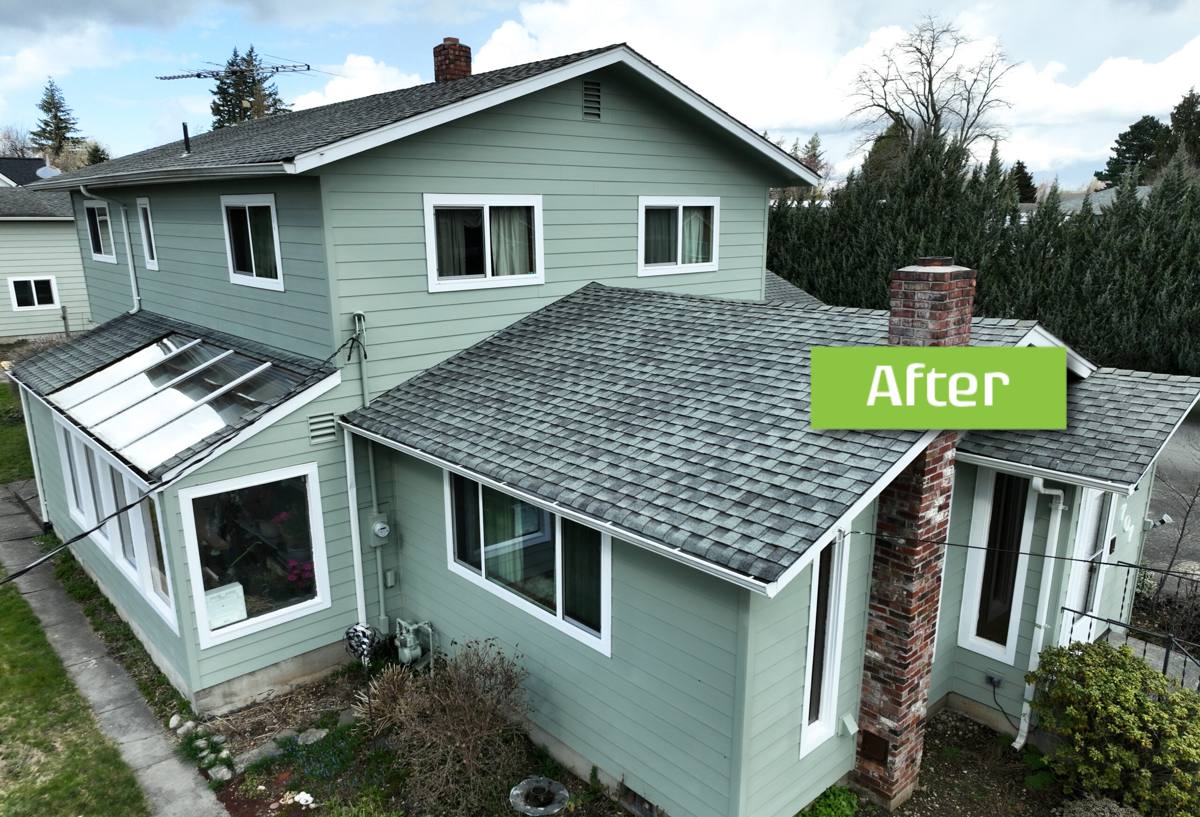
What a Correct Roof Replacement Actually Involves
"Roof replacement" gets used loosely. Done right, it's a full system replacement, not just new shingles laid over old problems. That distinction matters more in a wet marine climate, where hidden moisture damage is common and easy to miss if you're not looking for it.
Tear-Off and Deck Inspection
A full tear-off strips the roof down to the sheathing. That's the only point in the process where you can actually see the deck — and in older Bellingham-area homes, it's not unusual to find soft spots, delaminated plywood, or old water staining around chimneys and skylights that never showed up as an interior leak. Any compromised sheathing gets replaced before anything new goes down. Skipping this step, or only doing a partial tear-off, is how a new roof ends up sitting on a rotting foundation.
Underlayment and Flashing
In a climate with this much sustained rain, underlayment isn't a formality — it's the actual water barrier if wind ever drives moisture past the roof covering. We use synthetic or self-adhered underlayment at valleys, eaves, and around every penetration, and we treat flashing — chimneys, skylights, sidewall junctions, vent pipes — as high-priority detail work rather than an afterthought. Most roof leaks trace back to flashing, not the field shingles.
Ventilation
A roof deck that can't breathe traps moisture underneath it, which shortens the life of the sheathing and the roofing material from below. Balanced intake and exhaust ventilation matters everywhere, but especially under heavy tree cover where the roof surface itself dries slowly — the attic side needs to be doing its share of the work.
Choosing a Roofing Material for a Bay-Adjacent, Tree-Covered Lot
There's no single "best" material — it depends on how much maintenance you want to take on, your budget, and how much shade and moisture exposure your particular lot gets. Here's how the common options actually compare for a property like this:
| Material | Moss / algae resistance | Salt air durability | Maintenance |
|---|---|---|---|
| Asphalt composition shingle (standard) | Moderate — benefits from algae-resistant granules | Good with quality fasteners and flashing | Periodic cleaning, gutter clearing |
| Asphalt composition shingle (algae-resistant/copper-infused) | Better — slows moss and algae growth on the shingle surface | Good | Lower, but not maintenance-free |
| Standing seam metal | Very good — moss struggles to hold on smooth, steep metal | Depends on coating and fastener material; needs marine-grade hardware near the water | Low, but flashing and sealant points still need periodic checks |
| Cedar shake | Poor without diligent upkeep — organic material feeds moss in shade | Weathers naturally but salt speeds cupping and splitting | High — regular treatment and moss removal needed |
For heavily shaded, bay-facing lots, we generally steer homeowners away from cedar unless they're committed to an ongoing maintenance schedule, simply because the moisture-retention and moss-feeding tendencies of untreated wood shingle work against you in exactly the conditions Edgemoor has. That's not a knock on cedar as a product — it's a fit issue for this specific climate and tree cover, and we'll say so plainly rather than sell you something that'll fight the site it's on.
Moss Season Is Basically Year-Round Here
In a lot of the country, "moss season" is a few wet months. In Whatcom County, with our long rainy stretch and heavy shade in neighborhoods like Edgemoor, moss and algae growth can be active nearly any time conditions are damp and shaded — which is most of the year. A new roof doesn't make you immune to it; it just resets the clock and, if specified correctly, gives you tools to slow it down.
Two things make the biggest difference: algae-resistant shingle granules (or a naturally moss-resistant material like metal), and keeping tree limbs trimmed back from the roofline so sunlight and airflow can actually reach the surface. We'll also make sure valleys and gutters are detailed so debris sheds rather than collects — a roof that holds wet leaf litter in a valley is a roof that grows moss there first.
Our Edgemoor Roof Replacement Process
- On-site assessment — we walk the roof and attic, check for soft decking, existing moisture damage, ventilation, and flashing condition, and talk through material options for your specific tree cover and sun exposure.
- Written scope and estimate — a clear breakdown of tear-off, decking allowance, underlayment, material, flashing, and ventilation work, with no vague line items.
- Scheduling around the weather — we plan around Bellingham's rain patterns and build in contingency, because an open roof deck and a sudden downpour is not a risk we take with your home.
- Full tear-off and deck inspection — old roofing removed, deck inspected and repaired as needed before anything new goes on.
- Underlayment, flashing, and material installation — installed to manufacturer specification, with extra attention at valleys, penetrations, and sidewalls.
- Ventilation check and final walkthrough — intake and exhaust confirmed, site cleaned up, and a walkthrough so you understand what was done and why.
Cost Factors Specific to Edgemoor Properties
Every roof estimate depends on the specifics of the house, but a few factors come up more consistently on Edgemoor lots than elsewhere in Bellingham:
| Factor | Why it affects cost here |
|---|---|
| Access under tree canopy | Limited crane/truck access and overhead limbs can slow material staging and require more careful, manual handling |
| Roof pitch and complexity | Steeper or multi-plane roofs common on larger homes take longer to tear off and detail correctly |
| Decking condition | Older homes near the water more often need partial deck replacement once the old roof comes off |
| Material choice | Metal and algae-resistant shingle systems cost more upfront but reduce moss-related maintenance long-term |
| Debris and cleanup | Tree litter and moss buildup can mean a heavier disposal load than a comparable roof in an open, sunny area |
We'll walk through which of these actually apply to your house during the on-site estimate — broad ranges without seeing the roof aren't useful to you, and we won't pretend otherwise.
Why a Crew That Already Works Edgemoor Matters
A roofing crew that regularly works this part of Bellingham already knows how Edgemoor's tree cover and bay exposure behave on a roof — where moss tends to establish first, which flashing details need extra attention against wind-driven rain, and how to schedule and stage a job around limited access and a long rainy season. That's not something you can fully substitute with a generic checklist; it comes from having done the work here repeatedly.
It also matters for permitting and code compliance — City of Bellingham and Whatcom County requirements apply to roof replacement work, and a local crew handles that as a normal part of the job rather than a surprise. You're not paying to educate a contractor on our climate; you're paying for a job that already accounts for it.
After the Roof Is On: A Homeowner's Maintenance Checklist
A correctly installed roof still benefits from basic upkeep, especially under Edgemoor's tree cover. A simple annual routine goes a long way:
- Clear gutters and valleys of needles and leaf debris at least twice a year, more often under heavy tree cover
- Trim back tree limbs that overhang or touch the roofline
- Have moss or algae growth treated early rather than letting it establish
- Check attic ventilation isn't blocked by insulation or storage
- After major windstorms, do a visual check (from the ground) for lifted or missing shingles or displaced flashing
- Schedule a professional inspection every few years, even with no visible problems
If you're weighing a roof replacement for an Edgemoor home, we're happy to take a look and give you a straight, no-pressure assessment of what your roof actually needs. Use the form below to request a free estimate.