 Bellingham Exterior
 Edgemoor's Siding Problem Isn't Like Other Neighborhoods'
Edgemoor sits close to the water on Bellingham Bay, tucked under mature tree canopy that keeps these lots shaded and green almost year-round. That's part of why people love living here — and it's also exactly why siding takes more of a beating in Edgemoor than it does a few miles inland. Salt-laden air off the bay, wind-driven rain that finds every gap in a wall assembly, and a moss season that can run eight months or longer put constant moisture pressure on exterior walls. Add heavy shade from surrounding trees, and you get siding that stays damp longer after every storm, giving algae and moss more time to take hold before anything dries out.
None of that means Edgemoor homes are doomed to rot and repaint cycles every few years. It means the siding material and the installation details matter more here than in a drier, more open part of Whatcom County. We install James Hardie fiber cement exclusively, and this page is about what that looks like specifically for homes in this neighborhood.
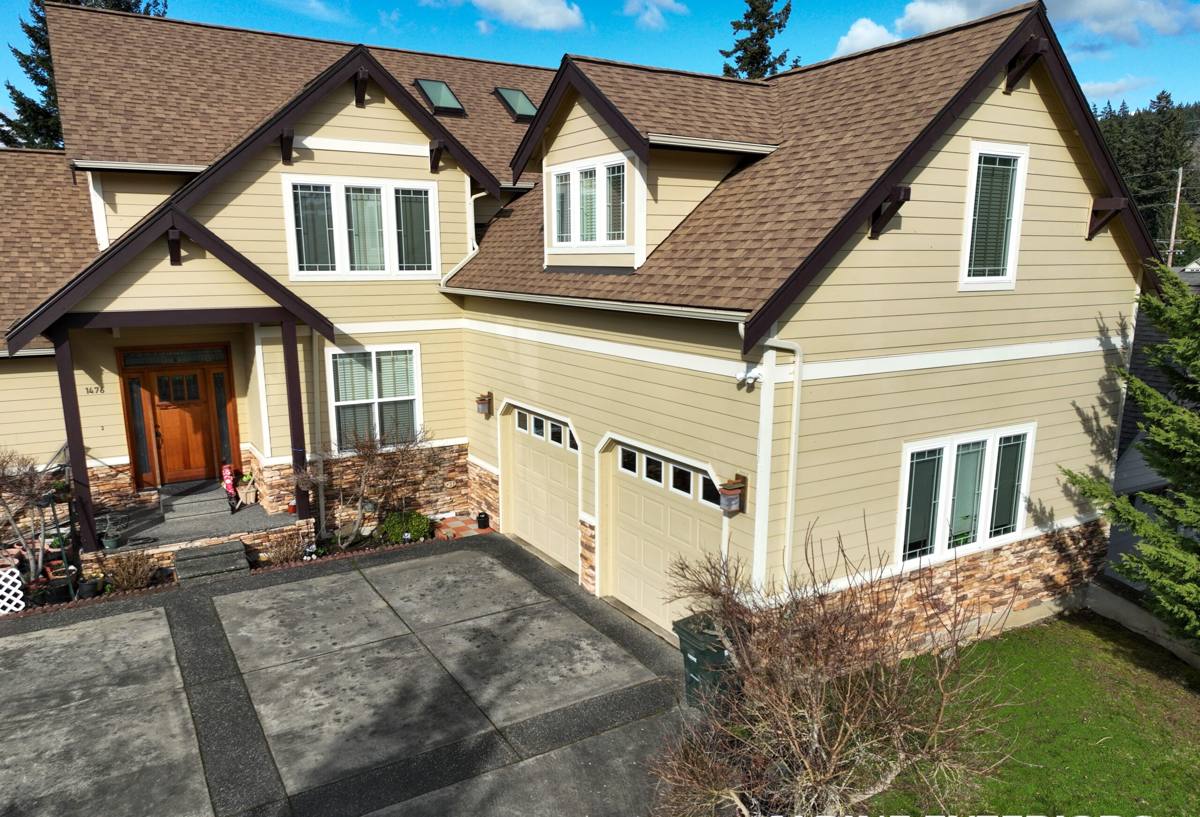
What Edgemoor Homes Actually Need From Their Siding
Moisture Management, Not Just Water Resistance
Any siding can shed rain in a light drizzle. What separates a good installation from a bad one is what happens during a sustained, wind-driven rain event coming off the bay — and what happens to any moisture that does get behind the cladding. A correct installation assumes some water will find its way past the surface layer eventually, and gives it a way out: proper drainage plane, correct flashing at every penetration, and a weep path at the bottom of the wall so trapped moisture can escape instead of sitting against sheathing.
Resistance to Salt Air Corrosion
Salt air doesn't just affect metal railings and hardware near the water — it accelerates the breakdown of paint films and can corrode standard fasteners over time. Fiber cement itself doesn't rust or corrode, but the fasteners, flashing, and trim details around it need to be chosen with that in mind, especially this close to Bellingham Bay.
A Finish That Can Handle Shade and Moss Pressure
Heavy tree cover means less direct sun to dry siding out between rain events, which is the exact condition moss and algae need to establish themselves. The siding's factory finish needs to hold up to that dampness without the color fading, chalking, or breaking down in a way that gives organic growth something to grip onto.
Why We Only Install James Hardie in This Climate
We don't install vinyl, LP SmartSide, Cemplank, Allura, primed spruce, or cedar — not because those products have no merit, but because we've made a professional call about what performs best under sustained coastal moisture, shade, and salt exposure, and we'd rather stand fully behind one system than offer several we're less confident in long-term.
- Vinyl can warp and gap over time, and once a seam or J-channel opens up, wind-driven rain off the bay finds its way behind it easily.
- Wood-based products (cedar, primed spruce) are organic material in a neighborhood with heavy moisture and shade — exactly the conditions that shorten their lifespan and increase repainting frequency.
- LP SmartSide is an engineered wood product, meaning it still relies on its outer coating staying intact to keep moisture out of the wood strand core.
- Fiber cement alternatives to Hardie (Cemplank, Allura) are reasonable products, but we've standardized on James Hardie's specific formulation, factory finish process, and warranty structure rather than mixing systems.
James Hardie fiber cement is non-combustible, doesn't absorb moisture the way wood-based products do, and its ColorPlus factory-applied finish is baked on under controlled conditions rather than field-painted — which matters a great deal when the goal is a finish that resists fading and holds up against damp, shaded exposure for decades rather than years.
What a Correct Installation Involves
Fiber cement siding is only as good as the details behind it. A rushed or corner-cutting install on the right product still fails in a climate like this one. Here's what we treat as non-negotiable on every Edgemoor project:
- A continuous water-resistive barrier installed and lapped correctly, shingle-style, so water always drains outward and down
- Proper flashing at every window, door, and roof-to-wall intersection — the single most common source of hidden rot we find on tear-offs
- Correct clearance between the bottom of the siding and grade, decks, patios, and roof lines, so splash-back and standing moisture don't sit against the material
- A weep screed or equivalent drainage detail at the base of the wall so any incidental moisture has somewhere to go
- Fastener spacing, type, and placement per James Hardie's published installation instructions — not a generic "close enough" pattern
- Factory-cut or field-cut edges properly sealed where required, since an unsealed cut edge is a weak point for moisture intake
- Correct caulking at butt joints and trim intersections, using products rated for the exposure, not whatever's on the truck
Cutting any one of these corners doesn't usually show up as a problem in year one. It shows up in year five or six, as staining, soft trim, or paint failure at specific spots — almost always the same spots where a detail was skipped.
Our Process for Edgemoor Siding Projects
1. On-Site Assessment
We walk the property, check the existing siding and trim for moisture intrusion, evaluate tree cover and drainage patterns specific to the lot, and look at how the home is oriented to prevailing wind and rain.
2. Tear-Off and Sheathing Inspection
We remove the existing siding rather than installing over it, because covering up an existing moisture problem just delays it. This is also the point where we can inspect sheathing and framing for any hidden rot and address it before new siding goes on.
3. Water-Resistive Barrier and Flashing
New house wrap or building paper goes on correctly lapped, followed by flashing at every penetration and transition — this step determines how the wall performs for the next 30-plus years far more than the siding itself does.
4. James Hardie Installation to Spec
Panels or lap siding go on per manufacturer fastening and clearance requirements, with trim, corners, and joints detailed for this specific exposure.
5. Final Inspection and Walkthrough
We walk the finished job with the homeowner, checking caulking, paint touch-up at any field cuts, and confirming clearances and drainage details are correct before we call it done.
Cost Factors for Edgemoor Siding Projects
Every project is different, but the same handful of factors drive cost on most Edgemoor homes. This table covers what typically affects a quote, without pretending to give a fixed number that doesn't apply to your specific house.
| Factor | Why It Matters Here |
|---|---|
| Existing siding removal and disposal | Tear-off is standard practice; the amount of hidden repair found underneath varies by home age and prior maintenance |
| Sheathing or framing repair | Homes with a history of moisture intrusion may need localized structural repair before new siding goes on |
| Home access and lot terrain | Sloped, wooded, or waterfront-adjacent lots can affect staging, scaffolding, and material handling |
| Trim and architectural detail | Custom trim, multiple gables, and dormers add labor beyond flat wall square footage |
| James Hardie product line and finish | Panel vs. lap profiles and color selections carry different material costs |
| Tree and vegetation clearance | Heavy canopy near the home may need trimming back for safe, proper installation access |
Signs Your Current Siding Is Losing the Battle
Because Edgemoor's shade and moisture load accelerate wear, it's worth knowing what to look for before small issues become expensive ones:
- Persistent green or black staining that returns quickly after cleaning
- Soft or spongy spots when you press on siding or trim, especially near the bottom of walls
- Paint that's chalking, peeling, or fading unevenly, particularly on shaded elevations
- Visible gaps, warping, or buckling at seams and panel joints
- Musty odor or visible moisture staining on interior walls that back up to exterior siding
- Caulking that's cracked, shrunk, or pulled away from trim and joints
Why a Crew That Already Works in Edgemoor Matters
General siding knowledge only goes so far here. A crew that regularly works Edgemoor's wooded, waterfront-adjacent lots already understands how to plan around limited access and staging space, how to schedule around this area's rain patterns instead of fighting them, and what level of tree clearance and drainage detail actually holds up given the shade and salt exposure specific to this part of Bellingham. That local pattern recognition is the difference between a crew guessing at what "should" work and one applying what they've already confirmed works on homes just like yours, in this exact microclimate.
If your Edgemoor home's siding is showing its age, or you're planning ahead rather than waiting for a problem, we're glad to take a look. Reach out for a free, no-pressure estimate — we'll walk the property, answer your questions honestly, and give you a straight assessment of what your home actually needs.