 Bellingham Exterior
 Why Decks in Ferndale Wear Out Differently Than You'd Expect
Ferndale sits close enough to Bellingham Bay and the Strait of Georgia that salt-laden air is a real factor in how decking ages here, not just an abstract concern. Combine that with Whatcom County's long wet season — months of driving rain followed by a heavy moss and algae bloom on anything shaded or north-facing — and you get a specific set of failure patterns that don't show up the same way in drier climates. Fasteners corrode faster near the coast. Wood fibers stay saturated for weeks at a time instead of drying out between storms. Moss holds moisture against the board surface long after the rain stops, which is worse for the wood underneath than the rain itself.
None of this means a deck in Ferndale is doomed. It means the build has to account for moisture that doesn't fully go away for half the year, and for hardware that has to survive salt exposure without failing quietly under the surface where you can't see it.
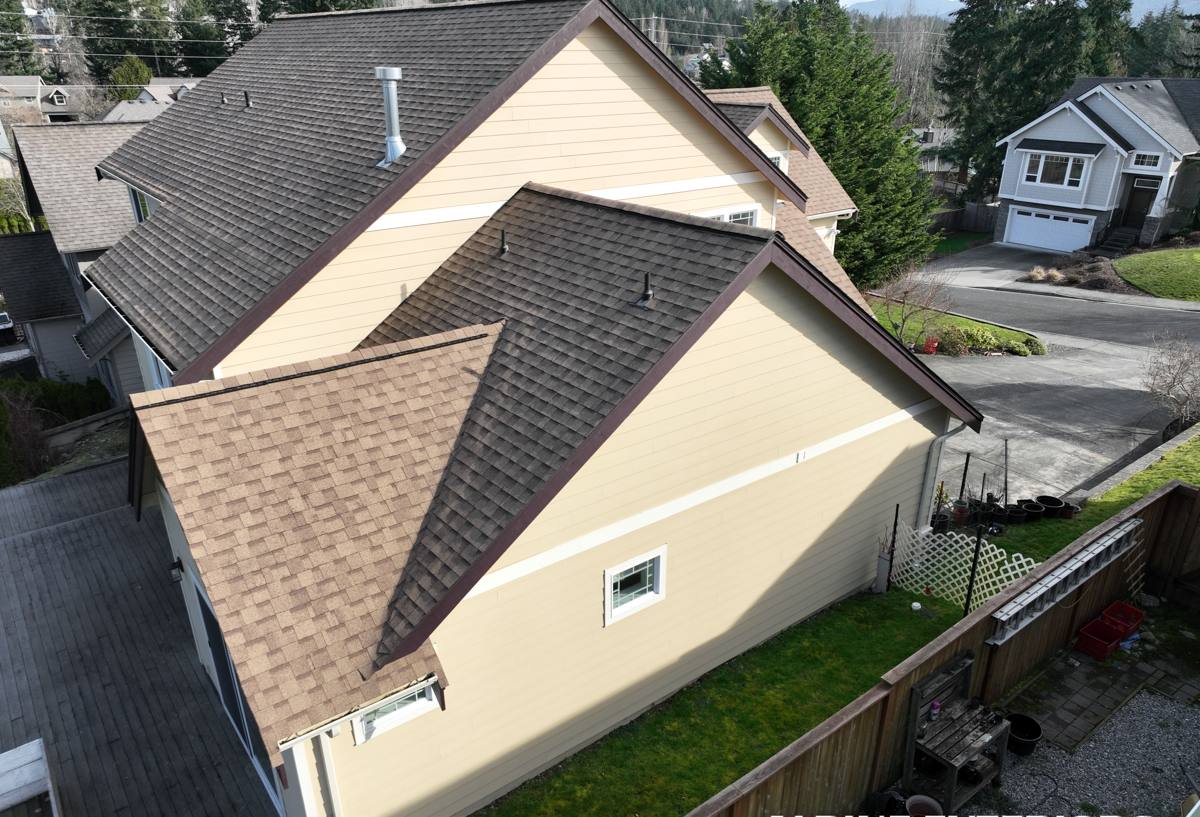
Signs a Deck Needs Replacement, Not Another Repair
Homeowners often call us wanting a repair quote and end up learning the deck is past the point where patching makes sense. A few honest signs to check yourself before you call anyone:
- Soft or spongy spots in the decking boards, especially near the house or in shaded corners — this usually means rot has already spread into the joist below.
- Rust streaking around fastener heads or joist hangers, which often means the metal is failing faster than the wood around it.
- A ledger board (where the deck attaches to the house) that feels loose, or gaps opening up between the ledger and the siding.
- Persistent moss or black-green staining that keeps coming back within weeks of cleaning, no matter how often it's washed.
- Visible sagging, bounce, or movement when you walk across the deck — a structural issue, not a cosmetic one.
If it's one or two boards, a repair can be the right call. If the framing, ledger, or footings are compromised, repairing the surface just delays a problem that's underneath.
Why Surface Repairs Often Miss the Real Issue
A lot of deck damage in this region starts below the decking boards, in the joists, ledger connection, or footings, where moisture sits longest and gets the least airflow. Replacing the top boards without checking what's underneath can leave a homeowner with a good-looking deck sitting on framing that's already compromised. Part of doing this job right is being willing to tell a homeowner when a repair won't actually solve the problem.
What a Correct Deck Replacement Actually Involves
A deck replacement is more than swapping old boards for new ones. Done properly, it touches every layer of the structure:
- Ledger board and flashing: The connection point to the house is the single most common source of hidden rot. Proper flashing here keeps water from wicking into the house's rim joist, not just the deck.
- Footings and posts: Checked for movement, rot, or undersized bearing for the deck's actual size and load.
- Joists and framing: Replaced where soft or corroded, and spaced to meet current code — older decks are frequently under-built by today's standards.
- Fasteners and hardware: Coastal exposure calls for corrosion-resistant hardware rated for treated lumber contact, not standard interior-grade fasteners.
- Decking surface: Wood, composite, or PVC, chosen based on the homeowner's budget, maintenance appetite, and how much sun or shade the deck actually gets.
- Railings and stairs: Brought up to current code, which matters both for safety and for resale — an out-of-code railing is a common flag in home inspections.
Skipping any of these steps to save time on the framing is how a deck ends up needing another full replacement in eight years instead of twenty-five.
Choosing Decking Material for Ferndale's Climate
There's no single right answer here — it depends on how much upkeep a homeowner wants to do and how much shade the deck sits in. What we won't do is install a product in a spot where it's a poor fit for the moisture conditions and call it a good outcome.
| Material | How It Handles Salt Air & Moisture | Maintenance | Typical Lifespan |
|---|---|---|---|
| Pressure-treated wood | Good if properly sealed and re-coated; untreated cut ends are a weak point near the coast | Annual cleaning and re-staining/sealing | 10–15 years |
| Cedar | Naturally moisture-resistant but still needs sealing in a wet climate; softer, shows wear faster in high-traffic areas | Sealing every 1–2 years | 15–20 years |
| Capped composite | Handles moisture and salt exposure well; won't rot, but shaded areas still need periodic cleaning to stay ahead of moss | Occasional washing, no sealing/staining | 25–30 years |
| PVC decking | Fully synthetic, best resistance to moisture and staining in shaded, damp spots | Lowest of the group — occasional washing | 25–30+ years |
For a deck that gets a lot of shade from trees or the house — common on north- and east-facing lots in Ferndale — we'll often steer a homeowner toward composite or PVC simply because the maintenance burden of a wood deck in constant dampness is significant. For a sunnier, more exposed deck, a well-sealed wood deck can perform fine and costs less up front. The honest trade-off is upfront cost versus ongoing maintenance time, not one product being "better" across the board.
Our Deck Replacement Process
- On-site assessment: We check the ledger, framing, footings, and existing decking to determine what's salvageable and what isn't — not just the visible surface.
- Written estimate: A clear scope of work and cost breakdown before anything is torn out, so there are no surprise line items mid-project.
- Permitting: We handle the permit application and inspection scheduling required for the rebuild.
- Demolition and structural rebuild: Old decking and any compromised framing come out; footings, posts, and joists are brought up to current code.
- Decking, railing, and stairs installed: Using the material selected, with hardware suited to the coastal exposure.
- Final walkthrough: We go over the finished deck with the homeowner, including basic care guidance for whichever material was chosen.
Permits and Code Considerations in Whatcom County
Most full deck replacements in Whatcom County require a building permit, particularly when the ledger attachment, footings, or railings are being redone — which is most of a proper replacement. Requirements can vary depending on deck size, height above grade, and location, so this isn't something to assume your way through. We handle the permit process as part of the job rather than leaving it to the homeowner, and we build to the code requirements in effect at the time, not to whatever standard the old deck was originally built under.
What Affects the Cost of a Deck Replacement
| Factor | Why It Matters |
|---|---|
| Deck size and shape | More square footage and more corners/cutouts increase both material and labor time |
| Decking material chosen | Wood costs less upfront; composite and PVC cost more but reduce maintenance over the deck's life |
| Height above grade | Taller decks need more substantial framing, railings, and often stairs, all of which add cost |
| Condition of existing structure | Rotted framing or footings that need full replacement adds labor beyond a straightforward surface swap |
| Railing style | Cable, glass, or custom railing systems cost more than standard baluster railing |
We won't quote a price without seeing the deck — anyone who does is guessing, and a guess isn't useful to a homeowner trying to budget. We give a written estimate after an on-site assessment.
Why a Crew That Already Works Ferndale Matters
A contractor who works regularly in Ferndale and around Bellingham already knows what the salt air and moss cycle do to a deck over time, because we've seen it happen to decks built without accounting for it. That means fewer surprises during the assessment, hardware and material choices that are already suited to the conditions instead of a generic recommendation, and a crew that isn't learning the local climate on your project. It also means we're not driving in from out of the area — if a question comes up after the job is done, we're close by.
Keeping a New Deck in Good Shape
Whatever material a homeowner chooses, a few habits make a real difference in how long it lasts in this climate:
- Sweep off leaves and debris regularly, especially in fall — trapped organic matter is what feeds moss and mildew.
- Wash the deck surface at least once a year, more often in shaded areas, to stay ahead of moss before it takes hold.
- Check and clear gaps between boards so water can drain through instead of pooling.
- For wood decks, reapply sealant or stain on the schedule recommended for the product — skipping a cycle in a wet climate compounds fast.
- Keep an eye on the ledger board area where the deck meets the house, since that's the first place hidden moisture problems tend to show up.
If you're seeing soft spots, rust, or a deck that just doesn't feel solid anymore, we're happy to take a look and give you a straight assessment of what it needs. Reach out for a free, no-pressure estimate using the form below.