 Bellingham Exterior
 Why Ferndale Roofs Wear Differently Than Roofs Inland
Ferndale sits close enough to the water and open farmland that roofs here take a different kind of beating than roofs twenty miles inland. You get salt-laden air drifting off the Strait, wind-driven rain that finds every gap in flashing and fastening, and a moss season that can run nine or ten months out of the year in shaded, north-facing sections of a roof. None of that is exotic — it's just Whatcom County weather, day in and day out — but it means a roof installed with generic, one-size-fits-all methods will show its age here faster than the same roof installed thirty miles east.
Salt air accelerates corrosion on exposed metal fasteners, flashing, and vent stacks. Driving rain, especially in wind events off the water, pushes moisture sideways and upward under shingle tabs and around penetrations rather than just running straight down. And moss doesn't just look bad — its root structure lifts shingle edges, holds standing moisture against the roof deck, and shortens the life of whatever material sits under it. A correct roof installation in Ferndale accounts for all three from the first nail, not as an afterthought.
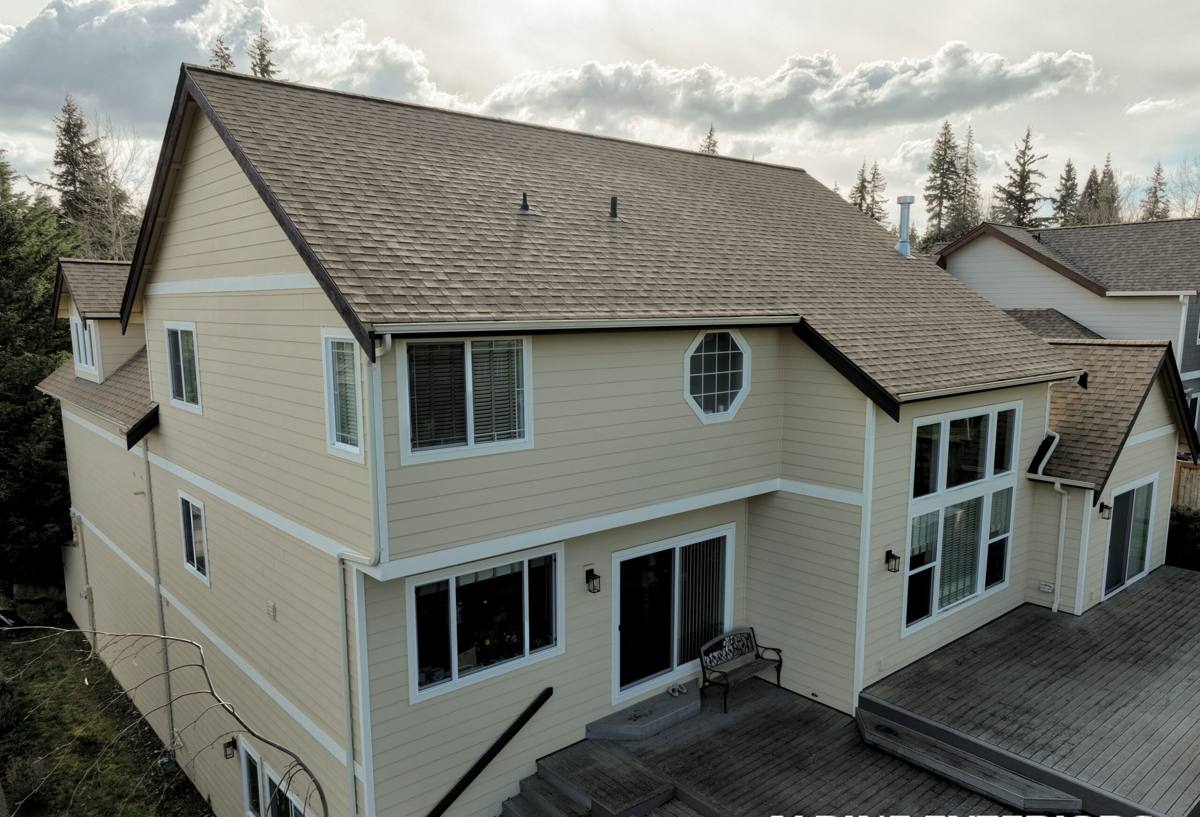
Signs Your Ferndale Home Needs a New Roof — Not Just Another Repair
Plenty of roofs in this area get patched for years past the point where patching still makes sense. Some signs are obvious; others show up as small, easy-to-dismiss details that add up.
- Granules collecting in gutters or at downspout outlets, especially after wind or heavy rain
- Shingles that are cupping, curling at the edges, or cracking when you look closely from the ground
- Moss growth that keeps returning within a season or two of cleaning, even on treated shingles
- Soft or spongy spots on the roof deck, felt through the attic or noticed during a walk-on inspection
- Daylight visible through the roof deck from inside the attic
- Interior ceiling stains, especially near chimneys, skylights, or valleys — the most common leak points
- A roof that's simply reached the back half of its expected lifespan and has multiple repair patches already
One or two of these usually means a repair is still reasonable. Several together, especially combined with the roof's age, usually means repair spending is just delaying the inevitable and adding up to more than a new roof would have cost outright.
What Actually Goes Into a Correct New Roof Installation
A new roof is more than swapping old shingles for new ones. Most of what determines whether a roof lasts 15 years or 30 happens in layers you never see once the job is done.
Tear-Off and Deck Inspection
We remove the old roofing down to the deck rather than layering over it. That's the only way to actually see the condition of the plywood or plank sheathing underneath — soft, delaminated, or water-stained sections get replaced before anything new goes down. Installing new roofing over a compromised deck just hides a problem that will resurface as a leak or a sag.
Underlayment and Water Protection
Given how much wind-driven rain this area sees, underlayment choice matters more here than in drier climates. We use synthetic underlayment as the primary water-resistant barrier, with self-adhering ice-and-water shield reinforcing the vulnerable areas — eaves, valleys, and around every penetration — where wind can push water backward under the shingle field.
Ventilation
A roof that can't breathe traps moisture in the attic, which speeds up deck rot and helps moss and mildew get established from underneath. Balanced intake and exhaust ventilation is part of every install, not an upsell — it protects the investment in the roofing material itself.
Flashing Details
Flashing around chimneys, skylights, vent stacks, and roof-to-wall transitions is where most roof leaks actually start, not out in the open field of shingles. We use corrosion-resistant flashing material and proper step-and-counter-flashing technique, which matters more here given the salt air's effect on lower-grade metals over time.
Roofing Material Options for Ferndale's Coastal-Influenced Climate
There's no single "best" roofing material for every home — it depends on your home's style, budget, and how much long-term maintenance you want to take on. Here's how the common options actually perform under Ferndale's conditions.
| Material | Performance in Salt Air & Rain | Moss Resistance | Typical Lifespan Here |
|---|---|---|---|
| Architectural asphalt shingle | Good with proper flashing; algae-resistant granules help | Moderate — benefits from copper/zinc strips | 20-30 years |
| Standing seam metal | Excellent when properly coated; sheds wind-driven rain well | High — moss struggles to root on smooth metal | 40-50+ years |
| Cedar shake | Attractive but higher maintenance in wet, shaded conditions | Low without regular treatment | 20-25 years with upkeep |
| Synthetic composite | Good; consistent performance, low absorption | Moderate to high depending on product | 30-50 years |
We install asphalt and metal roofing as our standard offerings because both give homeowners a predictable maintenance schedule and a manufacturer warranty structure that holds up over time. Cedar shake can look great on the right home, but the maintenance burden — regular treatment to fight moss and moisture retention in a climate like ours — is a real trade-off worth going in with eyes open, not a mark against the material itself.
Our New Roof Installation Process
- On-site assessment. We inspect the existing roof, attic ventilation, and deck condition, and measure the roof to scope material needs accurately.
- Written estimate. You get a clear breakdown of material, labor, and any deck repair contingencies before work starts — no surprise change orders for things we could have caught up front.
- Material delivery and site protection. Landscaping, siding, and gutters are protected before tear-off begins.
- Tear-off and deck inspection. Old roofing comes off, the deck is inspected board by board, and any needed repairs are made.
- Underlayment, flashing, and ventilation installed. This is the layer that determines how the roof performs during the next windstorm off the water.
- Roofing material installation. Installed to manufacturer specification, which is also what keeps the material warranty valid.
- Cleanup and magnetic sweep. Job site and yard cleared of debris and stray fasteners.
- Final walkthrough. We go over the finished roof with you before calling the job done.
Cost Factors for a New Roof in Ferndale
Every roof is priced on its own specifics, but the same handful of factors drive most of the variation we see on Ferndale homes.
| Factor | Why It Matters |
|---|---|
| Roof size and pitch | Steeper roofs take longer to work safely and use more material overage |
| Number of penetrations | Each chimney, skylight, or vent stack needs its own flashing detail |
| Deck condition | Rot or delamination found at tear-off adds material and labor to replace it |
| Material choice | Asphalt, metal, and composite options span a wide cost range |
| Layers of old roofing | Multiple existing layers mean more tear-off labor and disposal |
| Access and site conditions | Steep lots, limited driveway access, or tall trees affect setup and disposal logistics |
We won't quote a number over the phone without seeing the roof — anyone who does is guessing, and that guess tends to grow once the tear-off starts. A proper in-person estimate accounts for what's actually under the current roofing, not just square footage.
Why Hire a Crew That Already Works Ferndale Roofs
A roofing crew that mostly works drier, inland areas can still do competent work, but they're often applying general practices to a climate that punishes shortcuts around flashing, underlayment, and ventilation faster than most places. Crews that regularly work Whatcom County roofs already know which details matter here: how far ice-and-water shield needs to extend given our wind-driven rain, which fastener and flashing grades hold up against salt air over decades rather than years, and how attic ventilation choices affect moss growth on the north-facing slopes that never get direct sun.
That local pattern-recognition is also what shows up later, when a roof holds up through its second or third real windstorm without a callback. It's less about any single technique and more about consistently applying the right details for this specific climate, on every job, without cutting corners the weather here doesn't forgive.
Maintaining a New Roof Through Whatcom County's Moss Season
A correctly installed roof still needs basic upkeep to hit its full lifespan in this climate. None of this is complicated, but skipping it is how a 30-year roof turns into a 20-year roof.
- Keep gutters and downspouts clear so water isn't backing up under the lower courses of roofing
- Have moss and debris removed from shaded, north-facing roof sections before it establishes root structure
- Trim back overhanging branches that keep sections of the roof shaded and damp longer than the rest
- Schedule a periodic inspection of flashing around chimneys, skylights, and vents — the areas most exposed to wind-driven rain
- Address any small leak or stain promptly rather than waiting for it to spread
If you're weighing a repair against a full replacement, or just want a straight answer on what condition your current roof is really in, we're glad to take a look. Reach out for a free, no-pressure estimate using the form below.