 Bellingham Exterior
 Siding That Has to Work in Two Different Climates at Once
Barkley sits close enough to Bellingham Bay that homes here deal with salt-laden air moving in off the water, but far enough inland and shaded by mature trees that moss and algae get a long, comfortable growing season on anything that stays damp. That's a tougher combination than it sounds. Most siding products are engineered to handle one problem or the other — coastal corrosion resistance, or moisture and mildew resistance in a wet, shaded lot. Whatcom County asks a siding system to handle both, year-round, for decades.
Add in driving rain that comes sideways off winter storms, and you have a climate that finds every weak point in a siding installation eventually. Caulk joints that were rushed, fasteners that missed the stud, panels hung too close to grade — none of that shows up as a problem in year one. It shows up in year five or six, usually as soft trim, peeling paint, or a dark green cast creeping up from the bottom courses.
What Bellingham's Weather Actually Does to Siding
It helps to understand the specific failure modes we see on older or poorly installed siding around Bellingham, because it explains why we're strict about both the product we use and how it goes on the wall.
Moisture Intrusion
Wood-based and composite sidings absorb water at cut edges, fastener holes, and butt joints. Once moisture gets behind the surface, it doesn't dry out quickly in our climate — the air is humid enough, and the sun exposure low enough, that trapped water can sit for weeks. That leads to swelling, delamination, and eventually rot in the substrate behind the siding.
Moss and Algae
Shaded, north-facing walls and anything near overhanging trees will grow moss and algae if the surface stays damp and offers the organism something to grip. Painted wood and some composite products give moss a foothold at the grain and at chalking paint film. Once established, moss holds moisture against the wall, which accelerates whatever rot or swelling is already starting underneath.
Salt Air and Coastal Exposure
Proximity to Bellingham Bay means airborne salt settles on exterior surfaces, especially with onshore wind. Salt is corrosive to unprotected metal fasteners and trim, and it can accelerate the breakdown of lower-grade paint films, leading to chalking and fading well before a normal repaint cycle.
Why We Only Install James Hardie Fiber Cement in Barkley
We made a standing decision as a company to install James Hardie fiber cement siding exclusively — not LP SmartSide, not vinyl, not Cemplank or Allura, not primed spruce or cedar. That's not a marketing position, it's a practical one built around what actually holds up under the conditions described above.
Fiber cement is made from cement, sand, and cellulose fibers, which means it doesn't absorb water the way wood-based products do and it isn't a food source for moss or algae the way organic materials can be. It's also non-combustible, which matters in a region where wildfire smoke and defensible-space concerns have become part of home insurance conversations even west of the Cascades. Vinyl, by contrast, can warp and become brittle with age and temperature swings, and its seams and mounting profile give wind-driven rain more opportunities to get behind the panel over time.
None of this means other products are junk — LP SmartSide and vinyl both have legitimate use cases and reasonable installed cost. We simply won't put our name behind a job we don't think will hold up through fifteen or twenty Whatcom County winters without ongoing maintenance headaches for the homeowner.
The HZ5 Product Line: Engineered for Marine Climates
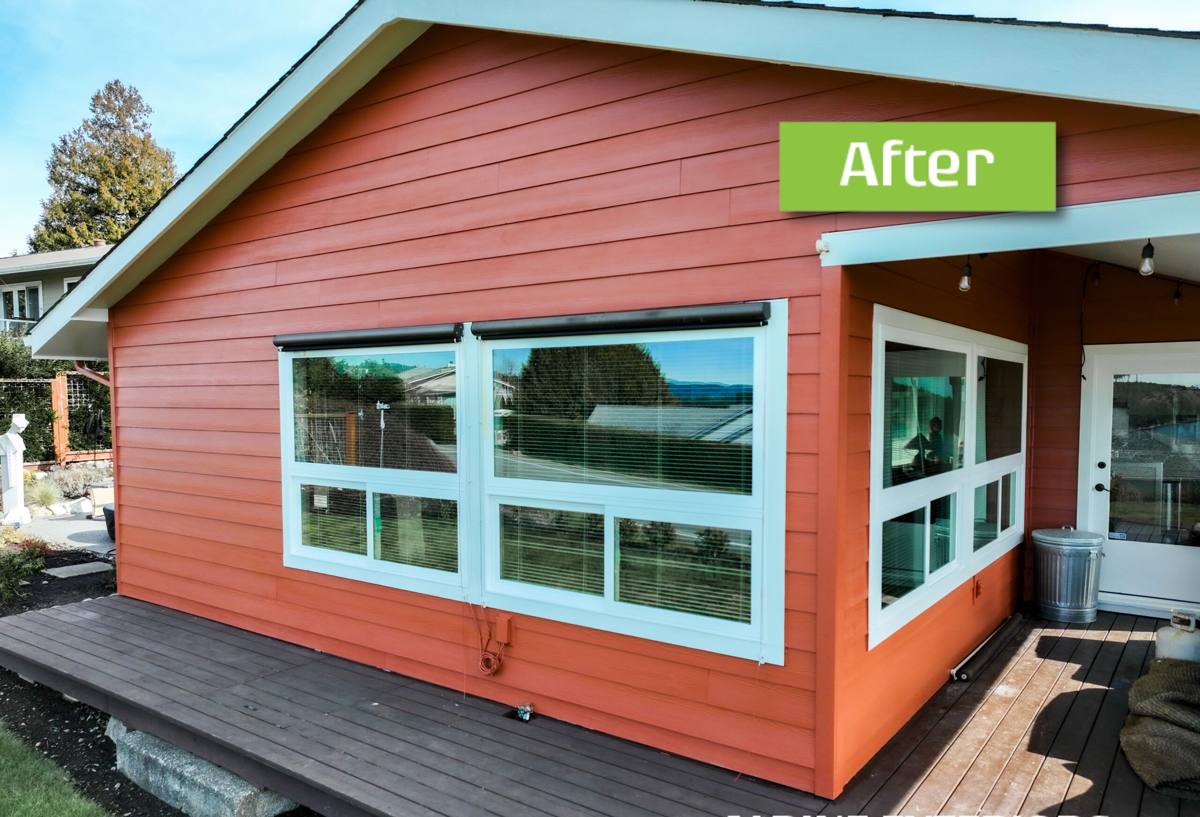
James Hardie makes region-specific formulations of its siding, and the HZ5 line is engineered for climates like ours — the Pacific Northwest, with its wet winters, moderate humidity, and coastal exposure. The difference from a generic fiber cement board isn't cosmetic; it's in the substrate formulation and how the product manages moisture at the cut edge and fastener penetration, which are the two most common points of failure in any siding system.
ColorPlus Factory Finish
Most of what we install uses Hardie's ColorPlus finish, a factory-applied, baked-on finish that's more consistent and more UV- and fade-resistant than field-applied paint. It also comes with its own finish warranty separate from the substrate warranty, which matters in a coastal climate where paint film breakdown is often the first visible sign of aging siding.
Product Lines We Use
Depending on the home and the look a homeowner wants, that can mean HardiePlank lap siding, HardiePanel for a more modern vertical look, or HardieShingle for a textured, traditional elevation. All of them share the same HZ5 substrate engineering underneath.
What a Correct Installation Actually Involves
The siding product is only part of the equation. Fiber cement siding installed to spec and fiber cement siding installed carelessly can look identical the day the crew leaves — the difference shows up years later. Here's what we consider non-negotiable on every job, including every Barkley project:
| Detail | Correct Installation | Common Shortcut We Won't Take |
|---|---|---|
| Weather-resistive barrier | Continuous, properly lapped house wrap with all penetrations flashed and taped | Reusing or patching old wrap, skipping flashing tape at penetrations |
| Fastening | Corrosion-resistant fasteners driven into framing per Hardie's fastening schedule | Fasteners landing in sheathing only, or spaced beyond spec |
| Clearance to grade and hard surfaces | Minimum clearance maintained per manufacturer requirements to keep the bottom edge out of standing moisture | Siding run tight to a patio, deck, or grade level |
| Joints and caulking | Butt joints backed with flashing or a rain-screen detail, sealed with a quality, paintable exterior sealant | Unbacked butt joints relying on caulk alone |
| Cut edges | Field cuts sealed per manufacturer guidance before installation | Raw, unsealed cut edges left exposed to moisture |
Every one of those shortcuts is invisible on installation day. In a climate as forgiving as Barkley's is unforgiving, they turn into the exact failures we described earlier — trapped moisture, soft trim, and premature paint or finish breakdown.
Our Process on a Barkley Project
The steps themselves aren't unusual, but the attention paid at each one is where jobs succeed or fail long-term.
- On-site assessment. We walk the existing exterior, checking for hidden moisture damage behind current siding, trim condition, and any drainage or grading issues at the foundation before we ever talk product or price.
- Tear-off and substrate check. Once old siding is off, we inspect sheathing for rot or soft spots and replace anything compromised before house wrap goes back on — this is the point where problems that caused the original siding to fail get fixed, not covered up.
- Weather barrier and flashing. A continuous, correctly lapped weather-resistive barrier goes on with flashing at every window, door, and penetration.
- Siding installation. HZ5 fiber cement is installed to Hardie's fastening and clearance specifications, with attention to butt joints, corners, and transitions.
- Trim, caulking, and touch-up. Trim is set, joints sealed, and any factory finish touch-up handled with Hardie-matched product.
- Final walkthrough. We go over the finished exterior with the homeowner before calling the job done.
Cost Factors for Fiber Cement Siding in Barkley
Every home is different, so we won't quote a number without seeing the house, but these are the variables that move a Barkley siding project up or down in price:
| Factor | Why It Matters |
|---|---|
| Existing siding removal | Tear-off of multiple layers or hazardous materials like old asbestos siding adds labor time |
| Substrate repair | Rotted sheathing or framing found during tear-off has to be replaced before new siding goes on |
| Home profile and cutouts | Homes with more corners, dormers, or window trim take more labor per square foot than a simple rectangular elevation |
| Product line and profile | Lap width, panel style, and shingle profiles carry different material costs |
| Access and site conditions | Sloped lots, mature landscaping, or tight setbacks common in established Barkley yards can affect staging and scaffolding needs |
Living With Fiber Cement Siding in a Moss-Prone, Salt-Air Neighborhood
Fiber cement is low-maintenance compared to wood, but "low-maintenance" isn't "no-maintenance," especially in this climate. A short annual routine keeps a Hardie exterior looking and performing the way it should for decades:
- Rinse siding gently once or twice a year to clear salt residue and organic buildup, especially on shaded or north-facing walls
- Keep gutters clear so overflow doesn't run down the siding face and feed moss growth
- Trim back landscaping and tree limbs that keep a wall shaded and damp longer than the rest of the house
- Check and re-caulk joints around trim, windows, and penetrations every few years as part of normal upkeep
- Address any paint or finish chipping promptly so bare substrate isn't exposed to moisture
None of this is heavy work, but skipping it is exactly how moss gets a permanent foothold on the shaded side of a Barkley home.
Why a Crew That Already Works in Barkley Matters
Siding installation quality depends on judgment calls that a spec sheet can't fully cover — how much clearance to leave above a specific grade condition, how to detail a wall that gets more wind-driven rain than the rest of the house, which walls in a given yard are going to stay damp longest through the fall and winter. A crew that has already worked on homes in Barkley and elsewhere around Bellingham has seen these conditions repeat across similar lots and building styles, and installs accordingly instead of treating every wall the same way a national crew working from a generic checklist might.
There's also a practical side: familiarity with Bellingham's permitting process, typical lot layouts in established Whatcom County neighborhoods, and realistic scheduling around our wet season all come from doing this work locally and repeatedly, not from a one-off job passing through the area.
Get a Straightforward Look at Your Siding
If you're weighing a siding project for a home in Barkley, we're glad to come take a look, explain what we're seeing, and give you a straightforward, no-pressure estimate — no upsell script, just an honest read on what your home needs. Use the form below to get started.