 Bellingham Exterior
 Siding Built for Columbia's Older Housing Stock and Bellingham's Wet Climate
Columbia is one of Bellingham's more established residential pockets, which means a lot of the homes here were built decades before fiber cement siding existed. Many are still wearing their second or third layer of paint over wood siding, or a run of vinyl that was bolted on sometime in the 80s or 90s to cut down on maintenance. Neither of those approaches holds up well against what Whatcom County weather actually does to a house year after year: long stretches of driving rain off the water, a moss and mildew season that can run from October into May, and salt-laden air that speeds up corrosion on anything metal or under-protected. James Hardie fiber cement siding was engineered specifically for climates like this, and it's the only siding product our crew installs — on Columbia homes or anywhere else we work.
This page is about that one job, in this one neighborhood: what Columbia homes specifically need from their siding, what a correct Hardie installation looks like, and why it matters that the crew doing the work already knows this area.
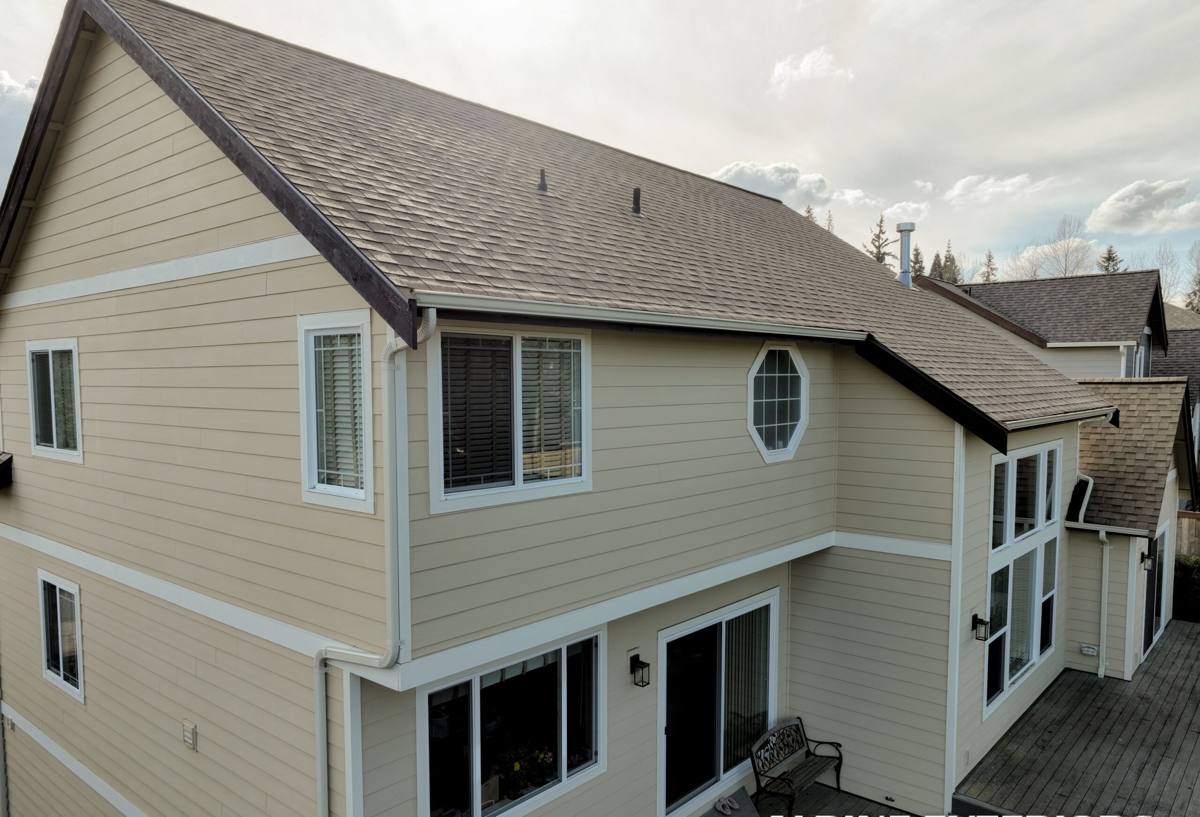
What Columbia's Climate Actually Does to Siding
Moisture Load
Bellingham sits in a marine climate where humidity stays elevated most of the year. Combined with tree cover common in older Columbia lots, that means siding surfaces often stay damp longer after a storm than they would in a drier or more open location. Wood siding and even primed spruce products can hold that moisture at the surface and in seams, which is exactly the condition mold, rot, and paint failure need to take hold.
Driving Rain and Wind-Driven Water
Storms coming off the Sound don't just fall straight down — wind pushes rain sideways into wall assemblies, especially on exposed elevations. Siding that isn't engineered with the right lap geometry and installed with correct clearances and flashing details will eventually let water track behind it, regardless of what the material is made of.
Moss and Organic Growth
Shaded, damp surfaces in this area grow moss and algae readily. On untreated wood or lower-grade siding, that growth holds moisture against the substrate and accelerates deterioration. Factory-applied finishes that resist this buildup, and siding materials that don't feed organic growth the way wood does, make a real difference in how a house looks and performs five and ten years out.
Salt Air
Bellingham's proximity to salt water means airborne salt reaches inland neighborhoods like Columbia more than people expect. Salt accelerates corrosion of fasteners, flashing, and any exposed metal trim, and it degrades cheaper paint finishes faster than inland climates would. Materials and finish systems need to be chosen with that in mind, not just for coastal-front homes.
Why We Only Install James Hardie
We made a decision as a company to stop installing vinyl, LP SmartSide, primed spruce, cedar, and other fiber cement brands like Cemplank or Allura. That's not a marketing position — it's based on what we've seen hold up in this climate and what we're willing to stand behind with our own labor and warranty.
- Non-combustible core: Hardie's fiber cement won't ignite, sustain flame, or contribute fuel the way wood-based products can — a meaningful factor as wildfire smoke seasons have become a regular part of Pacific Northwest summers.
- ColorPlus factory finish: baked-on, warrantied color that resists the fading and chipping that field-painted wood and lower-grade products struggle with in this humidity.
- HZ5 engineering: Hardie's HZ product line is engineered for climates with high moisture exposure, which describes Whatcom County accurately.
- Dimensional stability: fiber cement doesn't swell, cup, or split the way wood and some wood-composite products can when they cycle through wet and dry seasons repeatedly.
- Long, transferable warranty: a warranty structure that's actually meaningful because the material and finish are engineered to reach it.
We're not going to tell you vinyl or LP SmartSide are junk — they're not, and plenty of contractors do fine work with them. Our position is narrower: given what we've seen in the maintenance calls and repair jobs we get around Bellingham, we decided we'd rather install one product correctly than several products at varying levels of confidence. That's Hardie.
What a Correct Hardie Installation Involves
The material is only half the equation. Fiber cement siding fails prematurely almost exclusively because of installation mistakes, not product defects. On a Columbia job, our process includes:
- Tear-off and substrate inspection: removing existing siding and checking sheathing, framing, and any water damage that's been hidden behind the old material — common on homes that have carried the same siding for 20-plus years.
- Weather-resistive barrier and flashing: a correctly lapped water-resistive barrier, properly integrated window and door flashing, and rainscreen or drainage plane detailing where the wall assembly calls for it.
- Correct fastening: Hardie specifies fastener type, placement, and spacing precisely — corrosion-resistant fasteners matter even more here given salt air exposure.
- Proper clearances: minimum gaps at grade, roofline, decks, and other siding-to-surface transitions so water has somewhere to go instead of wicking into the board ends.
- Caulking and sealant discipline: sealing only where Hardie's instructions call for it — over-caulking traps moisture just as badly as under-caulking lets it in.
- Trim and finish detailing: corner boards, window trim, and butt joints installed to shed water rather than collect it.
Comparing Siding Options for a Columbia Home
| Factor | James Hardie Fiber Cement | Vinyl | Wood / Primed Spruce |
|---|---|---|---|
| Moisture resistance | Engineered for wet climates (HZ5) | Doesn't absorb water, but seams and expansion gaps can let it in behind panels | Absorbs moisture; prone to rot without diligent upkeep |
| Fire behavior | Non-combustible | Melts/deforms under heat | Combustible |
| Finish longevity | Factory ColorPlus finish, warrantied | Color molded in, but fades and can look plasticky over time | Requires repainting on a recurring cycle |
| Moss/algae resistance | Resists surface growth well | Can host mildew in grooves and laps | Readily supports moss and algae growth |
| Typical maintenance | Occasional wash-down | Low, but repairs are visually obvious (color-matching old panels) | Regular painting/staining and repair |
Why a Crew That Already Works Columbia Matters
Fiber cement installation quality varies a lot between crews, and the details that matter most — flashing sequencing, fastener placement, clearance at grade — are the ones a homeowner can't easily see once the job is finished. A crew that's already worked in Columbia and the surrounding Bellingham neighborhoods has a practical advantage: they've seen how the local housing stock is typically built, what's usually hiding behind older siding, and how the specific rain and wind exposure in this part of Whatcom County behaves against a wall assembly. That's not something you get from a general contractor doing one Hardie job a year alongside vinyl, LP, and wood jobs — it comes from repetition with one product, in one climate, done the same correct way every time.
What to Expect From Our Process
- On-site assessment of your current siding, sheathing condition, and any moisture or rot issues found during tear-off
- A written scope specifying Hardie product line, profile, and color — no vague "siding replacement" line items
- A realistic timeline that accounts for Bellingham's rain patterns, since fiber cement installation requires reasonably dry working conditions
- Clear communication about what's found once old siding comes off, before we proceed on any additional repair work
- Final walkthrough covering fastener lines, caulking points, and trim details before we call the job complete
Cost Factors Worth Understanding Up Front
Every home is different, so we won't quote a number without seeing the house, but the main cost drivers on a Columbia siding job are generally the same ones that drive cost anywhere in this climate:
| Factor | Why It Matters |
|---|---|
| Substrate condition | Rot or water damage found under old siding adds repair scope before new siding can go on |
| Home size and wall complexity | More corners, dormers, and trim transitions mean more labor and material cuts |
| Product line and profile | HZ5 planks, panels, and trim options are priced differently depending on style and finish |
| Access and site conditions | Mature landscaping, tight lot lines, or multi-story sections affect labor time |
| Existing siding removal | Multiple layers of old material or hazardous conditions (e.g., older paint) add tear-off time |
If you're weighing a siding replacement on a Columbia home, we're happy to come take a look and give you a straightforward, no-pressure estimate — including an honest read on what your current siding and sheathing are actually dealing with underneath. Use the form below to get started.