 Bellingham Exterior
 Why Silver Beach Decks Wear Out Faster Than the Brochures Say
If you live in the Silver Beach neighborhood, you already know your deck takes more abuse than a deck in a drier climate ever would. Whatcom County's marine air moves through every neighborhood in Bellingham, carrying salt and moisture that settle into fasteners, ledger boards, and joist hangers year-round. Add driving rain that comes in sideways during fall and winter storms, and a moss season that can stretch from October well into spring, and you have a recipe for decks that look fine on top while quietly failing underneath.
This is the piece a lot of deck work misses. A crew that doesn't work this area regularly tends to treat a deck replacement like a generic carpentry job — swap the boards, call it done. A deck built or rebuilt for Silver Beach has to be treated as a water-management system first and a place to put furniture second. Get the water management wrong and you'll be looking at soft spots, rust streaks, and slick green boards again within a few seasons, no matter how good the decking material looks in the showroom.
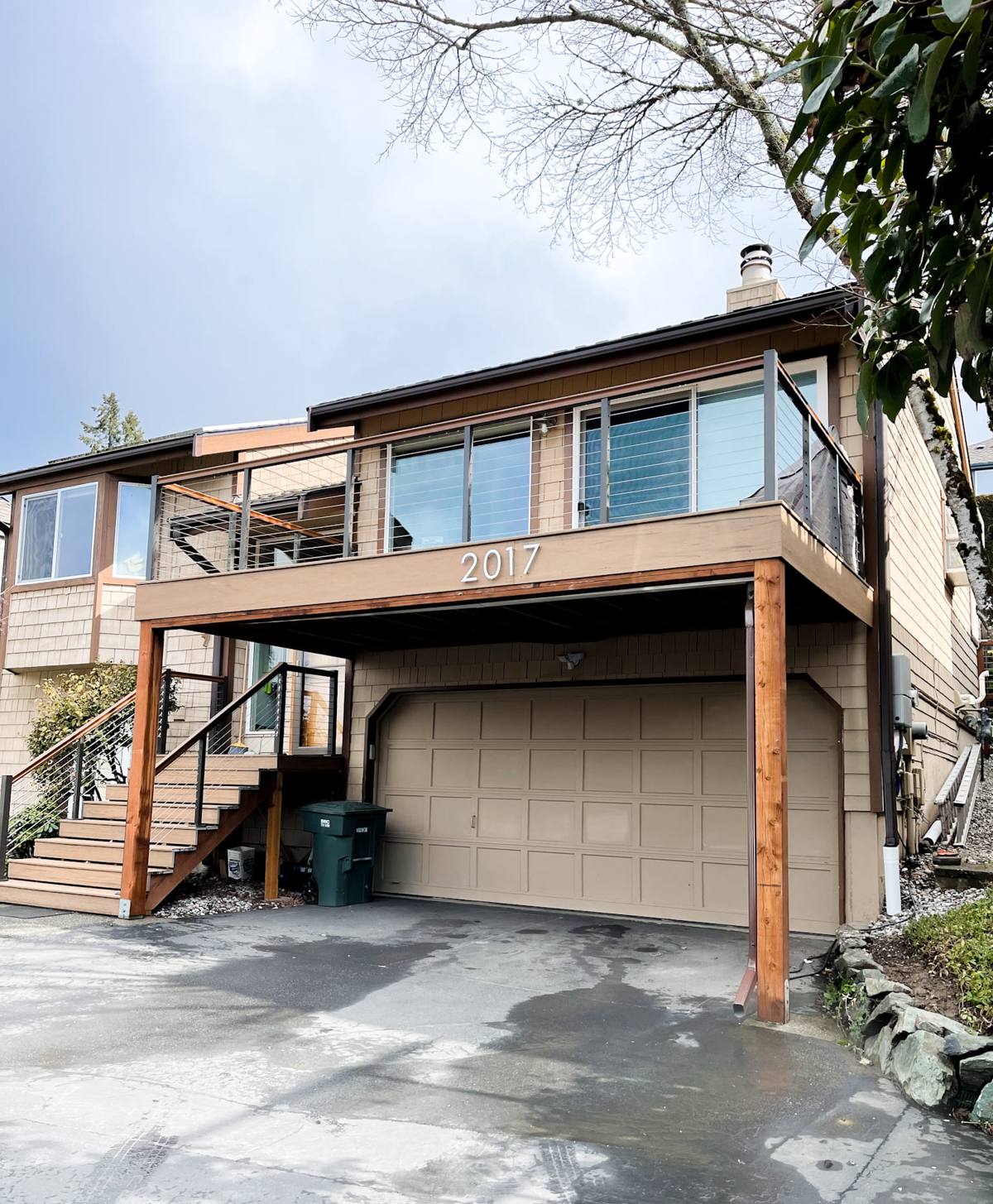
Signs a Deck Needs Replacement, Not Another Repair
Homeowners often ask us to patch a problem that's really telling us the whole structure is done. Here's how to tell the difference before you spend money on repairs that won't hold.
- Soft, spongy, or bouncy decking boards — especially near the house or in shaded corners where moss holds moisture longest
- Rust streaks below fasteners or joist hangers, a sign the hardware is corroding from constant damp exposure
- Gaps opening up between boards, or boards cupping and crowning unevenly
- A ledger board (where the deck attaches to the house) that shows staining, gaps, or gives when you push on it
- Persistent moss or algae that comes right back within weeks of cleaning, no matter how often you scrub
- Visible rot at post bases, stair stringers, or anywhere wood sits close to grade
- A deck older than 15-20 years that has never had the substructure inspected, only the surface refinished
One or two of these on their own might mean a targeted repair is enough. Several at once, or any sign of structural give underfoot, usually means the substructure has been absorbing moisture for years and a repair would just be cosmetic.
What a Correct Deck Replacement Actually Involves
Framing and Structure
A proper replacement starts below the decking, not at it. That means checking the ledger connection to the house, confirming post footings are sized and set correctly for our soil and frost conditions, and replacing any joists or beams showing rot or insect damage rather than building over them. In a climate that stays damp for months at a time, we also upgrade fastener hardware to corrosion-resistant grades — standard hardware corrodes faster here than it does on the dry side of the state, and a rusted joist hanger is a hidden failure point, not just an eyesore.
Flashing and Water Management
This is the step that separates a deck that lasts from one that doesn't. Every ledger board needs proper flashing that directs water away from the house rim joist, not into it. Deck boards need consistent, code-appropriate gapping so water sheds through rather than pooling on top or trapping debris that feeds moss growth. Any spot where the deck meets a wall, a step, or a lower roofline needs deliberate water management, not caulk as an afterthought.
Decking Material
Once the structure and water management are right, decking material becomes mostly a matter of maintenance tolerance, appearance, and budget. We'll walk through the honest tradeoffs below rather than push whatever has the best margin.
Decking Material Comparison for a Wet, Mossy Climate
| Material | Upfront Cost | Maintenance in This Climate | Moss & Moisture Behavior |
|---|---|---|---|
| Pressure-treated wood | Lowest | Annual cleaning and periodic sealing needed to keep moss and rot at bay | Absorbs moisture readily; needs gapping and ventilation underneath to dry out between rains |
| Cedar | Moderate | Regular sealing or staining to hold its look; left untreated it grays and softens faster in constant damp | Naturally rot-resistant compared to fir, but still needs airflow underneath to shed moisture |
| Capped composite | Higher | Occasional washing; no staining or sealing required | Won't rot, but moss and algae can still grow on the surface film in shaded, damp spots and need periodic cleaning |
| PVC decking | Highest | Lowest ongoing maintenance of the group; simple washing | Fully moisture-resistant surface; still requires proper substructure ventilation since the framing underneath is usually still wood |
None of these materials solve a bad substructure. Composite and PVC decking sit on top of the same wood framing as a traditional deck, so if the framing, flashing, and drainage underneath aren't done right, you've just put an expensive surface over the same moisture problem. We'll talk through which material fits your budget and how much upkeep you actually want to sign up for — there's no single right answer, just tradeoffs.
Cost Factors Homeowners Should Actually Weigh
We don't quote a number until we've seen the site, but here's what moves the price up or down so you're not guessing blind.
| Factor | Effect on Cost |
|---|---|
| Deck size and number of levels | Larger, multi-level decks need more framing, footings, and stair work |
| Decking material chosen | Composite and PVC run higher upfront than wood, lower over time in maintenance |
| Extent of substructure damage | Rotted joists, posts, or ledger connections add framing repair before new decking goes down |
| Railing system | Cable, glass, or metal rail systems cost more than standard wood or composite balusters |
| Site access | Sloped Silver Beach lots or limited equipment access can add labor time |
| Permit and inspection requirements | Structural changes, height, or footprint changes may require permitting steps that add time but protect you long-term |
As a broad range, a straightforward pressure-treated deck replacement often lands in the lower end of the cost spectrum, while a larger deck with composite or PVC decking, upgraded rail systems, and multiple levels can run well into the mid-to-upper range. We'll give you real numbers for your specific deck, not a generic quote pulled from a website calculator.
Our Deck Replacement Process
- On-site assessment — we inspect the ledger, framing, footings, and any visible rot or corrosion, not just the surface boards
- Honest scope of work — we tell you what actually needs replacing versus what's salvageable, in writing
- Material walkthrough — we go over wood, cedar, composite, and PVC options against your budget and maintenance appetite
- Permitting — we handle the paperwork for any work that requires it under local code
- Demolition and structural rebuild — old decking, damaged framing, and corroded hardware come out; new structure, flashing, and corrosion-resistant fasteners go in
- Decking installation — boards, rail systems, and stairs installed with correct gapping and drainage
- Final walkthrough — we go over the finished deck with you and explain what maintenance (if any) the material you chose needs going forward
Permits and Code Considerations in Whatcom County
Deck replacement work in Bellingham and unincorporated Whatcom County can trigger permit requirements depending on the deck's height, size, and whether structural elements like footings or the ledger connection are being changed. Guardrail height, stair geometry, and ledger attachment methods are all governed by code, and they're also the exact spots where a deck fails if they're done wrong. We handle the permit process as part of the job rather than leaving you to figure out what's required — it protects you if you ever sell the house and an inspection turns up unpermitted structural work.
Why Hire a Crew That Already Works Silver Beach
Deck failures in this area follow patterns you only learn by working here repeatedly: which ledger connections tend to trap water against a house, how fast moss reclaims a north-facing deck versus a south-facing one, and which fastener grades actually hold up after a decade of Whatcom County winters versus which ones start rusting in year three. A crew that's replaced decks throughout Bellingham neighborhoods like Silver Beach isn't guessing at these answers — they've already seen what fails and built the fix into how they frame, flash, and finish every job from the start.
That local track record also means faster, more accurate assessments. We're not learning your microclimate on your dime.
Keeping Your New Deck in Good Shape
Whatever material you choose, a few habits go a long way in this climate:
- Sweep leaves and debris off the deck regularly through fall and winter — trapped organic matter is what feeds moss and mildew
- Keep gutters and downspouts clear so roof runoff isn't dumping extra water onto or near the deck
- Wash the deck surface at least once or twice a year to knock back algae and moss before it gets established
- Reseal wood decking on the manufacturer's recommended schedule — don't wait until it visibly grays
- Check underneath the deck once a year for standing water, soft framing, or new rust spots
- Keep planters and furniture feet off direct wood-to-wood contact where moisture can collect
If your deck is showing its age or you're just ready for something built to actually handle a Silver Beach winter, we're happy to come take a look. Estimates are free, there's no pressure, and you'll get a straight answer about what your deck needs — use the form below to get started.