 Bellingham Exterior
 Why Cordata Homes Wear Out Siding Faster Than You'd Expect
Cordata sits far enough inland to avoid the worst of it, but Bellingham's marine climate still reaches every neighborhood in the city, and Cordata is no exception. Homes here deal with three things that age siding faster than most homeowners realize: salt-laden air moving in off Bellingham Bay and the Salish Sea, long stretches of driving rain that push moisture sideways into wall assemblies rather than just down, and a moss season that can run eight or nine months out of the year in shaded, north-facing exposures. None of that is dramatic on its own. It's the accumulation over a decade or two that shows up as cupped boards, soft spots at the bottom edge, and paint that won't hold no matter how many times it gets redone.
Whatcom County's building stock spans everything from older ranch homes to newer developments, and Cordata has a good mix of both. Older siding — especially untreated wood or the composite products popular in the 1990s and early 2000s — was rarely engineered with this specific combination of salt, rain, and shade in mind. When we're called out to look at failing siding in this area, the pattern is consistent enough that we can usually tell within a few minutes whether the problem is cosmetic or structural.
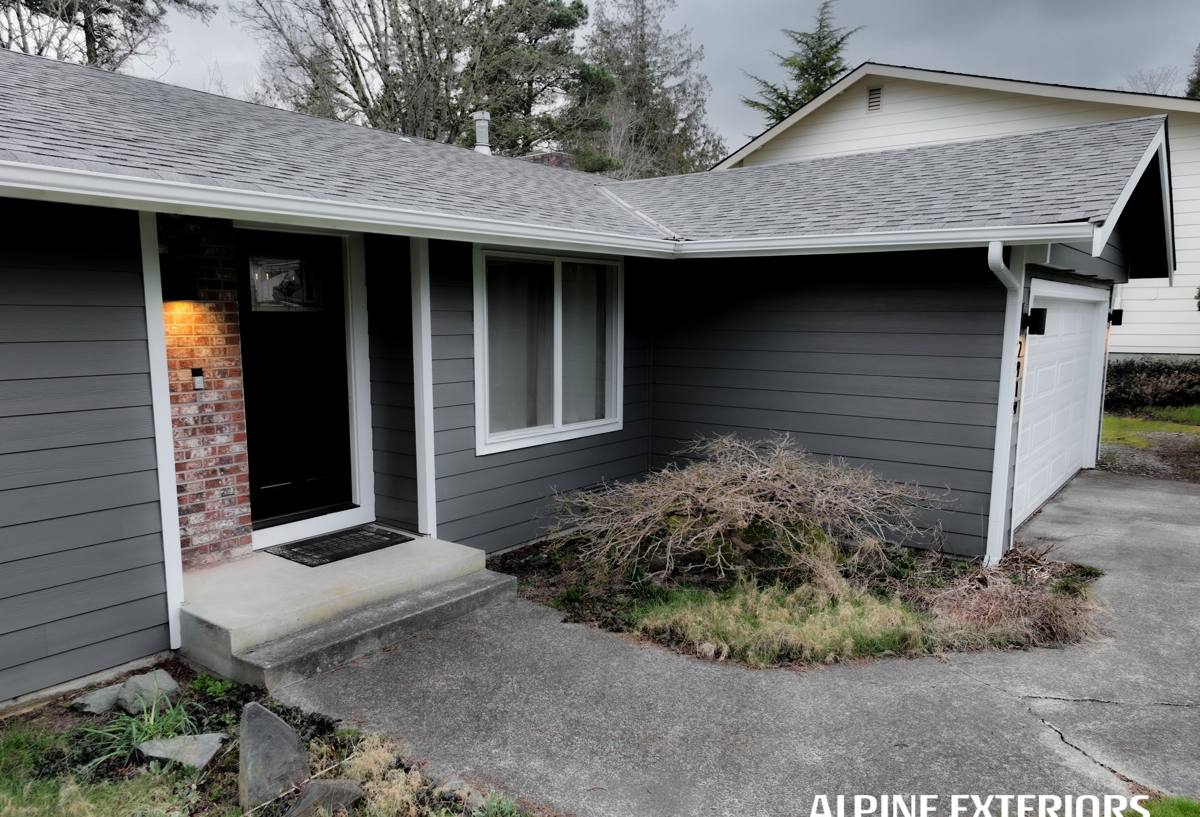
The Warning Signs Worth Acting On
Siding failure in this climate is gradual, which is exactly why it gets missed until it's expensive. A quick walk around the exterior once or twice a year, especially after a wet winter, catches most problems while they're still cheap to fix.
- Boards that look wavy, cupped, or bowed when viewed at a low angle along the wall
- Soft or spongy sections near the bottom few feet of siding, especially close to grade or a downspout
- Paint that blisters, peels, or won't hold for more than a couple of years in the same spot
- Persistent moss or dark streaking on north- and west-facing walls that returns within weeks of cleaning
- Visible gaps at seams, corners, or trim where caulking has shrunk or pulled away
- A musty smell in an adjacent room, which can mean moisture has already reached the wall cavity
Any one of these on its own isn't necessarily urgent. Two or three together, especially on the weather-facing sides of the house, usually mean the water-resistive barrier behind the siding is compromised and it's worth a proper inspection rather than another round of caulk and paint.
What a Correct Siding Replacement Actually Involves
Siding replacement is not just swapping old boards for new ones in the same pattern. In a climate that drives rain sideways and keeps moss growing most of the year, the assembly behind the siding matters as much as the siding itself.
Tear-Off and Sheathing Inspection
Once the old siding is off, we inspect the sheathing underneath for rot, delamination, or soft spots — this is the step that gets skipped by crews trying to keep a bid low, and it's the step that determines whether the new siding lasts. Any compromised sheathing gets replaced before anything new goes up.
Weather-Resistive Barrier and Flashing
A correctly lapped house wrap or building paper, installed shingle-style so every seam sheds water downward, is what actually keeps driving rain out of the wall. Window and door flashing gets integrated into that barrier in the right order — flashing first, wrap over the top — not caulked on as an afterthought. This is the single most common shortcut we see corrected on older Cordata homes.
Rainscreen Gap
Where the assembly allows for it, we install a small drainage gap between the barrier and the new siding. That gap lets any moisture that does get past the surface drain and dry out instead of sitting against the back of the board — a meaningful difference in a climate where surfaces rarely get a long dry stretch to fully air out.
Trim, Fastening, and Caulking
Fastener spacing, nail penetration depth, and caulk selection all follow the manufacturer's published specifications rather than a crew's habits. This is also where a lot of premature siding failure originates — over-driven nails and the wrong caulk type are invisible on install day and expensive five years later.
Why We Install Only James Hardie Fiber Cement
We don't install LP SmartSide, vinyl, Cemplank, Allura, or unfinished wood siding, and that's a deliberate standard rather than a limitation. James Hardie fiber cement is non-combustible, doesn't swell or rot the way wood-based products can when they take on moisture, and its ColorPlus factory finish is baked on under controlled conditions rather than field-applied — which matters in a region where paint has a short window to cure between rain events. Hardie also builds region-specific product lines, including HZ5 formulations engineered for wetter, harsher climates, which is a closer match to Whatcom County conditions than a generic siding spec designed for a drier part of the country.
We're not going to tell you every other product on the market is bad — plenty of them have real strengths. But we've made a professional call that fiber cement, installed correctly, holds up better against salt air, sustained rain, and moss pressure than the alternatives, and we'd rather stand behind one product we trust completely than offer several we have reservations about.
Our Process, Start to Finish
1. On-Site Assessment
We walk the exterior with you, note problem areas, and check for moisture intrusion at trim, window sills, and the bottom courses of siding — the places that fail first in this climate.
2. Written Scope and Estimate
You get a clear breakdown of what's being replaced, what product and color you're getting, and what's included — no vague allowances that turn into change orders mid-project.
3. Tear-Off and Sheathing Repair
Old siding comes off, sheathing gets inspected and repaired as needed, and you're told immediately if we find anything the original estimate didn't account for.
4. Barrier, Flashing, and Installation
Weather-resistive barrier, flashing, and James Hardie siding go on to manufacturer spec, with attention to the details — fastening, gapping, caulking — that determine whether the job lasts fifteen years or forty.
5. Final Walkthrough
We walk the finished exterior with you before calling the job done, and address anything that doesn't meet the standard we set for ourselves.
What Affects Cost on a Cordata Siding Job
Every home is different, but the same handful of factors drive most of the variation in siding replacement pricing in this area.
| Factor | Why It Matters |
|---|---|
| Sheathing condition | Rot found during tear-off adds material and labor that couldn't be seen from outside |
| Home size and wall complexity | More corners, dormers, and trim details mean more cutting and labor time |
| Siding profile and accessories | Lap width, trim boards, and accent details all affect material cost |
| Access and site conditions | Tight side yards, fencing, or landscaping close to the house slow the work |
| Existing paint or coatings | Lead-safe practices add time and cost on homes built before 1978 |
We don't quote a number until we've actually seen the house, but we'll walk you through which of these apply to yours during the estimate so there are no surprises later.
Why It Matters That We Already Work in Cordata
A crew that's worked this neighborhood knows which walls take the worst of the weather, how Whatcom County's permitting and inspection process runs, and what to expect from moss regrowth on shaded lots before it becomes a callback. That local familiarity shows up in small decisions — where to add extra flashing, which exposures need a closer look at ventilation — that a crew unfamiliar with Bellingham's specific rain patterns might not think to make.
After the Job: Keeping New Siding Looking Right
James Hardie siding is low-maintenance, not no-maintenance. A gentle wash once or twice a year keeps moss and algae from taking hold, especially on north-facing walls shaded by trees or neighboring structures. Keeping gutters clear and grade sloped away from the foundation protects the bottom courses, which are the first place any siding shows wear in a wet climate. Touch-up paint is rarely needed with ColorPlus finishes, but if trim boards ever need attention, matching products keep the warranty intact.
If your Cordata home is showing any of the signs above, or you're just planning ahead, we're happy to take a look and give you a straight answer — no pressure, no upsell. Fill out the form below for a free estimate and we'll walk the exterior with you in person.