 Bellingham Exterior
 Board & Batten in a Neighborhood Built Among the Trees
Sudden Valley sits in a setting that's harder on exterior siding than most of Bellingham realizes. Homes here are tucked into wooded, often steeply sloped lots near Lake Whatcom, with heavy tree canopy shading large sections of most roofs and walls for much of the year. That shade is part of what makes the neighborhood beautiful, and it's also exactly the condition that lets moss, algae, and mildew take hold on siding that doesn't shed water and dry out quickly. Board and batten is a strong fit for this setting when it's built correctly — but "correctly" matters more here than in a sunny, open subdivision.
Board and batten is a vertical siding profile: wide flat boards (or panels) installed side by side, with a narrower strip — the batten — covering each seam. It reads as clean, modern-farmhouse, or craftsman depending on trim details, and it pairs well with the mix of ranch, cabin-style, and newer builds you see around the lake. The look is only half the story, though. On a wooded, shaded, moisture-prone lot, the material behind that look does most of the work.
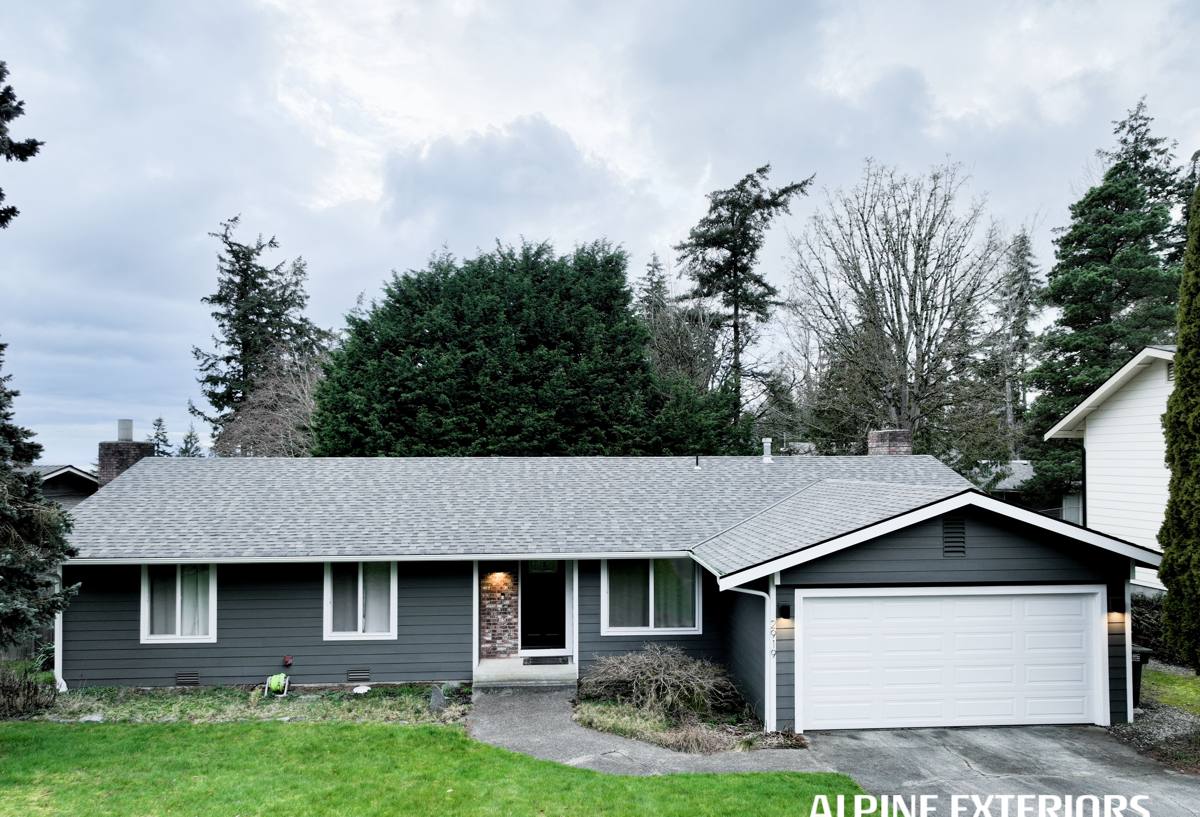
What Whatcom County's Climate Actually Does to Vertical Siding
Whatcom County sits in a marine climate shaped by proximity to the Salish Sea, and that damp, salt-tinged air moves through the whole region, not just the immediate shoreline. Combine that with the driving rain that comes through in fall and winter storms, and the long moss season that starts almost as soon as the rain does and doesn't fully let up until late spring, and you get an environment that punishes any siding material that can't handle repeated wetting and drying.
Around Sudden Valley specifically, tree cover adds a second layer to that problem. Shaded walls stay wet longer after every rain. Falling needles and leaf litter collect in horizontal seams and at the base of battens, holding moisture against the wall. Over a few seasons, that's the recipe for:
- Moss and algae staining that keeps coming back no matter how often it's cleaned off
- Swelling, delamination, or soft spots where lesser materials absorb water at the seams
- Paint failure at butt joints and batten edges, since these are the first spots to trap water
- Accelerated rot in any wood-based product where caulking or flashing details were cut short
None of this is exotic — it's just what happens to vertical siding in a wet, shaded, coastal-adjacent climate over ten, fifteen, twenty years. The question isn't whether the wall will get wet. It's whether the material and the installation are built to dry out again before that moisture does damage.
Why the Profile Alone Doesn't Protect the Wall
Board and batten has more vertical seams per square foot than lap siding, and every seam is a potential water entry point if it isn't detailed correctly. That's true no matter what material you choose. What changes based on material is how forgiving the assembly is when water does get behind it, and how well the boards themselves hold up to repeated wetting.
A correct board and batten installation accounts for this with:
- A drainage plane and rainscreen gap behind the siding so any water that gets past the surface can drain and the wall can breathe
- Properly lapped and sealed house wrap or weather-resistive barrier at every penetration
- Batten spacing and fastening that allows for the material's expansion and contraction without splitting the boards or blowing out caulk joints
- Flashing at every horizontal transition — window heads, trim boards, roof-to-wall intersections — so water is directed out, not into the seam
- Factory-primed or factory-finished boards, not field-primed cut edges left exposed to the weather
Skip any one of these steps and the siding can look fine for a year or two before the underlying wood, sheathing, or trim starts to suffer — usually well before the surface finish shows any obvious sign of trouble.
Why We Install This Profile Only in James Hardie Fiber Cement
We don't offer board and batten in vinyl, LP SmartSide, primed spruce, or cedar. That's a deliberate call, not a limitation of what we're capable of installing. Each of those materials has real strengths, but none of them holds up the way we want a Sudden Valley wall to hold up through repeated wet-shade cycles:
- Vinyl board and batten is affordable and low-maintenance in dry, open climates, but it's a poor moisture manager — it doesn't provide the same drainage assembly behind it, and it can warp or bow when it takes direct sun after long damp stretches, a pattern common on partially shaded lots.
- LP SmartSide and other engineered wood products perform reasonably well when installation is flawless, but they're wood-based, which means cut edges, seams, and fastener penetrations are all places where prolonged moisture exposure can lead to swelling over time. That sensitivity is a bigger liability under heavy tree cover than in open, sunny lots.
- Primed spruce and cedar are traditional, attractive choices, and cedar in particular has genuine appeal — but both are natural wood, which means they need more frequent refinishing to stay protected, and moss and mildew take hold on organic wood surfaces faster than on fiber cement, especially in shaded, damp settings like this one.
James Hardie fiber cement is non-combustible, dimensionally stable, and engineered specifically for wet climates through its HZ10 product line, which is built for exactly the kind of moisture cycling the Pacific Northwest produces. It carries a factory-applied ColorPlus finish that resists fading and doesn't need repainting on the same schedule wood or primed products do, and it comes with a strong, transferable manufacturer warranty. It won't stop moss from landing on the surface — nothing does — but it won't absorb that moisture, swell, or rot the way wood-based alternatives can.
Material Comparison for This Climate
| Material | Moisture absorption | Moss/mildew resistance | Upkeep in shaded lots | Typical lifespan here |
|---|---|---|---|---|
| James Hardie fiber cement | Very low | Surface only, doesn't compromise the board | Occasional wash | 30+ years to warranty limit |
| Vinyl | Low, but poor drainage assembly | Prone to surface staining | Wash plus watch for warping | 15-25 years |
| LP SmartSide / engineered wood | Moderate at seams and cuts | Moderate, depends on finish upkeep | Repaint/reseal cycle needed | 15-25 years with maintenance |
| Primed spruce / cedar | Higher, natural wood | Needs regular refinishing to resist | Frequent repainting/staining | 10-20 years without heavy upkeep |
What Our Process Looks Like for a Sudden Valley Home
Because we already work this neighborhood, we know to look for specific conditions before we ever price a job: tree overhang and how close it sits to the walls, north- and east-facing sides that stay shaded longest, drainage around the foundation on sloped lots, and how the existing siding has weathered on the shaded side compared to the sunny side of the same house. That comparison alone tells us a lot about how the new assembly needs to be built.
- On-site assessment — we walk the exterior, check for rot or moisture damage behind the existing siding, and note tree cover, drainage, and shaded exposures specific to your lot.
- Tear-off and sheathing check — we remove the old siding and inspect the sheathing underneath for hidden moisture damage before anything new goes up.
- Weather-resistive barrier and rainscreen — house wrap is lapped and sealed correctly, and a drainage gap is built in behind the boards so the wall can dry.
- Flashing details — every window, door, and horizontal trim transition gets flashed to shed water outward, not into the seams.
- Hardie board and batten installation — boards and battens go up per manufacturer fastening and spacing specifications, with factory-finished edges kept intact wherever possible.
- Final walk-through — we review the finished work with you and go over what routine upkeep will look like for your specific exposure.
Signs Existing Siding Needs Attention
If you're not sure whether your current siding is still doing its job, walk the exterior — especially the shaded, tree-covered sides — and look for:
- Moss or green staining that returns quickly after cleaning
- Soft or spongy spots when you press on the board, especially near the base
- Visible gaps, cracking, or separation at batten seams
- Peeling or bubbling paint concentrated at joints and edges rather than flat faces
- Dark staining below window sills or trim, which usually points to a flashing failure
- Warping or bowing on sections that get direct afternoon sun after long damp periods
Catching these early is a lot cheaper than waiting until the sheathing behind the siding is compromised.
Living With Board & Batten in a Wooded, Lakeside Setting
Even with the right material and installation, a shaded, tree-covered lot means your siding will collect moss and organic debris faster than a house in an open, sunny neighborhood. That's not a defect — it's the setting. The difference fiber cement makes is that periodic washing keeps the surface clean without the material underneath degrading in the meantime. Keeping gutters clear, trimming back branches that rest against the wall, and rinsing shaded sides once or twice a year goes a long way toward keeping board and batten looking sharp for decades rather than years.
Why Local Experience with This Neighborhood Matters
Sudden Valley's lots aren't uniform — grade, tree cover, and sun exposure can vary dramatically from one property to the next, sometimes on the same street. A crew that hasn't worked here before is guessing at drainage details and flashing needs that a crew with local experience already knows to check first. We've built our process around what actually happens to siding in Whatcom County's wet, shaded conditions, and we bring that same standard to every board and batten project in this neighborhood.
If you're weighing board and batten siding for a Sudden Valley home, we're happy to walk the property, look at what your current siding is telling us, and put together a straightforward, no-pressure estimate. There's no obligation — just a clear look at what your home actually needs.