 Bellingham Exterior
 Why Sudden Valley Siding Wears Differently Than Siding in Town
Sudden Valley sits among tall conifers along Lake Whatcom, and that setting is exactly what makes it a beautiful place to live — and exactly what makes siding repair here its own specialty. Heavy tree canopy means many homes get long stretches of shade, which slows drying time after every rain. Add in Whatcom County's marine climate, with driving rain off the Sound and the salt air that reaches inland across Bellingham, and you get siding that stays damp longer than siding on an open, sunny lot in town.
That combination shows up as a long moss season that can run from fall through spring, algae staining on north- and shade-facing walls, and moisture that finds its way into any gap, crack, or failed caulk joint faster than it would elsewhere. None of this means Sudden Valley homes need more repairs than average — it means the repairs need to account for a wetter, shadier microclimate, or the same problem comes back in a year or two.
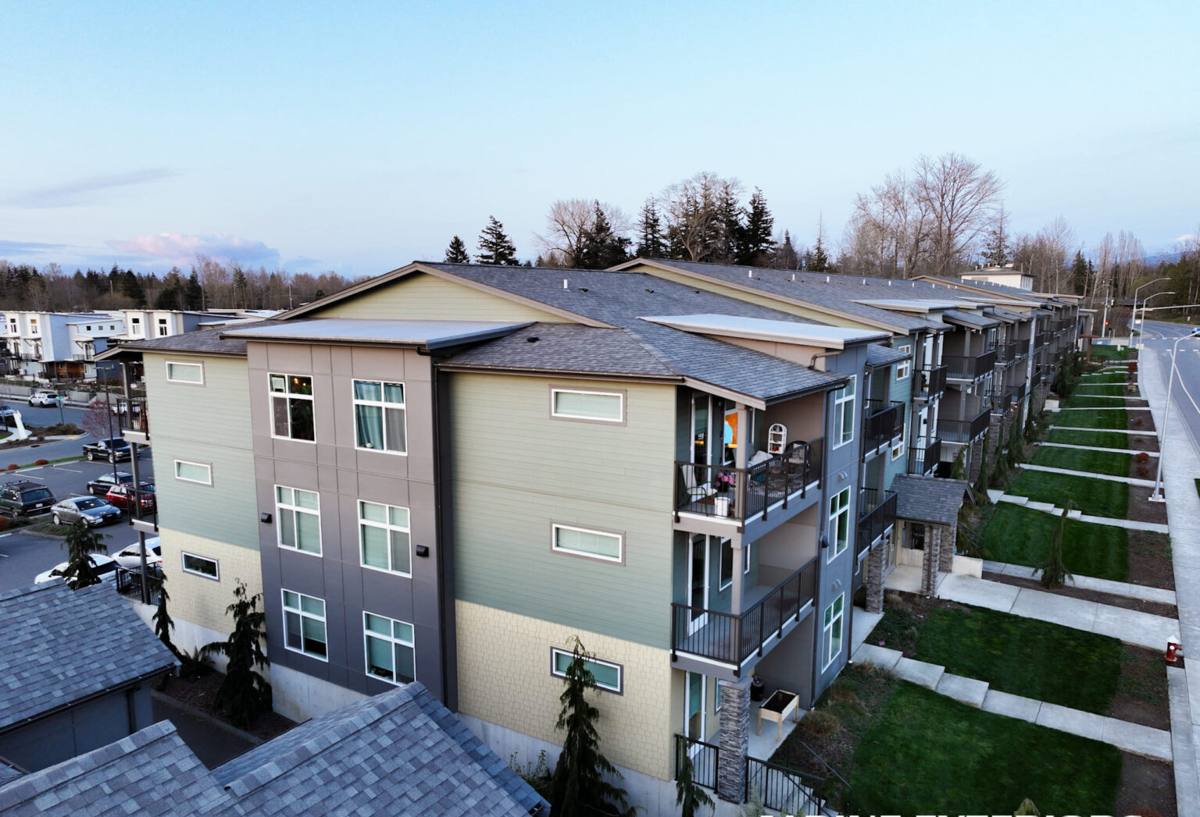
Signs Your Siding Needs Repair — Not a Full Replacement
Most siding problems we see in Sudden Valley are localized: a section near a downspout, a run of boards under a shaded eave, or trim around a window that's been catching runoff for years. Catching these early is what keeps a repair a repair instead of turning into a bigger project.
What to look for
- Green or black staining that keeps returning even after cleaning, especially on shaded walls
- Soft, spongy, or bubbled sections when you press on the siding with your hand
- Cracked, split, or warped boards, particularly at butt joints and corners
- Paint or finish that's peeling, chalking, or failing in one specific area rather than the whole house
- Caulking that's cracked, shrunk, or pulled away from trim, windows, or corner boards
- Visible gaps where siding has pulled away from the wall or is buckling outward
If you're seeing one or two of these in a contained area, that's almost always a repair situation. If the damage is spread across multiple walls or you're finding soft wood at multiple points around the house, that's worth a full assessment before you spend money patching a symptom rather than the cause.
What a Correct Siding Repair Actually Involves
A siding repair that holds up in this climate isn't just cutting out a bad board and nailing in a new one. It has to address what let moisture in to begin with, or the replacement piece fails the same way within a season or two.
Diagnosing behind the surface
Before any board comes off, we check what's happening underneath: whether the water-resistive barrier is intact, whether flashing above windows and at butt joints is doing its job, and whether the damage is a surface issue or has already reached the sheathing. In shaded, damp lots like much of Sudden Valley, we pay close attention to areas that stay wet the longest — under eaves, behind shrubs and landscaping, and anywhere sunlight rarely reaches.
Matching material and reveal
A patch that doesn't match the existing board width, reveal, or profile stands out and telegraphs that a repair happened. We match the existing siding's dimensions and, where the original product allows it, its factory finish so the repaired section blends in rather than becoming an obvious seam.
Rebuilding the moisture path, not just the board
Correct flashing, proper overlap, and sealed penetrations matter more than the board itself. A brand-new piece of siding installed over a broken drainage plane will fail again — often faster than the original did, since the underlying problem was never fixed.
Finish and color match
Where the surrounding siding is factory-finished, we match color and sheen as closely as the product allows. Field-painted patches on factory-finished siding are one of the most common repair mistakes we get called to fix a second time — the color shifts under UV exposure at a different rate than the factory finish.
Moss, Shade, and Moisture: The Sudden Valley Factor
Moss on siding isn't just a cosmetic problem. It holds moisture against the surface, which keeps that section of wall wetter for longer after every rain, and it can work into seams and lap joints where it accelerates whatever the underlying issue already was. On a heavily shaded lot, moss can regrow within a season of cleaning if the conditions that caused it — poor sun exposure, trapped humidity, clogged gutters redirecting water onto the wall — aren't addressed alongside the repair itself.
Part of doing this right in Sudden Valley means looking past the siding to the systems around it: gutters that are undersized or clogged, downspouts discharging too close to the wall, and roof lines that dump water directly onto a section of siding below. A siding repair that ignores those factors is a repair you'll be paying for again.
Repair or Replace? Cost and Condition Factors
| Factor | Leans Toward Repair | Leans Toward Replacement |
|---|---|---|
| Extent of damage | Isolated to one wall or a few boards | Recurring issues across multiple walls |
| Sheathing condition | Dry and solid behind the siding | Soft, stained, or rotted sheathing found |
| Age of existing siding | Under 10-15 years, in generally good shape | Original siding near or past its service life |
| Moisture barrier | Intact, just needs local flashing correction | Missing, degraded, or improperly installed originally |
| Cosmetic match | Product still available, close finish match possible | Discontinued product, no reasonable match |
Cost for a targeted repair typically runs far less than a full re-side, but the real driver of cost is what's found once the damaged boards come off — not the repair itself. A quick patch on dry sheathing is inexpensive; a repair that uncovers rot behind three walls is really the start of a larger conversation, and we'll always tell you honestly which situation you're in before work proceeds.
Why We Rebuild With James Hardie When a Section Needs Full Replacement
When a repair calls for replacing more than a patch — a full wall section, a corner that's failed repeatedly, or siding that's reached the end of its life — we install James Hardie fiber cement, and only James Hardie. It's the one product we've found holds up to this specific combination of shade, moisture, and moss pressure without becoming a recurring maintenance problem.
Why it fits this climate
Hardie's HZ5 product line is engineered specifically for climates like ours, with freeze-thaw cycling and high moisture exposure factored into the formulation. It's non-combustible fiber cement, so it doesn't swell, rot, or feed moss the way wood-based products can when they stay damp for long stretches under tree cover. The factory ColorPlus finish is baked on and warranted against fading, which matters on shaded lots where field-applied paint tends to mildew and fail faster than it would in full sun.
What this means for a repair
If your home is already sided in Hardie, a repair is straightforward — we match the plank width, texture, and color line so the new section is close to invisible. If your home has a different siding product and the repair has grown into a replacement of a full wall or more, we'll walk you through what a transition to Hardie in that area looks like, including how it ties into the rest of the house.
Our Process for Sudden Valley Siding Repairs
- On-site inspection of the damaged area and a check of adjacent walls, gutters, and roof drainage that may be contributing to the problem
- Removal of affected boards and inspection of the sheathing and water-resistive barrier underneath
- Repair or replacement of flashing and moisture barrier at the affected section, not just cosmetic patching
- Installation of matching material, cut and fastened to the original reveal and pattern
- Finish and color matching, using factory-finished product where the existing siding allows it
- Final walkthrough covering what caused the damage and what, if anything, should change to prevent it recurring
Maintenance Checklist for Shaded, Lakeside Lots
- Clean gutters at least twice a year — clogged gutters are one of the most common causes of localized siding damage we find on wooded lots
- Trim back branches and shrubs that keep siding in constant shade and block airflow along the wall
- Rinse moss and algae off siding before it builds up thick enough to hold moisture against the surface
- Check and refresh caulking at trim, window edges, and corner boards every couple of years
- Walk the exterior after major storms and check for anything that looks different — a small crack found early is a small repair
- Confirm downspouts discharge water away from the foundation and siding, not directly onto a wall section
If you're seeing moss, staining, soft spots, or damage on your Sudden Valley home, we're happy to take a look and give you a straight answer on what it needs — a targeted repair, a larger section replacement, or just a maintenance fix. Reach out for a free, no-pressure estimate using the form below.