 Bellingham Exterior
 Composite Decking for Birchwood's Wooded, Wet Conditions
Birchwood sits inland from Bellingham Bay but still gets the full weather picture of Whatcom County: long stretches of driving rain off the Sound, salt-tinged air that drifts in with the marine layer, and a moss season that can run from October through May. Add in the mature tree canopy common on many Birchwood lots, and you've got a recipe for decks that stay damp longer than they should. Composite decking handles that combination better than wood, but only when it's specified and installed correctly for this specific climate — not just bolted down the way a spec-home crew might do it in a drier region.
This page covers what a composite deck actually needs to hold up in Birchwood conditions, what our installation process looks like from first visit to final walkthrough, and what to check for if you're comparing bids from different contractors.
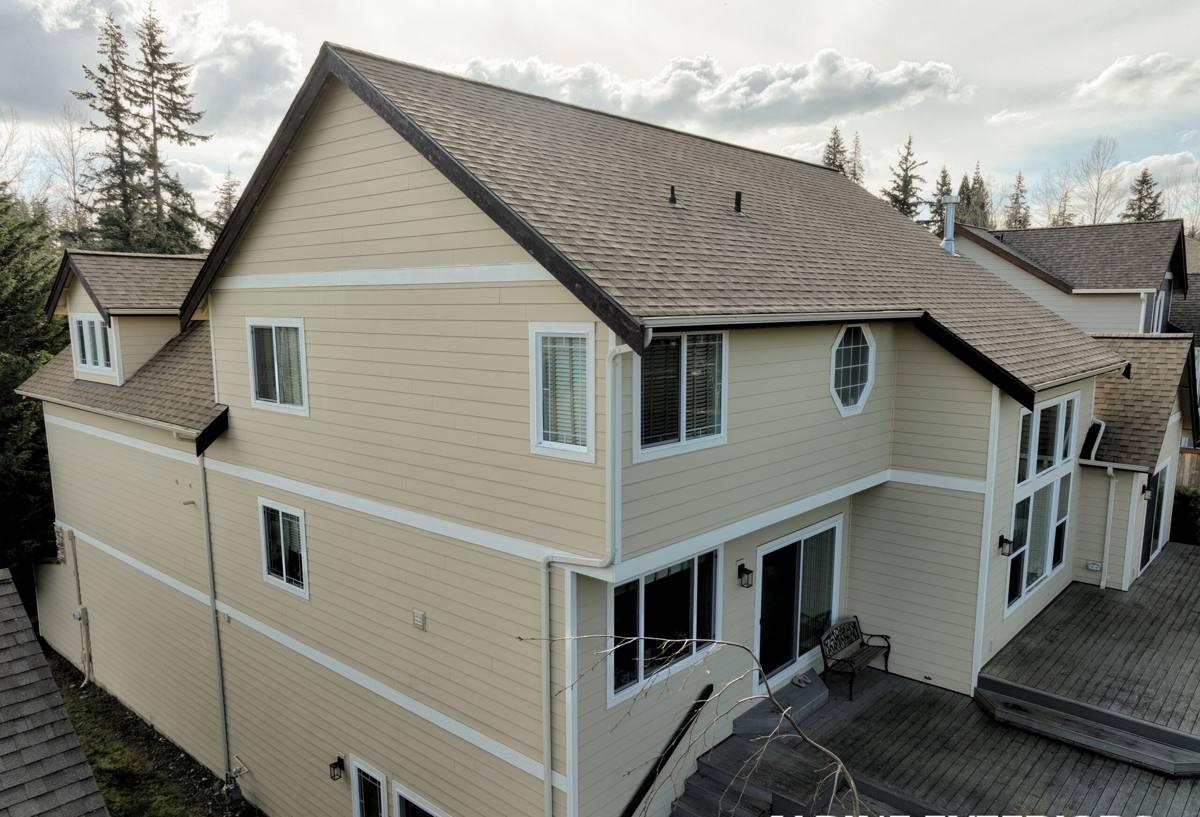
What Whatcom County Weather Does to a Deck Over Time
A deck doesn't fail all at once. It fails in the small places water and organic debris get trapped and never fully dry out.
Salt Air and Fasteners
Even a few miles inland, salt-laden moisture carried off Bellingham Bay accelerates corrosion on lower-grade fasteners and hidden hardware. Over a few seasons, corroded screws and clips can loosen boards, cause staining around fastener heads, and weaken structural connections you can't see from the surface.
Driving Rain and Standing Water
Rain here rarely falls straight down. Wind-driven rain gets pushed sideways into ledger connections, stair stringers, and the gaps between boards, then has to find its way back out. If the substructure wasn't built with drainage in mind, water sits against framing members and fascia longer than it should, even on decking material that's technically waterproof on top.
Moss, Algae, and Shade
Many Birchwood properties have mature trees close to the house, which means afternoon shade, leaf litter, and slower drying times on the deck surface. Moss and algae need moisture and organic material to take hold, and a shaded deck with poor airflow underneath gives them both. Left unmanaged, this turns a deck surface slick and, over years, can stain even a capped composite board if debris is allowed to sit.
Composite vs. Wood vs. PVC: What Actually Fits This Climate
There's no single "best" decking material for every situation, but for Birchwood's combination of moisture, shade, and salt air, the trade-offs tend to favor capped composite for most homeowners. Here's how the three common options compare on the factors that matter most locally.
| Factor | Wood (cedar/pressure-treated) | Capped Composite | PVC/Cellular |
|---|---|---|---|
| Moisture resistance | Absorbs water, prone to cupping and rot in shaded spots | Capped shell resists moisture absorption | Fully synthetic, essentially waterproof |
| Moss/algae resistance | Porous surface holds organic growth | Smooth cap sheds debris, easier to clean | Very smooth, similar cleaning ease |
| Annual maintenance | Sanding, staining, sealing | Periodic washing only | Periodic washing only |
| Upfront cost | Lowest | Mid-range | Highest |
| Heat/flex behavior | Stable in most temps | Some expansion; needs correct gapping | More expansion movement; needs precise fastening |
| Typical warranty structure | None from manufacturer | 25–50 year limited, fade/stain coverage varies | Long limited warranties, varies by brand |
Wood costs less up front but asks for real annual upkeep to survive our wet seasons, and shaded wood decks in particular are the ones we get called out to repair most often. PVC performs well but is more sensitive to installation tolerances and temperature-driven movement, which matters if the crew isn't used to working with it. For most Birchwood homes, a good capped composite board strikes the practical balance: minimal upkeep, strong moisture and moss resistance, and a wide range of colors that don't require the perfect installation tolerances PVC demands.
What a Correct Composite Deck Installation Involves
Composite boards themselves are fairly forgiving, but a deck is only as good as the structure underneath it and the details most people never see. This is where a rushed installation shows up as problems two or three years later, not on day one.
Ledger and Flashing
Where the deck attaches to the house is the single most common source of hidden water damage. Proper flashing — installed so it sheds water out and away from the house, not just tucked behind siding — is non-negotiable in a climate with as much sideways rain as ours.
Joist Protection
Even under composite decking, the framing underneath is usually still wood. Joist tape over the top of each joist keeps fastener penetrations from becoming water entry points and significantly extends the life of the substructure, which is what actually carries the load.
Board Spacing and Fasteners
Composite boards expand and contract with temperature more than most homeowners expect. Gapping needs to account for that movement, and fasteners need to be rated for the specific board system — hidden fastener clips, screws, or a manufacturer-specific system. Using the wrong fastener spacing or skipping clips to save time leads to buckling or squeaking boards down the line.
Ventilation Underneath
On lower decks or decks close to grade, airflow underneath matters as much as drainage on top. Without it, moisture gets trapped between the ground and the deck surface, which is exactly the environment moss and mildew need.
Drainage and Airflow: The Part That Prevents Problems
This deserves its own section because it's the part most often shortchanged on a budget install, and it's the part that determines whether a deck stays trouble-free for 20 years or starts showing moss and soft spots in five.
- Grading the ground beneath the deck so water moves away from the house rather than pooling under the frame
- Maintaining clearance between the decking and grade for airflow, especially on shaded lots
- Flashing every ledger and stair stringer connection, not just the most visible ones
- Keeping fascia and rim joists protected so trapped moisture doesn't sit against wood framing
- Planning gaps and drainage paths at stair landings and against the house, where debris collects fastest
None of this is visible once the deck is finished, which is exactly why it's worth asking a contractor directly how they handle it — not just what decking brand they install.
Our Process, Start to Finish
We walk every Birchwood property before writing a quote, because tree cover, slope, and sun exposure vary block to block and even yard to yard. What works on an open, sun-exposed lot isn't automatically right for a shaded one backed up to trees.
1. On-Site Assessment
We look at existing framing (if this is a replacement deck), grading and drainage around the footprint, sun/shade exposure, and how the deck ties into the house.
2. Material and Layout Discussion
We talk through board options, color, and layout in plain terms — what a given product actually costs to own over 10-15 years, not just what it costs to install.
3. Permitting and Structural Work
Structural framing, ledger attachment, and footings are built to code and inspected as required by the local jurisdiction. This is the part that determines the deck's lifespan more than the surface material does.
4. Installation
Joist protection, correct fastening systems, proper gapping, and finished trim work — done in the sequence that keeps water moving away from the structure at every step.
5. Final Walkthrough
We go over basic care for the specific board you chose and answer questions before we consider the job done.
Choosing a Composite Board for a Shaded, Wet Lot
Not every composite product is the same, and the right choice depends partly on how much shade and moisture your specific spot gets.
Capped vs. Uncapped Composite
Fully capped composite has a protective shell around all four sides of the board, which matters more on shaded, damp lots where moisture exposure is constant rather than occasional. Uncapped or partially capped boards cost less but are more vulnerable to moisture absorption at cut ends and exposed faces over time.
Color and Streaking
Lighter, streaked composite colors tend to hide pollen, tree debris, and water spotting better than solid dark tones — worth considering on a lot with heavy tree cover. Darker boards look sharp but show surface debris and mineral streaking from rain runoff more readily between cleanings.
Texture and Slip Resistance
A deck that stays damp longer under tree cover benefits from a board with more surface texture, especially on stair treads, since smooth-finish boards can get slick faster when moss spores or algae film start to form.
Maintenance Checklist for Whatcom County Conditions
Composite decking is genuinely low-maintenance compared to wood, but "low-maintenance" doesn't mean "no maintenance" in a climate like ours. A little seasonal attention goes a long way toward keeping moss and staining from ever getting a foothold.
- Sweep leaves, needles, and debris off the deck surface regularly through fall, especially under tree canopy
- Rinse or lightly wash the deck a few times a year to clear pollen, mineral film, and early moss growth before it sets in
- Keep gutters and downspouts near the deck clear so runoff isn't dumping extra water onto the surface
- Check that gaps between boards stay clear of packed debris, which traps moisture against the board core
- Inspect railings, stair connections, and ledger flashing once a year for movement or water staining
- Trim back overhanging branches where practical to improve sun exposure and airflow across the deck
Why Local Installation Experience Matters
A contractor who mostly works drier inland climates can install a technically fine deck that still struggles here, because the details that matter in Bellingham — flashing for sideways rain, drainage for shaded lots, fasteners that hold up to salt air — aren't the same details that matter everywhere. A crew that regularly works Birchwood and the surrounding Bellingham neighborhoods has already seen which lots hold moisture, which slopes need extra grading attention, and which board finishes actually hold their color under Whatcom County's tree cover and long wet season. That's not something you can fully substitute with a manufacturer's install guide alone.
If you're planning a new deck or replacing one that's showing its age, we're happy to take a look and talk through what makes sense for your specific lot. Reach out for a free, no-pressure estimate using the form below.