 Bellingham Exterior
 Siding in Birchwood Has a Specific Job to Do
Birchwood sits close enough to Bellingham Bay that salt-tinged air reaches the neighborhood on a regular basis, and it shares the same wet-season pattern as the rest of Whatcom County: rain that gets driven sideways by wind rather than falling straight down, and a long stretch of overcast, damp months where north- and west-facing walls barely get a chance to dry out. Add in a moss season that can run for the better part of the year on shaded exterior surfaces, and you've got a combination of stresses that ages siding faster than most homeowners expect. None of that makes siding a lost cause here — it just means the material and the installation both have to be chosen with those specific conditions in mind, not treated like a generic exterior going on a generic house.
This page is about what that actually looks like for a Birchwood home: what James Hardie fiber cement siding is built to handle, what a correct installation involves in this climate, and how our process works from the first estimate to the final walkthrough.
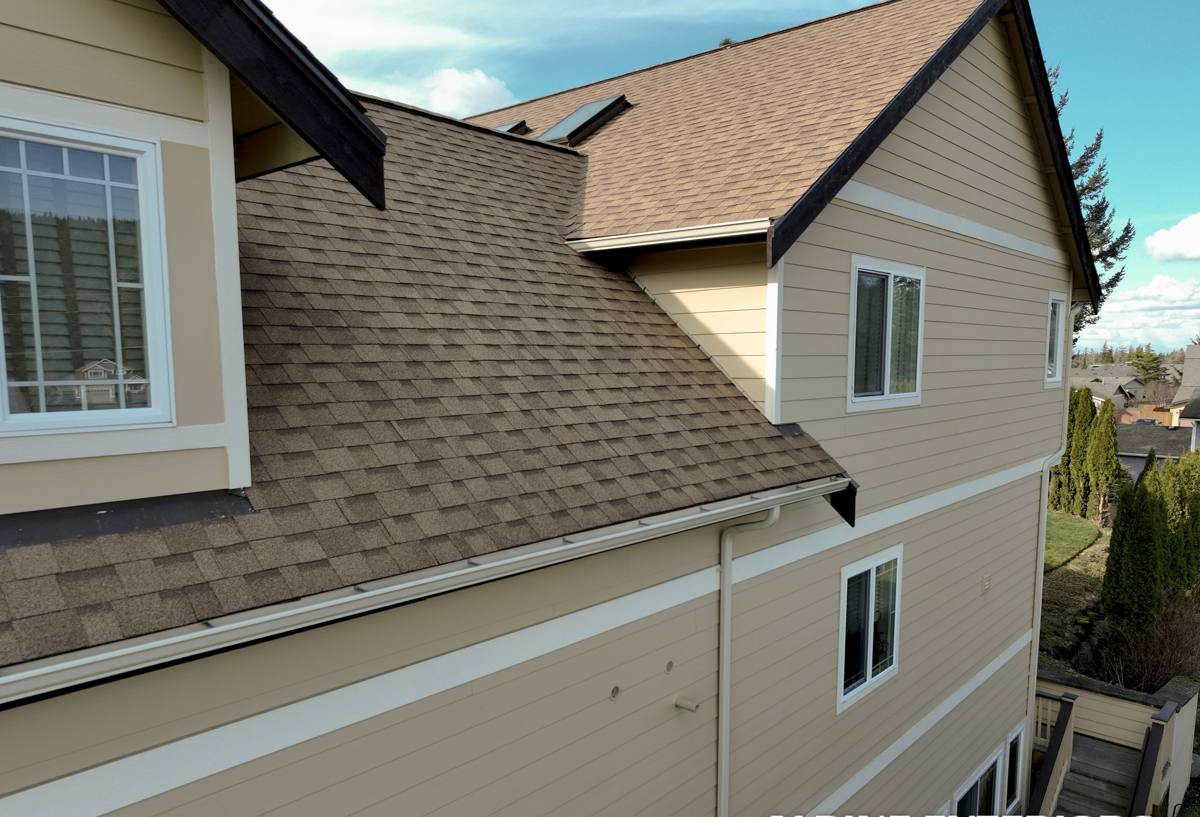
Why We Only Install James Hardie Fiber Cement
We don't install vinyl, LP SmartSide, or wood-based sidings like primed spruce or cedar — not because those products can't be installed well, but because after years of working on homes in this climate, we standardized on one system that we can stand behind without qualifications. James Hardie fiber cement is non-combustible, doesn't provide an organic food source for the moss and algae that Birchwood's damp season encourages, and holds its shape and finish in conditions that push wood-based and vinyl products toward their weak points — expansion and contraction, moisture absorption at cut edges, and UV or thermal degradation over time.
That's a narrower product lineup than a lot of siding contractors offer, on purpose. It means every crew member on every job is deeply familiar with one manufacturer's installation specifications rather than switching between several systems, and it means the warranty conversation is simple and consistent instead of different for every product we might have sold you.
What the HZ5 Line Is Actually Engineered For
James Hardie manufactures regionally engineered product formulations rather than one generic board for the whole country. The HZ5 formulation is built for climate zones like ours — places with sustained moisture exposure, freeze-thaw cycling, and coastal or near-coastal air — and it's formulated to resist moisture-related damage better than a one-size-fits-all product would. That regional engineering is one of the practical reasons we standardized on Hardie rather than a lower-cost fiber cement alternative: the product is built for the specific stresses Birchwood siding actually faces, not for an average of every climate in the country.
What a Correct Installation Involves in This Climate
Fiber cement siding's reputation for longevity depends almost entirely on installation quality. The board itself can be excellent and still fail early if it's hung wrong, and in a climate that drives rain sideways and keeps surfaces damp for long stretches, the margin for error is smaller than it is in a drier region.
Clearances and Flashing We Never Skip
- Ground clearance: A minimum gap between the bottom edge of the siding and the ground or any hard surface, so splash-back moisture and standing water don't wick into the board.
- Roof-line clearance: Proper clearance where siding meets a roof plane, with kick-out flashing installed at every point where a roof edge meets a wall, directing water away from the wall rather than letting it run down behind the siding.
- Weather-resistive barrier integration: A correctly lapped and taped house wrap behind the siding, acting as the real waterproofing layer while the siding itself sheds bulk water.
- Butt joint and panel gaps: Manufacturer-specified gaps at joints and penetrations, sealed with a flexible sealant rated for the movement fiber cement goes through with temperature and moisture changes.
Where We See Installations Go Wrong
Most of the early siding failures we get called out to look at trace back to a small number of repeated mistakes: fasteners driven too high or too low on the board, which can cause cracking or reduce wind resistance; missing or undersized flashing at roof-wall intersections, which is one of the most common sources of hidden water intrusion; caulking used as a substitute for flashing instead of alongside it; and panels installed tight to the ground or a deck surface with no clearance at all. Every one of these is avoidable, and every one of them is written into Hardie's own installation instructions — the failures come from skipping steps, not from unclear guidance.
ColorPlus Factory Finish vs. Field-Applied Paint
James Hardie's ColorPlus finish is baked on at the factory under controlled conditions, rather than sprayed or brushed on-site after installation. In a climate where a house can go weeks without a stretch of dry weather long enough to properly cure field-applied paint, that matters. ColorPlus finishes are backed by their own dedicated finish warranty separate from the substrate warranty, and they're formulated specifically to resist the fading and chipping that field paint is more prone to over time, especially on siding that stays damp longer than it would in a drier climate.
Field-painted fiber cement isn't wrong, and there are situations — custom colors, matching existing trim — where it's the right call. But for most Birchwood homes, a factory ColorPlus finish removes one more variable from a job that already has enough variables working against it in this climate, and it means you're not looking at a repaint cycle every five to seven years the way you would with a wood-based product.
Signs Your Current Siding Is Already Losing the Battle
Siding problems in this climate rarely show up as one dramatic failure. They build slowly, and by the time they're obvious from the street, moisture has usually already been getting behind the surface for a while.
- Soft or spongy spots when you press on the siding, especially near the bottom courses or around window and door trim
- Paint that's peeling, bubbling, or failing faster than it should, which often points to moisture trying to escape from behind the siding rather than a simple paint quality issue
- Persistent moss or algae staining on north- or west-facing walls that keeps coming back within a season or two of cleaning
- Visible gaps, warping, or separation at butt joints and trim, which lets wind-driven rain in directly
- Staining or discoloration streaking down from window heads or roof-wall intersections, a common sign of a flashing failure
If any of that sounds familiar, it's worth having the siding looked at before another wet season works on whatever damage has already started, rather than waiting until it's visible from the street.
What Drives the Cost of a Birchwood Siding Project
| Factor | Why It Matters |
|---|---|
| Home size and wall complexity | More square footage and more corners, gables, and trim details mean more material and more cutting and fitting time |
| Tear-off of existing siding | Removing and disposing of old siding, and repairing any sheathing damage found underneath, adds real labor before new siding can go on |
| Moisture or rot repair | Damaged sheathing or framing discovered during tear-off has to be replaced before siding installation can continue — this is the most common source of a bid changing mid-job |
| Board profile and finish | Lap siding, board-and-batten, and shingle-style panels carry different material and labor costs, and ColorPlus colors vary in price by collection |
| Trim and accessory work | Window and door trim, corner boards, and soffit detailing all add labor time separate from the field of siding itself |
| Access and site conditions | Multi-story walls, tight side yards, and limited staging space all affect how efficiently a crew can work |
A written estimate that breaks these out separately is worth far more than a single number. Ask any contractor to walk you through what's actually included before comparing two bids side by side — a lower number often means less scope, not a better deal.
Our Process, Start to Finish
- In-person assessment: We walk the exterior with you, check for existing moisture damage, and look at trim, flashing, and window details before writing anything down.
- Written estimate: A clear, itemized bid covering tear-off, sheathing repair contingency, flashing and moisture barrier work, siding profile and color, trim, and cleanup.
- Product and color selection: We help you choose the right Hardie profile and ColorPlus color for the home, factoring in HOA or neighborhood considerations where relevant.
- Tear-off and prep: Old siding comes off, sheathing is inspected and repaired where needed, and the weather-resistive barrier goes on correctly lapped and sealed.
- Installation to manufacturer spec: Fastening, clearances, flashing, and joint sealing are done to James Hardie's published installation instructions, not shortcuts.
- Final walkthrough: We review the finished exterior with you in person and do a full site cleanup before calling the job done.
Why Hiring a Crew That Already Works in Birchwood Matters
A crew that regularly works on homes in and around Birchwood has already seen how salt-tinged air affects fasteners and trim over time, which wall orientations hold moisture and moss longest through the wet months, and which older siding systems in the area tend to be hiding damage behind a surface that still looks fine from the curb. That's practical knowledge that shows up in small decisions throughout a job — decisions a crew unfamiliar with this specific stretch of Whatcom County might not think to make at all.
It also matters after the job is finished. A warranty is only as useful as the company standing behind it years down the road, and a contractor with an established, ongoing presence in the Bellingham area is one you can actually reach if a question comes up later, not a name that moved on after the sale.
What to Ask Before You Hire Any Siding Contractor
- Are they a James Hardie-recognized installer, and can they explain the difference between the product warranty and their own workmanship warranty?
- Does the estimate specify siding profile, ColorPlus color, flashing scope, and moisture barrier details — not just "new siding"?
- Do they carry current WA contractor licensing, liability insurance, and workers' compensation?
- Will they inspect sheathing during tear-off and tell you before covering up anything they find, rather than after?
- Can they point to recent, real work in or near Birchwood?
- Is ground clearance, roof-line flashing, and joint sealing spelled out in writing, not just implied?
If you'd like an honest look at your Birchwood home's siding and a written estimate you can compare against anything else you've received, we're glad to come take a look — no pressure, no obligation. Use the form below to request a free estimate.