 Bellingham Exterior
 Roofing in a Marine Climate: Why Columbia Roofs Wear the Way They Do
Bellingham sits right on Bellingham Bay, and neighborhoods like Columbia feel that proximity every day of the year — not just in the view, but in what the weather does to a roof. Salt-laden air off the water, long stretches of driving rain that run from fall through spring, and tree cover that keeps parts of a roof shaded and damp for weeks at a time all add up. None of that is dramatic on its own. It's the accumulation — years of moisture sitting where it shouldn't, fasteners slowly corroding, moss roots working into shingle edges — that turns a roof that looked fine last summer into one that's leaking by winter.
A roof replacement done right for a Whatcom County home isn't just "put new shingles on." It's choosing materials and installation details that account for how much water this climate throws at a house and how long moss and algae have to grow between dry spells. That's the standard we hold every Columbia job to.
The Three Things That Do the Damage
Almost every early roof failure we see in this area traces back to one of three things. Salt air accelerates corrosion on exposed nail heads, flashing edges, and any metal component that isn't properly coated or covered. Driving rain — rain that comes in sideways during a windstorm — finds every gap in flashing, every under-lapped shingle, and every place where underlayment was cut short. Moss and algae hold moisture directly against the roofing material for months, which softens shingle mats, lifts edges, and clogs the granule surface that's supposed to shed water in the first place. A replacement that doesn't address all three isn't really built for where it's going.
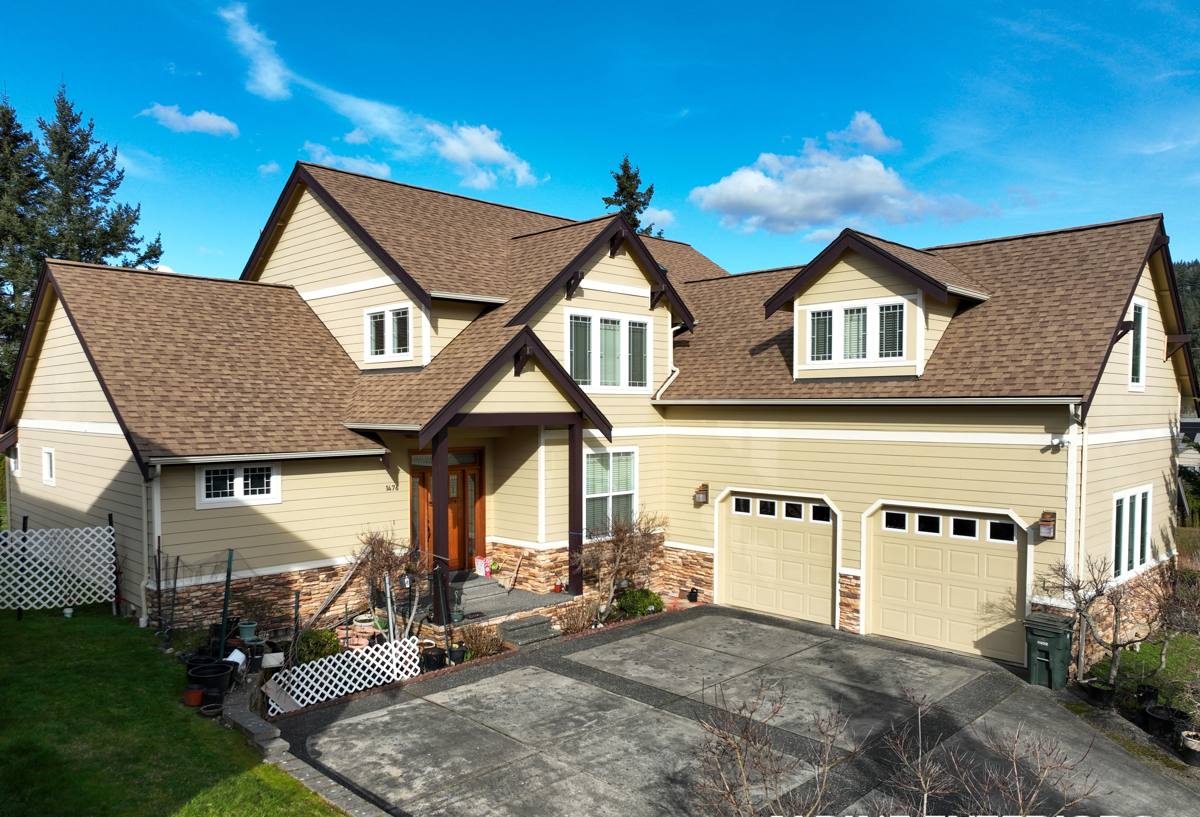
Signs a Columbia Roof Needs Replacement, Not Another Patch
Repairs make sense when a roof has years of life left and the problem is isolated. Replacement makes sense when the roof's ability to shed water has broken down system-wide. Here's what usually tips a roof from "repair" into "replace" territory in this climate:
- Granules collecting in gutters and downspouts, leaving bald, shiny patches on the shingle surface
- Shingles that are curling, cupping, or cracking rather than lying flat
- Moss mats that keep coming back within a season or two of being cleaned off
- Soft or spongy spots when walking the roof, which usually means the decking underneath is wet
- Daylight, water stains, or a musty smell in the attic, especially near valleys or penetrations
- Repeated leaks around the same chimney, skylight, or valley despite prior repairs
- A roof approaching or past 20–25 years old, which is the realistic upper end for asphalt shingles in a wet, mossy marine climate — often shorter than the manufacturer's rated lifespan because of local conditions
If you're only seeing one or two of these, a repair or a maintenance visit might still be the right call. If several show up together, that's usually the roof telling you it's past the point where patching makes financial sense.
What a Correct Roof Replacement Actually Involves
Tear-Off and Deck Inspection
Everything comes off down to the decking — we don't install a new layer over old, failing shingles. That's the only way to actually see the plywood or plank decking underneath and find soft, delaminated, or water-damaged sections before they're covered up again. Any bad decking gets replaced before anything else goes down. Skipping this step is one of the most common shortcuts in the business, and it's the one that causes the most expensive problems later.
Underlayment and Water-Shedding Details
In a climate with this much sustained rainfall, underlayment isn't a formality — it's the roof's backup plan for the moments when wind-driven water gets past the surface layer. We pay particular attention to eaves, valleys, and any area prone to ice or heavy water flow, using ice-and-water membrane where it matters most rather than relying on felt paper alone across the whole roof.
Ventilation That Matches the Climate
A roof that can't breathe traps moisture in the attic, which condenses, soaks into the decking from underneath, and feeds the same mold and rot problems that outside moisture causes. Balanced intake and exhaust ventilation is part of a correct replacement, not an upsell — it protects the new roof's underside the same way good flashing protects the top.
Flashing and Penetrations
Chimneys, skylights, vent pipes, and roof-to-wall transitions are where the vast majority of leaks originate — almost never in the open field of shingles. Every one of these gets new flashing, properly stepped and lapped so water is always shed downhill and never trapped behind a joint. Reusing old flashing to save time is a shortcut we don't take.
Choosing a Roofing Material for Columbia's Conditions
There's no single "best" roofing material — there's the material that fits your home, your budget, and how much upkeep you want to take on. Here's how the common options actually perform in a salty, wet, moss-prone climate like this one:
| Material | Moss & Moisture Behavior | Salt Air Durability | Typical Upkeep |
|---|---|---|---|
| Architectural asphalt shingle | Good when installed with proper ventilation; algae-resistant granule options help slow staining | Solid, especially with corrosion-resistant fasteners and flashing | Periodic moss removal and gutter clearing |
| Standing-seam metal | Sheds moisture fast; little surface for moss to root into | Very good with a quality factory coating; raw or poorly coated metal can corrode faster near the bay | Low; occasional inspection of seams and fasteners |
| Synthetic/composite shake | Resists moisture absorption better than natural wood; less prone to moss taking hold | Good; doesn't corrode | Low to moderate |
| Natural cedar shake | Attractive but naturally moisture-absorbent, which makes it more moss-prone in a wet, shaded climate | Fine, but requires more diligent maintenance to prevent moisture-related decay | Higher; regular treatment and inspection needed |
We'll install what fits your home, but we're honest about trade-offs. Natural cedar, for example, can look great, but in a climate that stays damp and shaded for long stretches, it asks for more ongoing maintenance than most homeowners want to commit to. That's a maintenance conversation, not a knock on the product — plenty of homeowners choose it anyway and keep up with the care it needs.
Our Roof Replacement Process for Columbia Homeowners
- On-site inspection. We walk the roof and check the attic, looking at deck condition, ventilation, flashing points, and how moss or moisture has affected different sections.
- Written estimate with real options. You get a clear scope of work and material choices at different price points — no vague allowances, no surprise change orders for things we could see up front.
- Permitting. We handle the City of Bellingham or Whatcom County permit process for the job so you're not the one navigating it.
- Tear-off and disposal. Old roofing comes off, decking gets inspected, and debris is hauled off site — including a magnetic sweep of the yard and driveway for stray nails.
- Deck repair. Any soft, rotted, or delaminated decking found during tear-off is replaced before anything new goes down.
- Underlayment, flashing, and roofing installation. Installed in that order, with the water-shedding details covered above built in, not skipped.
- Final cleanup and walkthrough. We walk the finished roof and the site with you before we consider the job done.
Keeping a New Roof Ahead of Moss and Salt Air
A correctly installed roof still needs a little attention in this climate to hit its full lifespan. None of this is complicated, but skipping it is how a 25-year roof turns into a 15-year roof.
- Clear gutters and downspouts at least twice a year so water actually leaves the roof instead of backing up under the edge
- Have moss treated (or install zinc or copper strips near the ridge) before it forms thick mats, not after
- Trim back overhanging limbs to cut down on shade and debris, which both feed moss growth
- Do a visual check after major windstorms for lifted shingles, dented flashing, or debris caught in valleys
- Rinse accumulated grime and salt film off the roof surface periodically rather than letting it build up
- Watch for granule buildup in gutters, which signals the shingle surface is starting to wear
Why a Crew That Already Works Columbia Matters
Roofing crews that work all over Western Washington aren't wrong to do so, but there's a real advantage to working the same neighborhoods repeatedly. We know how Bellingham and Whatcom County permitting works, which materials hold up near the water versus further inland, and what older homes in established neighborhoods like Columbia tend to need — different roof pitches, older decking, and sometimes ventilation that was never brought up to a modern standard. When a windstorm rolls through the bay and you need someone who can actually get to your roof and knows the area, that local presence is the difference between a fast response and a long wait.
What Affects the Cost of a Roof Replacement
We're not going to hand you a number that doesn't mean anything until we've seen your roof — every job here comes with an itemized, written estimate. But the main factors that move the price on a Columbia roof replacement are consistent:
Roof size and pitch — more square footage and steeper pitches both take more material and more labor. Layers to remove — a roof with one prior layer costs less to tear off than one with two. Decking condition — how much plywood or plank needs replacing isn't fully known until tear-off, which is why we flag it as a possible add rather than guessing. Material choice — asphalt, metal, and shake carry different material and labor costs. Access and staging — steep lots, limited driveway access, or tall roofs affect how much equipment and time the job takes. Permit fees — set by the city or county, not by us.
The honest answer is that cost varies enough between homes that a real number only comes from a real inspection. That's what the estimate is for.
Get a Straight Estimate for Your Columbia Roof
If your roof is showing wear from moss, salt air, or one too many wet Bellingham winters, we're glad to come take a look. The estimate is free, there's no pressure attached to it, and you'll get a straight answer about whether you need a full replacement or just a repair. Use the form below to get started.