 Bellingham Exterior
 Decks in Sudden Valley Face a Different Kind of Weather
Sudden Valley sits back from Bellingham Bay, wrapped around the lake and the golf course, with a lot of tree cover and a lot of shade. That combination is beautiful to live with and hard on a deck. Homes here deal with long stretches of damp, dappled shade from mature evergreens, and the kind of driving rain that comes sideways off Whatcom County storms. Add in the salt-tinged air that reaches inland from Bellingham Bay on windy days, and you have a microclimate that ages an ordinary deck faster than most homeowners expect.
A deck built without that in mind will look fine for a year or two, then start showing the signs: green film on the boards by late fall, soft spots where water pools against a ledger board, fasteners bleeding rust streaks down the face boards. None of that is inevitable. It's a function of material choice, framing detail, and drainage — all things we control at the build stage, not things you have to fight forever after.
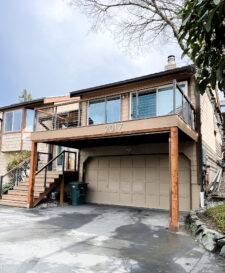
What Sudden Valley's Climate Actually Does to a Deck
Moss and Algae
Shade plus moisture equals moss, and Sudden Valley has both in abundance. On horizontal wood surfaces, moss isn't just cosmetic — it holds water against the board long after the surrounding air has dried out, which is exactly the condition that leads to soft, rotting wood underneath a healthy-looking surface. Composite decking resists this better than wood because it doesn't have open grain for spores to root into, but even composite needs airflow underneath and periodic cleaning to keep the growth from taking hold in shaded corners.
Driving Rain and Wind-Driven Moisture
Storms coming off the bay don't just rain down — they rain sideways. That matters for ledger board flashing, for the gaps around house-side connections, and for any place where a deck meets siding or a door threshold. A ledger board that isn't properly flashed and sloped away from the house is one of the most common failure points we find on older decks in this area, and it's almost always invisible until the rot has already spread into the rim joist.
Salt Air
Sudden Valley is inland enough that salt exposure is lighter than a waterfront lot, but Bellingham Bay's air still carries enough salt to accelerate corrosion on lower-grade fasteners and hardware over years of exposure. It's a slower effect than moss or rot, but it shows up eventually as rust stains and weakened connections at exactly the points — joist hangers, structural screws — where you don't want a weak connection.
Building It Right the First Time
A correct deck build in this environment starts below the decking boards, not at them. The framing, fasteners, and drainage details determine whether the deck ages gracefully or needs major repair inside ten years.
- Ledger boards flashed with a proper drip cap and sloped so water sheds away from the house, never toward it
- Stainless steel or heavy hot-dip galvanized fasteners and joist hangers rated for ground contact and coastal exposure
- Joist tape or a comparable barrier on top of every joist to stop water from wicking into the end grain
- Adequate under-deck airflow and clearance from grade so moisture doesn't sit trapped beneath the structure
- Footings sized and set to local frost depth and soil conditions, not a generic minimum
- Board spacing and fastening pattern matched to the specific decking material's expansion and contraction behavior
Skip any one of these and the deck can still look good on install day. The problems show up two, five, or eight winters later, and by then they're framing repairs, not board replacements.
Choosing a Decking Material for This Climate
There's no single right answer for every homeowner — budget, maintenance tolerance, and how the deck will be used all factor in. Here's how the common options actually perform under Sudden Valley's shade-and-moisture conditions.
| Material | Moss Resistance | Maintenance | Typical Lifespan Here |
|---|---|---|---|
| Pressure-treated wood | Low — needs regular cleaning and re-sealing | Annual cleaning, re-staining every 2-3 years | 10-15 years with upkeep |
| Cedar | Moderate — naturally rot-resistant but surface still hosts algae in shade | Periodic cleaning and oiling to maintain color and protection | 15-20 years with upkeep |
| Composite decking | High — dense cap resists spore rooting, but still needs surface cleaning | Occasional washing, no staining or sealing | 25-30+ years |
| PVC decking | Highest — fully synthetic, nothing for moisture to penetrate | Lowest — soap and water cleaning only | 25-30+ years |
We install all of these depending on what a homeowner wants, and we'll tell you honestly which one fits your budget and how much upkeep you're willing to do. Our standard is that whatever material goes down, the framing underneath gets the same moisture-management details — that's where the real protection comes from, regardless of what's on top.
Why We're Selective About Some Products
We don't install every decking product on the market. Some lower-tier composite boards use a construction method that lets moisture penetrate the core over time, which leads to swelling and delamination — a maintenance burden and warranty headache we'd rather steer a homeowner away from than deal with later. When we recommend a specific composite or PVC line, it's because we've found its moisture behavior and warranty structure hold up to what Whatcom County weather actually does, not because of a sales incentive.
Railings, Fasteners, and the Details That Get Skipped
Railings and hardware are the other place shortcuts show up fast in a wet, shaded environment. Aluminum and stainless cable or rod railing systems handle moisture without the paint failure that wood or lower-grade metal railings develop within a few seasons. Every exposed fastener — screws, brackets, post bases — should be rated for exterior and coastal exposure, not just standard exterior-grade. It's a small cost difference at build time and a large one if you're replacing rusted hardware in a stained deck surface five years in.
Repair, Replace, or Rebuild: How We Help You Decide
Not every aging deck in Sudden Valley needs to be torn out. We look at three things before recommending anything:
- The framing: if joists, beams, or the ledger connection are soft, cracked, or show rot, that's a structural issue no amount of surface repair fixes
- The fasteners and hardware: rusted or corroded connectors are a safety issue even if the wood around them looks fine
- The surface material: boards that are cupping, splintering, or hosting persistent moss but sitting on sound framing can often be replaced without rebuilding the structure underneath
If the frame is solid, a resurface can extend the life of a deck substantially for a fraction of a full rebuild's cost. If the frame has failed, resurfacing just buries the real problem under new boards — we'll tell you which situation you're in and why, not push toward whichever job is bigger.
How Our Process Works
1. On-Site Assessment
We walk the site, check existing framing where applicable, look at drainage and grade around the deck footprint, and talk through how you actually use the space — entertaining, grilling, quiet mornings with coffee — since that shapes size and layout decisions.
2. Design and Material Selection
We lay out the deck footprint, railing style, and material options against your budget, walking through the trade-offs in the table above so you're choosing with full information, not guessing.
3. Permitting
Most deck projects in unincorporated Whatcom County or within Bellingham city limits require a building permit, particularly for anything attached to the house or elevated above a certain height. We handle the permit application and inspection scheduling as part of the project.
4. Build
Framing and flashing details go in first and get inspected before decking goes down — this is the stage that determines whether the deck holds up through Sudden Valley winters, and it's the stage that's invisible once the project is finished.
5. Final Walkthrough
We walk the finished deck with you, cover basic care for whatever material you chose, and make sure railings, stairs, and fasteners are solid before we call the job done.
Living With a Deck in Sudden Valley: Ongoing Care
Even a well-built deck benefits from a little seasonal attention in this climate:
- Sweep leaves and debris off the surface regularly in fall — trapped organic matter is what feeds moss growth
- Rinse or wash the deck surface once or twice a year, more often in heavily shaded areas
- Check that gutters and downspouts near the deck are directing water away, not onto the deck surface
- Inspect railings and stair connections annually for any looseness or corrosion
- Keep vegetation trimmed back from the deck edges to maintain airflow and reduce shade where possible
None of this is difficult, but skipping it is how a well-built deck ends up looking neglected within a few seasons — the maintenance matters as much as the construction quality.
Why Local Experience in Sudden Valley Matters
A contractor who's built decks throughout Bellingham and Whatcom County knows which details matter here versus in a drier climate, without having to relearn it on your project. That means correctly sizing footings for the local soil and frost conditions, knowing which fastener grades hold up against the bay's salt air over the long run, and recognizing moss and moisture patterns in shaded lots before they become structural problems. It also means understanding the county and city permitting process well enough that it doesn't slow your project down. A deck built by a crew that already knows this area is a deck built for the weather you'll actually get, not generic weather from a manufacturer's spec sheet.
If you're considering a new deck, a replacement, or aren't sure whether your current deck needs repair or a full rebuild, we're happy to take a look. Reach out for a free, no-pressure estimate using the form below.