 Bellingham Exterior
 Why Ferndale Decks Take More Punishment Than People Expect
Ferndale sits close enough to Puget Sound and the Strait of Georgia that salt-laden air is a real factor in how outdoor structures age here, not just a coastal-town cliché. Combine that with Whatcom County's long wet season, driving rain that comes in sideways off frequent storms, and months where a deck rarely gets a full day of direct sun to dry out, and you have conditions that are genuinely harder on a deck than what you'd find on the dry side of the state. A deck built to a generic national spec, using generic fasteners and generic drainage details, will show it within a few years — soft spots at the ledger, rust bleed at the screw heads, and a green film that keeps coming back no matter how many times you scrub it off.
None of that means a deck can't hold up well in Ferndale. It means the build has to account for moisture and salt exposure from the framing up, not just at the surface. That's the difference between a deck that looks good for one summer and one that's still solid in fifteen years.
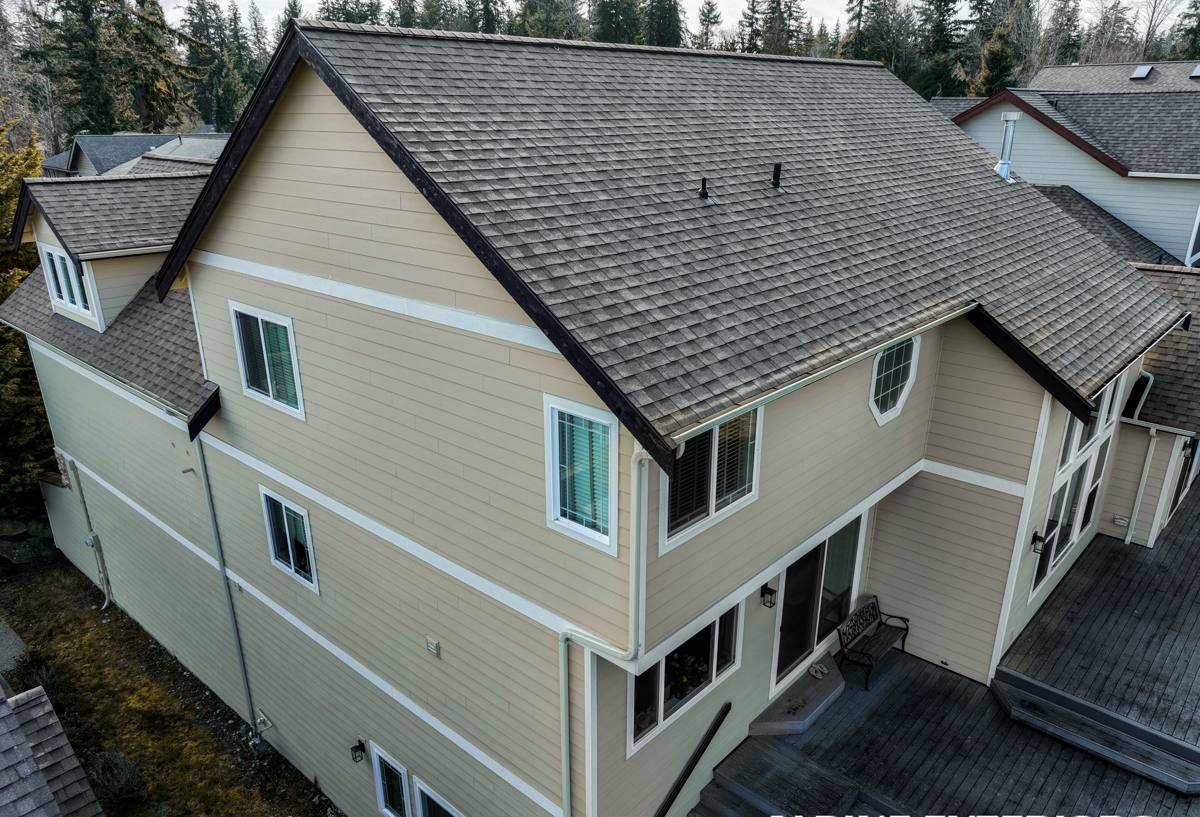
What Local Conditions Actually Demand From a Deck
Salt Air and Metal Fatigue
Salt air accelerates corrosion on any exposed metal — screws, joist hangers, post bases, railing hardware. Standard zinc-coated fasteners that would be fine in a drier inland climate can start rusting and staining the wood around them within a couple of seasons this close to the water. We spec stainless steel or heavy hot-dip galvanized hardware rated for coastal exposure on every Ferndale deck, not as an upgrade option but as the baseline.
Driving Rain and Water Intrusion
Rain that comes in at an angle finds its way into places vertical-only rain never would — behind ledger boards, under railing post bases, into end-grain cuts on decking boards. Every one of those points needs a deliberate water-management detail: flashing, sealant, or a drainage gap, not just a caulk bead and hope.
Moss and the Long Wet Season
Whatcom County's moss season isn't a few weeks — it's most of the year when conditions stay damp and shaded. Moss and algae need standing moisture and organic debris to take hold, so a deck that's designed to shed water and dry out between rains will stay far cleaner than one with flat spots, tight board spacing, or heavy shade with no airflow underneath.
Choosing Decking Material for This Climate
There's no single "best" decking material for every Ferndale home — it depends on budget, how much upkeep you want to do, and how the deck is shaded and oriented. Here's how the common options actually perform under local conditions.
| Material | Moisture Performance | Moss Resistance | Maintenance |
|---|---|---|---|
| Pressure-treated fir/pine | Good if properly sealed and maintained | Moderate — needs regular cleaning | Annual cleaning, re-seal every 1-2 years |
| Cedar | Naturally moisture- and rot-resistant | Good, especially with airflow underneath | Periodic cleaning, occasional oil or stain |
| Composite (capped) | Excellent — doesn't absorb water like wood | Good, but surface algae can still form in shade | Occasional washing, no sealing or staining |
| Composite (uncapped/older style) | Fair — more prone to surface wear over time | Moderate | More frequent cleaning than capped composite |
We're honest with clients about the trade-offs here rather than pushing one product. Cedar looks and smells great and holds up naturally, but it does need periodic attention to keep its color and resist graying. Capped composite costs more up front but essentially eliminates the sealing and staining cycle, which matters a lot to homeowners who don't want a yearly deck-maintenance weekend. Pressure-treated lumber is the most budget-friendly option, but in this climate it only performs as well as the maintenance schedule behind it — skip a couple of sealing cycles and moisture problems catch up fast.
What Happens Below the Boards Matters More Than the Boards
Framing and Fastener Choices
The visible decking gets all the attention, but the framing underneath is what determines whether a deck is safe and long-lasting. We use lumber rated for ground contact where it's near soil, and we don't cut corners on joist spacing or beam sizing to save a few boards — undersized framing is a safety issue, not just a longevity one.
The Ledger Board Connection
The ledger board — where the deck attaches to the house — is the single most common failure point on decks in wet climates, and it's also the one homeowners can't see once the project is finished. It has to be properly flashed so water sheds away from the house framing instead of getting trapped behind the deck, and it has to be fastened with structural lag bolts or through-bolts sized for the load, not just deck screws. A poorly flashed ledger is how decks end up with hidden rot behind the siding that isn't obvious until it's a real problem.
Post Bases and Footings
Posts that sit directly on or in wet soil rot from the bottom up. We set posts on elevated metal bases that keep the wood off the concrete and out of standing water, and footings are sized and placed according to Whatcom County's frost and soil requirements for the site.
Designing a Deck to Shed Water, Not Collect It
A lot of moss and rot problems trace back to design decisions made before a single board is installed. We build in a slight slope away from the house so water runs off rather than pooling. Board spacing is set to let water drain through quickly instead of sitting on the surface. Where a deck sits under trees or in a shaded corner of the yard — common in Ferndale's tree-heavy lots — we talk with homeowners about airflow underneath the structure, since stagnant, shaded, damp air under a deck is exactly what moss and mildew need to thrive.
None of this is exotic. It's just attention to the details that a generic build sometimes skips because they take a little more planning and don't show up in a quick estimate.
Our Deck Building Process
- On-site assessment. We look at drainage patterns, sun and shade exposure, soil conditions, and how the deck will connect to your home before recommending materials or layout.
- Design and material selection. We walk through the honest trade-offs of each decking option for your budget, maintenance preference, and how the space will be used.
- Permitting. We handle the permit application and inspections required for the project so you're not tracking down paperwork on your own.
- Framing and structural work. Footings, posts, beams, joists, and ledger attachment are built to code with coastal-rated hardware throughout.
- Decking, railing, and finish work. Boards, railings, and any stairs are installed with attention to drainage and fastener placement.
- Final walkthrough. We go over the finished deck with you, including what maintenance it needs and when, so there are no surprises down the road.
Permits and Local Requirements
Deck construction in and around Ferndale generally requires a building permit once a deck exceeds a certain height or size, along with inspections for footings, framing, and guardrails where applicable. Requirements can vary depending on your exact property and jurisdiction within Whatcom County, so we confirm what applies to your specific site rather than assuming. Guardrail height, baluster spacing, and stair details are code-driven safety requirements, not aesthetic choices, and we build to them as a matter of course.
Maintaining Your Deck Once It's Built
Even a well-built deck needs some seasonal attention in this climate to stay ahead of moss and moisture. A simple routine goes a long way:
- Sweep leaves and debris off the deck surface regularly, especially in fall — trapped organic matter is what moss and mildew feed on.
- Rinse or lightly scrub the surface a couple of times a year to keep algae and moss from establishing, particularly in shaded areas.
- Check railing posts and stair connections annually for looseness — wood movement from wet-dry cycles can work fasteners loose over time.
- Reseal or re-stain wood decking on the schedule appropriate to the product, before you see graying or water no longer beading on the surface.
- Keep gutters and downspouts near the deck clear so roof runoff isn't dumping extra water onto or under the structure.
- Trim back overhanging branches where practical to improve sun exposure and airflow.
Why It Matters That We Already Work in Ferndale
A crew that only occasionally works this far north of Bellingham is guessing at local conditions. A crew that regularly builds and repairs decks in Ferndale already knows how the salt air, rain patterns, and moss season here behave, and builds accordingly from the first framing decision. That local familiarity shows up in things like fastener choice, drainage detailing, and realistic maintenance advice — the parts of the job that don't show up in a photo but determine whether the deck is still solid a decade from now.
If you're planning a new deck or replacing one that's showing its age, we're happy to take a look at your property and talk through honest options for your budget and site. Reach out for a free, no-pressure estimate using the form below.