 Bellingham Exterior
 Siding Replacement in Ferndale: What Local Homes Are Up Against
Ferndale sits close enough to the water and to the Nooksack lowlands that its siding takes a different kind of beating than siding twenty miles inland. Homes here deal with salt-tinged air drifting in off the bay, long stretches of driving rain pushed sideways by wind, and a moss season that can run most of the year in shaded, north-facing spots. None of that is dramatic on any given day. It's the accumulation that gets homeowners — siding that looked fine in year eight and is visibly failing by year fourteen, not because anything catastrophic happened, but because the material was never really built for this specific mix of moisture and salt exposure.
When we replace siding in Ferndale, we're not just swapping old boards for new ones. We're addressing the specific failure patterns we see repeatedly on homes in this part of Whatcom County: moisture trapped behind panels with no way to dry out, paint film breaking down early on sun-and-salt-exposed walls, and moss and algae staining that keeps coming back no matter how often it's washed off.
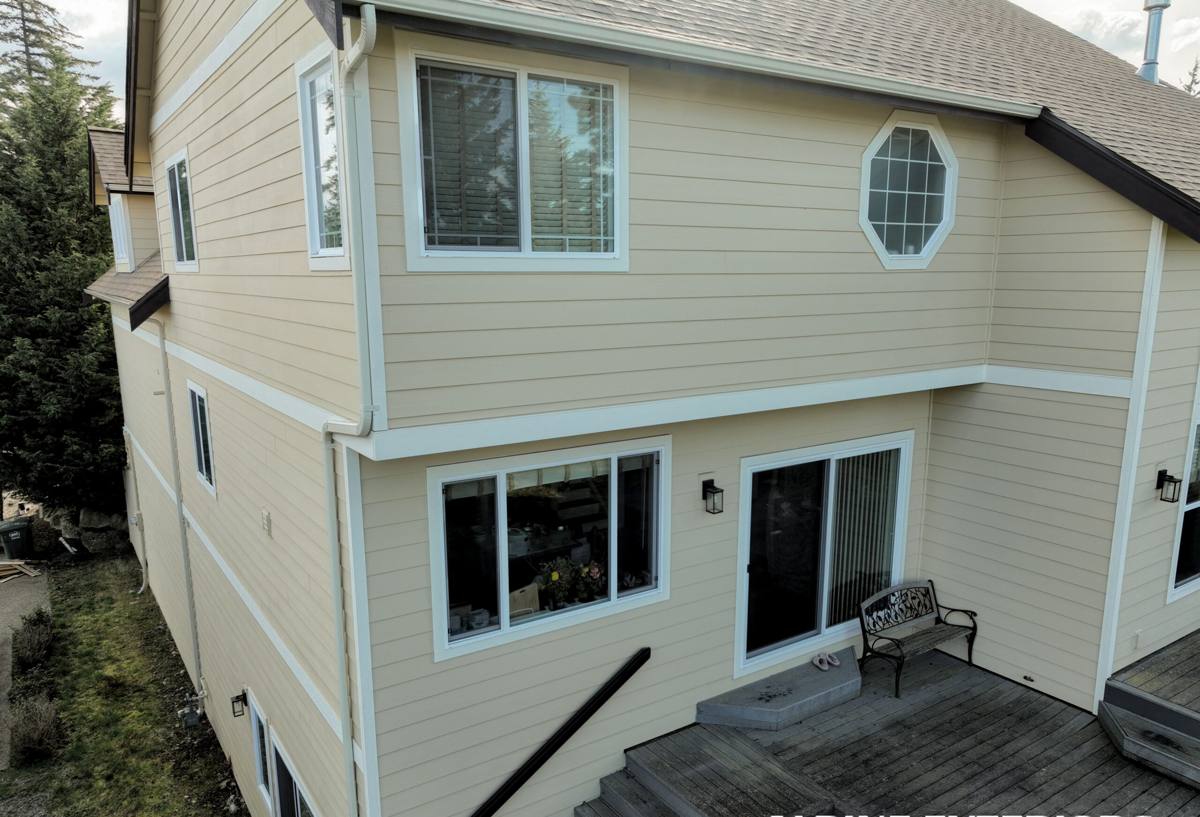
Why Siding Fails Faster Near Ferndale
Salt Air and Coastal Moisture
Ferndale isn't oceanfront, but it's close enough to tidal water that salt-laden air reaches homes on windy days, especially on west- and north-facing walls. Salt accelerates corrosion of fasteners and metal trim, and it interacts with paint and caulking in ways that speed up chalking and cracking. Siding that isn't engineered to handle that combination tends to show its age early — fading unevenly, developing hairline cracks at seams, or letting moisture behind the panel where fasteners have started to corrode.
Driving Rain
Whatcom County rain isn't just frequent, it's often wind-driven, which means it hits siding at an angle instead of running straight down. That matters because a lot of siding failures aren't from rain hitting the face of the wall — they're from wind-driven rain finding its way behind laps, around trim, and into seams that weren't detailed tightly enough during the original install. A correct installation accounts for this from the start: proper lap coverage, flashing at every horizontal transition, and sealed penetrations wherever pipes, vents, or fixtures pass through the wall.
Moss and Sustained Dampness
Shaded sides of a house, areas under overhangs, and anything near mature trees or landscaping stay damp longer here than they would in a drier climate. That sustained dampness is exactly what moss and algae need to take hold. On wood-based or fiberboard products, that moisture sits against a substrate that can absorb it, swell, and eventually rot from the inside out — often before the surface staining even looks bad enough to worry about.
Why We Only Install James Hardie Fiber Cement
We've made a deliberate decision to install James Hardie fiber cement siding exclusively — not vinyl, not LP SmartSide, not Cemplank or Allura, not primed wood or cedar. That's not a marketing position, it's a standard we hold ourselves to because of what we see on real homes in this climate.
Fiber cement is non-combustible and dimensionally stable, meaning it doesn't expand and contract with moisture the way wood-based products do, and it doesn't rely on a plastic substrate that can warp or deform in sustained heat and cold cycling the way vinyl can. James Hardie's HZ5 product line is engineered specifically for wetter, harsher climates like ours, and the factory-applied ColorPlus finish is baked on under controlled conditions rather than field-applied, which gives it more consistent resistance to fading and chalking than a job-site paint job can match. For a coastal-adjacent town like Ferndale, that combination — moisture resistance, dimensional stability, and a finish designed to hold color under UV and salt exposure — is the reason we standardized on it.
We're upfront that other products have their place and their advocates. Vinyl is inexpensive and low-maintenance in mild climates. Wood has a look some homeowners love. LP SmartSide and other engineered wood products have improved over the years. But installed on a home exposed to Ferndale's specific mix of salt, wind-driven rain, and prolonged dampness, we've found the trade-offs — moisture sensitivity, seam performance, finish longevity — aren't ones we're willing to install and stand behind. Fiber cement, installed correctly, is.
What a Correct Siding Replacement Involves
Replacing siding is not just removing old panels and nailing up new ones. On a home in this climate, the sequence matters as much as the material.
- Full tear-off and inspection. Old siding comes off completely so the sheathing underneath can be checked for rot, soft spots, or existing moisture damage — problems that are invisible until the wall is opened up.
- Sheathing repair. Any damaged sheathing gets replaced before anything else happens. Installing new siding over compromised sheathing just hides a problem that will resurface.
- Weather-resistive barrier. A properly lapped and sealed water-resistive barrier goes on next, giving the wall assembly a drainage plane so any moisture that does get past the siding has somewhere to go.
- Flashing at every transition. Windows, doors, horizontal trim breaks, and any wall penetration get flashed individually — this is where wind-driven rain finds its way in if it's skipped or rushed.
- Correct fastening and lap coverage. James Hardie specifies fastener type, spacing, and minimum lap coverage for a reason; these aren't suggestions, they're what the warranty and the performance depend on.
- Caulking and sealant at seams. Done with the right product, in the right joints — not everywhere, since fiber cement systems are designed to manage some joints as drainage points rather than sealed seams.
- Finish and trim details. Corner trim, fascia, and transitions get finished so water sheds away from the wall rather than pooling or wicking behind the siding.
How Our Process Works
Every Ferndale project starts with a walk-around inspection of the existing siding and a look at the sheathing wherever we can access it — corners, penetrations, areas around windows — to get a real sense of what's underneath before we quote the job. From there:
- We provide a written estimate that breaks out material, labor, and any sheathing repair contingencies, so there are no surprises once tear-off begins.
- We schedule around Whatcom County's weather rather than fighting it — fiber cement installation has real cure and moisture requirements, and rushing it in the wrong conditions is how corners get cut.
- We handle tear-off, disposal, sheathing repair, weather barrier, flashing, and installation as one continuous scope, so there's a single crew accountable for the whole wall assembly rather than a patchwork of different trades.
- We walk the finished job with the homeowner before calling it done, checking trim lines, caulking, and paint touch-up.
Why It Matters That We Already Work in Ferndale
A crew that's replaced siding on homes throughout Whatcom County already knows which walls in Ferndale take the worst of the wind-driven rain, which lots stay damp longest into the summer, and where salt exposure tends to show up first. That's not something you can fully account for from a general specification sheet — it comes from having actually done the work here, seen how the last installation failed, and adjusted the next one accordingly. A contractor unfamiliar with the area might install siding that's technically correct on paper but doesn't account for how a specific lot's exposure or drainage actually behaves through a Whatcom County winter.
Cost Factors for Ferndale Siding Replacement
Every home is different, but the factors that most often move the price on a Ferndale siding replacement are consistent enough to plan around:
| Factor | Why It Affects Cost |
|---|---|
| Sheathing condition | Hidden rot or water damage found during tear-off requires repair before new siding goes on |
| Home size and wall complexity | More corners, dormers, and trim details mean more labor and material for flashing and fitting |
| Siding profile and color | Lap width, texture, and ColorPlus finish options vary in material cost |
| Existing siding removal | Multiple layers or difficult-to-remove materials add tear-off time |
| Trim and accessory scope | Fascia, soffit, and corner trim replacement alongside siding adds to the total |
| Access and site conditions | Steep lots, mature landscaping, or limited equipment access can affect labor time |
We walk through each of these during the estimate so homeowners understand exactly what's driving the number, rather than getting a flat quote with no explanation behind it.
Signs a Ferndale Home Needs Siding Replacement Soon
- Visible cracking, buckling, or warping in the siding, especially on west- or north-facing walls
- Soft spots when pressing gently on the wall, which often indicates trapped moisture or rot underneath
- Recurring moss or algae staining that returns quickly after cleaning
- Paint that's chalking, peeling, or fading unevenly across different walls
- Gaps opening up at seams, corners, or trim joints
- Rising energy bills that suggest the wall assembly isn't insulating or sealing the way it should
Catching these early matters. Once moisture gets behind siding and into sheathing, the repair scope grows from a siding job into a structural one, and that's a more expensive and disruptive project than replacing siding before it fails.
If you're seeing any of these signs on a Ferndale home, or you'd simply like an honest look at how your current siding is holding up against this climate, we're happy to walk the property and give you a straightforward, no-pressure estimate — just fill out the form below.