 Bellingham Exterior
 Fairhaven's Waterfront Location Puts Extra Demands on Siding
Fairhaven sits close to Bellingham Bay, and that proximity to open water changes what a house needs from its exterior. Salt-laden air moves inland off the bay, driving rain comes through sideways during winter storms, and the Pacific Northwest's long wet season leaves shaded siding damp for days at a time. Add in the moss and algae growth that thrives in Whatcom County's mild, moisture-heavy climate, and you have a set of conditions that will find every weakness in a siding job within a few years, not a few decades.
This isn't a reason to panic about your home's exterior. It's a reason to be specific about what you install and how it goes on. Some siding materials tolerate this environment well. Others need constant upkeep to survive it. We install James Hardie fiber cement exclusively because it holds up to salt air and standing moisture better than the alternatives we used to work with, and because Fairhaven homes near the water don't get a second chance if the siding is installed wrong the first time.
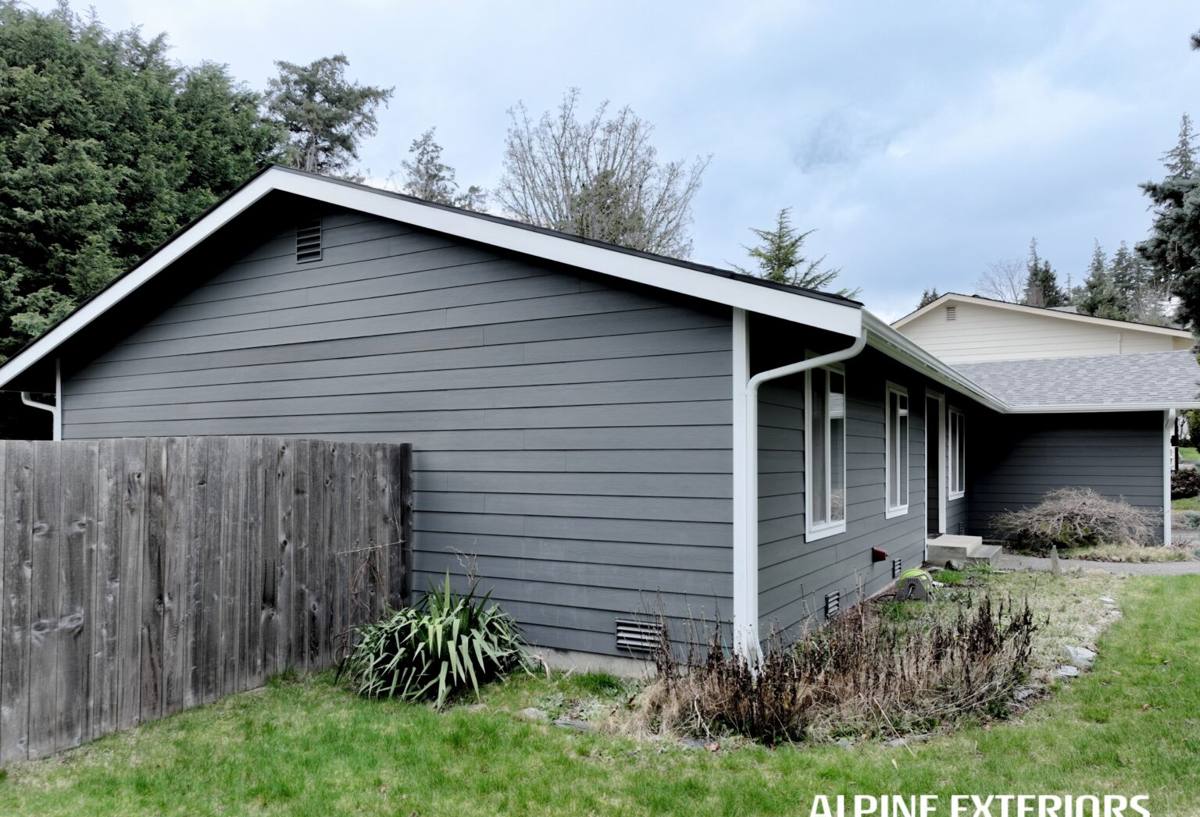
What Salt Air, Rain, and Moss Actually Do to a House
Salt Air and Metal Fasteners
Homes near Bellingham Bay see more airborne salt than homes even a few miles inland. Over time, salt accelerates corrosion on unprotected fasteners, flashing, and trim hardware. Siding that relies on staples or the wrong fastener material can show rust streaks and loosening panels years before an identical house further from the water would.
Driving Rain and Wind-Driven Moisture
Storms coming off the water don't just fall straight down — wind pushes rain sideways into wall assemblies, seams, and anywhere a gap exists. Siding that isn't lapped, flashed, and sealed correctly will let water behind the surface, where it can sit against sheathing and framing long after the storm passes.
Moss and Sustained Dampness
Bellingham's mild, wet climate keeps shaded and north-facing walls damp for extended stretches, especially under overhangs, near mature trees, and on the lower courses of a wall closest to the ground. That sustained moisture is exactly what moss and algae need to take hold. On absorbent or poorly finished siding, this shows up as green-black staining and, eventually, surface breakdown.
Why We Standardized on James Hardie Fiber Cement
We used to install a wider range of siding products. We don't anymore, and the decision came down to how each material actually performs once it's on a house in this climate rather than how it looks in a showroom.
James Hardie fiber cement is engineered specifically for regions like ours. Hardie makes an HZ5 formulation designed for climates with freeze-thaw cycles and sustained moisture exposure, which fits Whatcom County's weather pattern better than a one-size-fits-all product. It's non-combustible, it doesn't swell or delaminate from water exposure the way wood-based products can, and its factory-applied ColorPlus finish is baked on under controlled conditions rather than field-applied, which gives it more consistent, longer-lasting color and better resistance to the fading and chalking that salt air and UV exposure cause over time.
We're not going to tell you every other product on the market is worthless — vinyl, engineered wood, and other fiber cement brands all have a place. But we made a professional decision to install one product system we can stand behind fully, install to a consistent spec, and warranty with confidence, rather than juggling multiple product lines with different moisture tolerances and installation requirements. For a neighborhood sitting this close to the water, that consistency matters.
Matching the Hardie Product Line to Fairhaven's Housing Stock
Fairhaven has a mix of older homes with historic character alongside newer construction, and the right Hardie profile depends on the style of the house as much as the climate. Matching siding profile to house style isn't just cosmetic — the wrong profile can also complicate flashing details on older wall assemblies.
| Hardie Product | Best Fit For | Why It Works Here |
|---|---|---|
| HardiePlank Lap Siding | Traditional and craftsman-style homes | Classic horizontal reveal sheds driving rain efficiently when lapped and fastened to spec |
| HardieShingle | Homes with historic or cottage-style detailing | Replicates a shingled look without the moisture absorption and moss susceptibility of real wood shingles |
| HardiePanel | Accent areas, gables, and modern-style facades | Clean vertical lines for architectural accents, still backed by the same moisture-resistant core |
| HardieTrim | Corners, fascia, window and door surrounds | Won't rot or absorb water the way dimensional wood trim does in a wet climate |
All of these come through the ColorPlus finish system, which matters in a salt-air environment because it removes the weakest link in most siding jobs: field-applied paint that starts failing at seams and cut edges within a few years near the water.
What a Correct Installation Actually Involves
Fiber cement siding is only as good as the installation behind it. James Hardie publishes specific fastening, clearance, and flashing requirements, and skipping them is the single biggest reason siding fails early in a climate like this one. A correct job on a Fairhaven home includes:
- A weather-resistant barrier installed and lapped correctly behind the siding, with all penetrations properly flashed
- Rain-screen or drainage gap detailing where the wall assembly calls for it, so incidental moisture can drain and dry instead of sitting against the sheathing
- Correct fastener type, spacing, and depth per Hardie's installation specs — not just "enough nails to hold it up"
- Proper clearance between the bottom edge of the siding and the ground, decks, patios, and roof lines, so splash-back and standing water don't sit against the material
- Factory-cut and factory-primed edges used wherever possible, with any field cuts sealed per Hardie's guidelines
- Correct caulking at joints and transitions — enough to seal, not so much that it traps moisture behind the panel
Every one of these steps is invisible once the job is finished. That's exactly why it's worth asking a contractor to walk you through their process before they start, rather than judging the work by how straight the reveal lines look from the street.
Our Process for a Fairhaven Siding Job
1. On-Site Assessment
We look at the existing siding, the condition of the sheathing underneath where accessible, drainage around the foundation, roof overhangs, and any areas already showing moss, staining, or moisture damage. Homes closer to the water or under heavy tree cover get extra attention to shaded, damp-prone walls.
2. Tear-Off and Substrate Check
We remove the old siding rather than installing over it, so we can check the wall assembly underneath for rot, water damage, or missing weather barrier before anything new goes on. Covering up a hidden problem just delays a much more expensive repair.
3. Weather Barrier and Flashing
We install or repair the weather-resistant barrier and flash every window, door, and penetration before the first piece of siding goes up. This step matters more here than almost anywhere else in the installation, given how much wind-driven rain the bay throws at this neighborhood.
4. Installation to Hardie Spec
Siding, trim, and fasteners go on according to James Hardie's published installation guidelines, including proper clearances, fastening patterns, and joint treatment — the details that determine whether the product performs to its rated lifespan.
5. Final Inspection
We walk the finished job checking reveals, caulk lines, clearances, and flashing details before calling it complete, so problems get caught on our schedule, not yours.
What Influences the Cost of This Job
Every Fairhaven home is different, so we don't quote a job without seeing it. But these are the factors that most commonly move the price up or down:
| Factor | Effect on Cost |
|---|---|
| Condition of existing sheathing and framing | Hidden rot or moisture damage found during tear-off adds repair work before new siding can go on |
| Home's architectural detailing | Multiple gables, dormers, or trim-heavy facades take more labor and material than a simple rectangular wall |
| Siding profile mix | Combining lap siding with shingle accents or panel details costs more than a single uniform profile |
| Access and site conditions | Tight lots, steep grades, or limited staging area near the water can affect labor time |
| Trim and flashing scope | Full trim replacement in HardieTrim versus reusing sound existing trim changes material cost |
Why Hiring a Crew That Already Works This Neighborhood Matters
Fairhaven's mix of older homes and waterfront exposure means a contractor needs to be comfortable with both historic wall assemblies and the more aggressive weathering that comes with being close to Bellingham Bay. A crew that mostly works inland subdivisions may not think twice about fastener corrosion resistance or drainage detailing that a bay-adjacent home actually needs. A crew that regularly works Fairhaven and similar Bellingham neighborhoods builds those details into the job automatically, because they've seen what happens when they're skipped.
Local experience also means knowing how Whatcom County's permitting process works for exterior work, understanding realistic weather windows for tear-off and installation without leaving a wall exposed longer than necessary, and being available to come back if a question comes up after the job is done.
Living With Hardie Siding in a Marine Climate
Correctly installed James Hardie siding is low-maintenance, not zero-maintenance. In Fairhaven's climate, a few habits go a long way:
- Rinse siding periodically to keep salt residue and organic buildup from accumulating, especially on walls facing the water
- Trim back vegetation and tree cover that keeps a wall shaded and damp longer than the rest of the house
- Check and clear gutters regularly so overflow doesn't run down the siding face or pool at the base of a wall
- Have caulking at trim and joint lines inspected every few years and refreshed if it's cracking or pulling away
None of this is heavy lifting, but it's the difference between siding that reaches its full expected lifespan and siding that starts showing problems early because small issues went unaddressed.
If your Fairhaven home's siding is showing moss, staining, cracked caulking, or you're just planning ahead for a replacement, we're happy to take a look and walk you through what we'd recommend and why. Reach out for a free, no-pressure estimate using the form below.