 Bellingham Exterior
 New-Construction Windows for Sudden Valley Homes
Sudden Valley sits back in the trees on Lake Whatcom, southeast of Bellingham — a setting that's a big part of why people build here, and also part of why the windows on a new home need more thought than a standard order off a spec sheet. Heavy tree cover, lake-effect humidity, and the long, wet stretch of a Pacific Northwest winter mean new windows here are working against moisture and shade almost every day of the year, not just during a storm. Getting the product, the flashing, and the installation sequence right at the framing stage saves you from chasing leaks and rot repairs a few years down the road.
"New-construction" windows are a different job than replacement windows, even though the finished product can look identical from the street. On a new build, we're not working around an existing wall — we're setting windows into a raw rough opening, tying them into the house wrap and flashing system before siding goes on, and coordinating with the framing and siding schedule. Done right, that sequence is what actually keeps water out of the wall cavity for the life of the house.
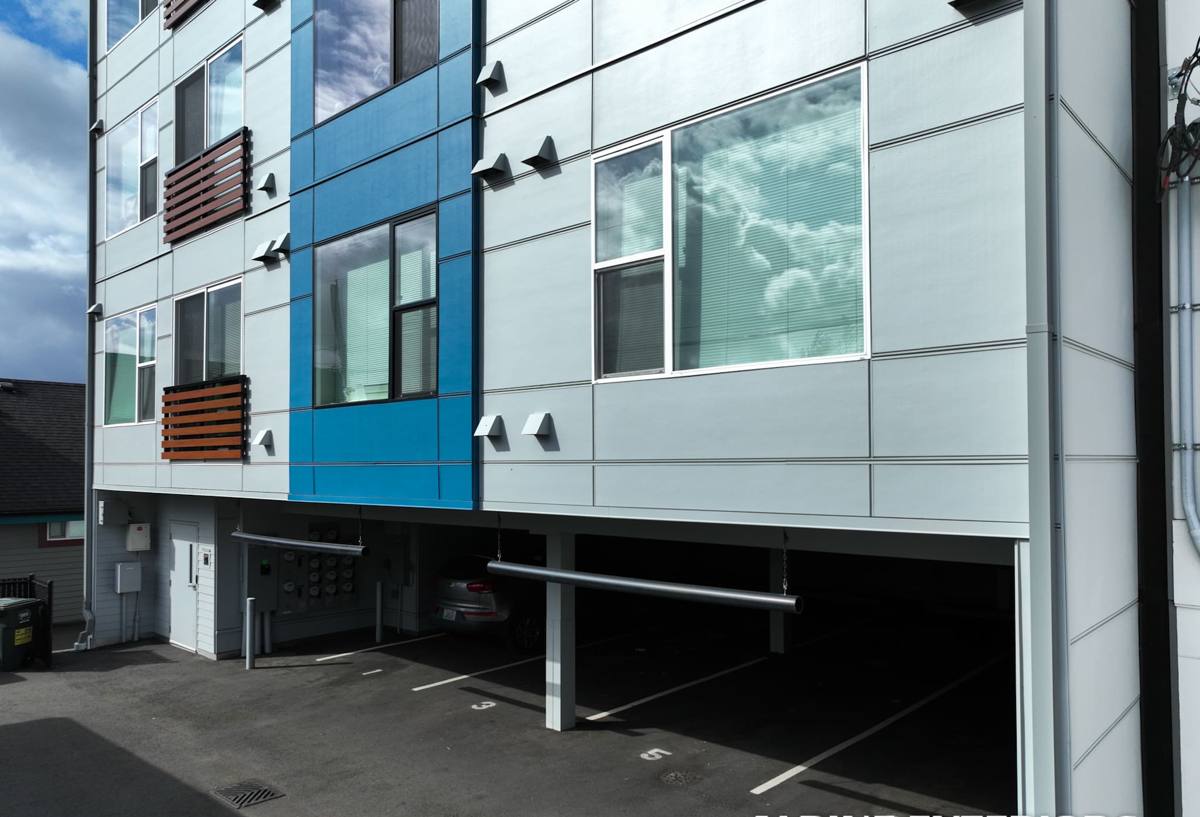
What Whatcom County's Climate Asks of a New Window System
Whatcom County sits in a marine climate — the same weather pattern that gives Bellingham its mild temperatures also brings long stretches of low-intensity rain, humid air off the water, and short winter daylight that keeps damp surfaces from drying out quickly. On a wooded, lake-adjacent site like Sudden Valley, that climate shows up in a few specific ways that matter for window selection and installation.
Shade, Humidity, and Moss
Homes tucked under fir and cedar canopy get less direct sun on their walls and window trim than an open lot in town. Less sun means surfaces stay wet longer after a rain, and that's exactly the environment moss and algae need to take hold on sills, trim, and cladding. Moss itself doesn't damage glass or vinyl, but it holds moisture against wood trim and caulk joints, and it's often the first visible sign that water is sitting somewhere it shouldn't be.
Driving Rain and Wind-Driven Wetting
Storms moving through the county frequently bring wind-driven rain rather than straight-down rain, which pushes water sideways into any gap in the flashing or seal around a window. A window that's watertight in a light shower can still leak in a wind-driven event if the flashing details underneath weren't done correctly — which is why the installation sequence matters as much as the window itself.
Marine Air and Hardware
Even away from open salt water, the marine air that moves through this part of Whatcom County carries more moisture and salt content than a dry inland climate. Over years, that air can accelerate corrosion on lower-grade window hardware — hinges, locks, and screen frames — which is one more reason to weigh long-term hardware quality, not just up-front price, when you're selecting a window package for a home you plan to keep.
What "Correct" Looks Like on a New-Construction Install
A window looks the same whether it was installed correctly or not — until the wall gets wet. The difference lives in a handful of steps that happen before a single window is ever set in the opening.
Sill Pans, Not Just Caulk
Every rough opening should get a sloped sill pan — a physical pan flashing at the bottom of the opening that channels any water that gets past the window back outside the wall, instead of letting it pool on bare framing. Caulk alone is a seal, not a drainage plane; seals fail eventually, and when they do, a sill pan is what keeps a small leak from becoming rot inside the wall.
Flashing Sequence and the Weather-Resistive Barrier
New-construction windows integrate with the house wrap in a specific shingle-style order — wrap first, then side flashing, then the window's nailing flange, then head flashing lapped over the top, so water is always directed down and out over the layer below it, never up underneath it. Get that order backwards and you've built a hidden channel for water to travel behind the siding.
Setting the Window Square and Supported
A rough opening isn't always perfectly square or level, especially on custom framing. Shimming the window plumb, level, and square — and fastening it per the manufacturer's schedule — keeps the sash operating smoothly and the seals compressed evenly. A window that's racked even slightly in the opening will bind, and gaps at the corners are where air and water find their way in first.
Choosing a Frame Material and Glass Package
New construction is the one time you get to choose a window system from scratch, without being locked into a frame size or style that's already there. That's worth taking seriously, because the choice you make now is the one you'll live with for decades.
| Frame Material | How It Handles This Climate | Trade-Offs |
|---|---|---|
| Vinyl | Good moisture resistance, low maintenance, solid value | Limited color/finish options; can flex on larger sizes |
| Fiberglass | Very stable in temperature and moisture swings, holds paint well | Higher upfront cost than vinyl |
| Wood-Clad | Warm interior look, exterior cladding sheds weather | Any cladding seam is a spot to inspect over time; higher cost |
| Aluminum | Strong, slim sightlines | Conducts cold; needs a thermal break for this climate |
On the glass side, a dual-pane, low-E coated unit with an argon or krypton gas fill is the baseline we'd recommend for any new build in this climate — it cuts heat loss through the glass and reduces interior condensation on cold, damp mornings, which is common in homes near the lake. On north- and west-facing walls that catch more wind-driven weather, we'll also talk through upgraded weatherstripping and a heavier-duty operating hardware set, since those elevations take the brunt of it.
How We Handle a New-Construction Window Job
New-construction window work runs on the builder's schedule, not ours, so coordination matters as much as the install itself.
- Plan review and window schedule: we go through the architectural plans with you or your builder to confirm sizes, swing directions, egress requirements for bedrooms, and any structural headers needed for larger openings.
- Rough opening verification: before windows arrive, we check that framed openings match the ordered sizes and are square — catching a framing error before install day is far cheaper than catching it after.
- Flashing and sill pan install: this happens in coordination with whoever is running house wrap, timed so the sequence isn't interrupted or done out of order.
- Window setting and fastening: each unit shimmed, squared, and fastened to the manufacturer's spec, with flashing tape and head flashing installed as we go.
- Final check and adjustment: every sash and lock operated and adjusted before we sign off, plus a walk-through so you know what to expect from the hardware.
Why Local Sudden Valley Experience Matters Here
Sudden Valley is a private, HOA-governed community, and new construction here typically goes through an architectural review process before a permit is pulled — window style, exterior color, and sometimes glazing specs can be part of what gets reviewed. A crew that's worked in the community before knows to check for that review up front, rather than ordering windows that need to be re-selected after the fact.
The terrain and access matter too. Wooded, hilly lots with limited staging space change how materials get delivered and how a crew stages a window install day. And because so much of the county's new construction inspection and permitting runs through Whatcom County's building department, familiarity with local inspection expectations — rough-in checks, flashing inspections before siding closes the wall — keeps a job moving instead of waiting on a callback inspection.
Checklist: What to Confirm Before Your Windows Go In
- Rough openings measured and confirmed square before windows are ordered
- Sill pan flashing specified for every opening, not just the ones that face weather directly
- Flashing sequence (wrap, side flashing, window flange, head flashing) documented for your inspector
- Frame material and glass package matched to each elevation's sun and wind exposure
- Egress sizing confirmed for any bedroom windows
- HOA architectural review submitted and approved, if your lot requires it
- Manufacturer warranty registration completed after install
Keeping New Windows Performing Under a Wooded Canopy
Once the windows are in, the biggest long-term threat in a Sudden Valley setting isn't the window itself — it's what grows around it. Trim and sills under heavy shade should get an occasional rinse and a look for moss buildup, especially heading into fall before the wet season sets in. Keeping gutters clear so water isn't sheeting down past window heads, and trimming back branches that hold moisture against a wall, both go a long way toward protecting the flashing work underneath the finish, long after the crew has left the site.
If you're planning a new build or an addition in Sudden Valley and want windows specified and installed to actually hold up to this climate, we're happy to walk the plans with you and put together a free, no-pressure estimate.