 Bellingham Exterior
 Why Decks in the Puget Area Wear Out Faster Than You'd Expect
If you own a home in the Puget area of Bellingham, you've probably noticed your deck aging faster than a similar structure might inland. That's not your imagination, and it's not bad luck. It's the local climate doing exactly what it does to every exposed wood or composite structure in Whatcom County: salt-laden air off the Sound, long stretches of driving rain, and a moss season that can run from fall clear through spring.
Each of those factors attacks a deck in a different way. Salt air accelerates corrosion in fasteners, hardware, and any metal flashing or connectors. Driving rain doesn't just fall straight down — wind-driven moisture gets pushed sideways into joints, ledger connections, and end grain that a standard rain event wouldn't reach. And moss, once established on a damp deck surface, holds water against the boards around the clock, which is exactly the condition that rot needs to take hold.
None of this means a deck in Puget is doomed. It means the materials, fasteners, and detailing have to be chosen and installed with this specific exposure in mind — not just "what's standard" for a deck built somewhere drier or more sheltered.
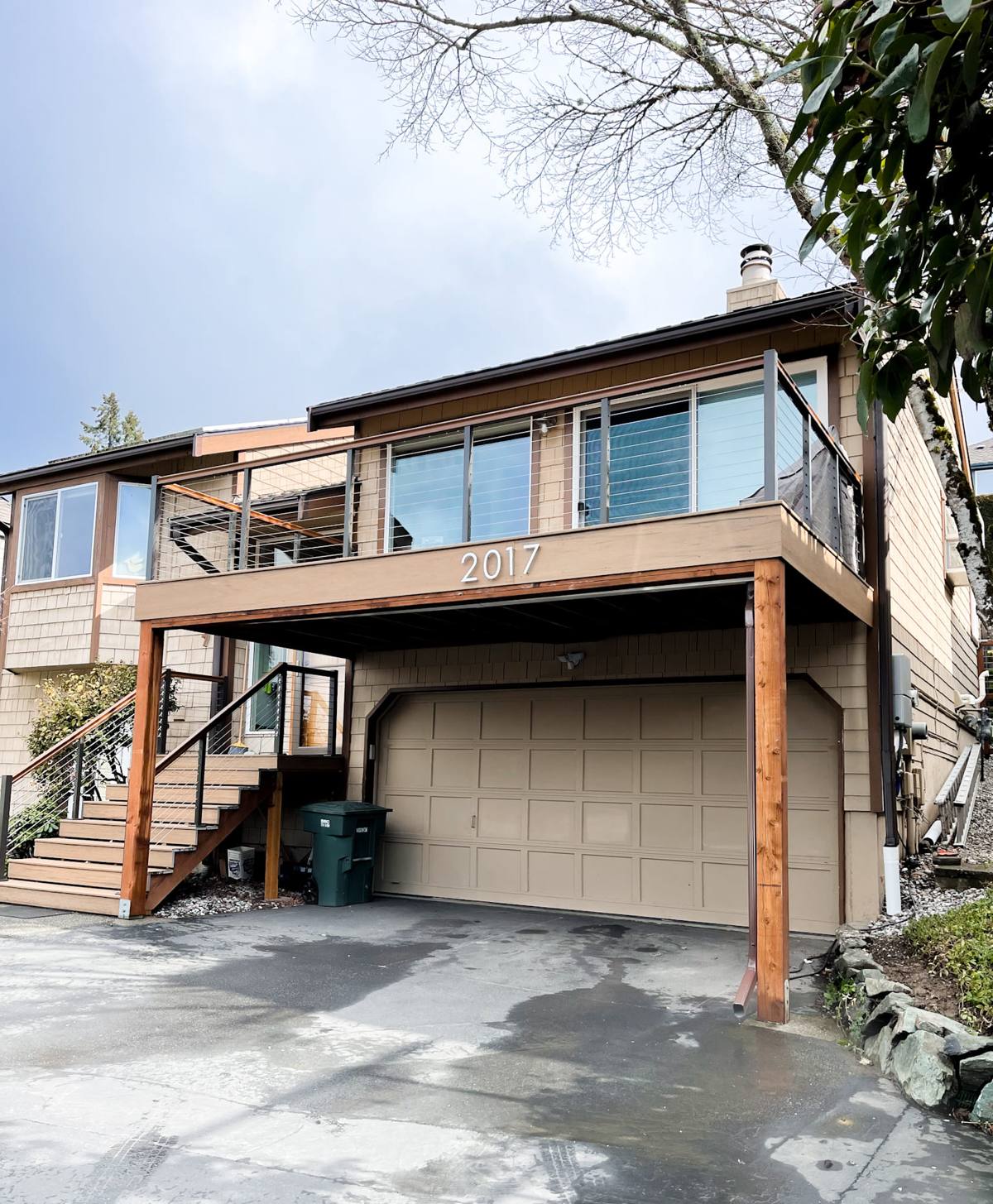
Signs Your Deck Needs Replacement, Not Just Repair
We get calls where a homeowner wants a quote to "fix a few boards," and after a walk-through the honest answer is that the structure underneath has failed and boards are the least of it. Here's how we tell the difference:
- Soft, spongy, or bouncy decking underfoot — usually means moisture has gotten into the framing, not just the surface boards
- Rust streaking or visible corrosion at fastener heads, especially near the perimeter or close to ground level
- Gaps or movement at the ledger board where the deck attaches to the house
- Persistent moss or dark staining that comes back within weeks of cleaning
- Posts or footings that show cracking, heaving, or visible rot at the base
- A deck older than 15-20 years that's never had the substructure inspected
Surface staining and a board or two with minor checking can often be repaired. Structural softness, rusted-through hardware, or a compromised ledger connection cannot — those are safety issues, and patching around them just delays a failure.
What a Correct Deck Replacement Actually Involves
A deck replacement done right isn't just pulling old boards and screwing down new ones. In a climate like ours, the parts you don't see matter more than the parts you do.
Structure First
We start below the surface: footings, posts, beams, and joists. Any framing member showing rot, insect damage, or undersized spans relative to current code gets replaced, not patched around. This is also where we correct common builder shortcuts from decades past — undersized footings, joists spaced too far apart, or a ledger attached without proper flashing.
The Ledger Connection
The ledger board — where the deck ties into the house framing — is the single most common failure point on older decks in wet climates, and it's also the point where a deck collapse is most likely to originate if it's neglected. A correct installation includes proper flashing that sheds water away from the house sheathing, not just caulk over old lag screws.
Fasteners and Hardware
Given the salt air off the Sound, we use corrosion-resistant fasteners and structural connectors rated for exterior and coastal-adjacent exposure. Standard interior-grade hardware will rust and stain the decking within a couple of seasons here — that's a real trade-off worth paying attention to when you're comparing bids.
Drainage and Airflow
Water has to have somewhere to go, and air has to be able to move underneath the deck to let framing dry out between rain events. We grade and space accordingly, and we avoid trapping moisture against the house or against the ground with poor skirting choices.
Decking Material Options for This Climate
There's no single "best" decking material for every home — it depends on your budget, how much upkeep you're willing to do, and how the deck is used. Here's an honest comparison for a wet, salt-air, moss-prone environment:
| Material | Moisture & Moss Behavior | Maintenance | Typical Lifespan Here |
|---|---|---|---|
| Pressure-treated wood | Absorbs moisture, prone to moss/algae if not cleaned; treatment resists rot but not staining | Annual cleaning, periodic sealing | 15-20 years with upkeep |
| Cedar | Naturally rot-resistant, but greys and can hold moisture without regular sealing | Sealing every 1-3 years | 15-25 years with upkeep |
| Composite decking | Sheds water well, but low-quality boards can still grow surface moss in shaded, damp spots | Periodic washing, no sealing | 25-30+ years, varies by product |
| PVC/capped polymer | Best moisture resistance of the group, minimal moss adhesion when kept clean | Occasional washing | 25-30+ years |
We're not going to tell you composite or PVC is "maintenance-free" — no exterior product in this climate truly is. What we will say is that some materials handle standing moisture and constant damp shade far better than others, and we'll walk you through which trade-off makes sense for your specific site, sun exposure, and budget rather than pushing one product line.
Our Replacement Process, Start to Finish
- On-site assessment — we inspect the existing structure, footings, ledger, and framing, not just the visible decking
- Honest scope — we tell you plainly what's repair-worthy versus what needs full replacement, and why
- Material walkthrough — we go over decking and hardware options suited to salt air and rain exposure, with real trade-offs
- Permitting — we handle the permit process where required so you don't have to
- Demolition and disposal — old materials removed and hauled off, site protected
- Structural rebuild — footings, framing, and ledger flashing done to code, built for this climate
- Decking and finishing — surface material installed with proper spacing and fastening for drainage and movement
- Final walkthrough — we review the finished deck with you before calling the job done
Permits and Code Considerations in Whatcom County
Deck replacement often triggers permitting requirements, particularly when the structure is being rebuilt rather than simply re-surfaced, or when it's attached to the home above a certain height. Requirements and review timelines vary by project scope and jurisdiction within Whatcom County, so we handle the permit application and inspection scheduling as part of the job rather than leaving you to sort it out. Skipping a required permit can create real problems later — at resale, with insurance, or if an inspector flags unpermitted work down the road.
What to Ask Before Hiring a Deck Replacement Contractor
Deck work looks simple from the outside, which is exactly why it attracts a lot of low-bid, low-accountability contractors. Before you sign anything, it's worth asking:
- Are you licensed and insured to do structural exterior work in Washington?
- Will you pull the required permit, or is that left to me?
- What's your plan for the ledger flashing and connection to the house?
- What fasteners and hardware do you use, and are they rated for coastal/exterior exposure?
- Will you inspect and replace footings and framing if they're compromised, or just resurface over them?
- Can you explain, in plain terms, why you're recommending one decking material over another for my specific yard?
- Do you regularly work in this area, or is this a one-off trip?
If a contractor can't answer the ledger and fastener questions specifically, that's worth noting — those are the details that separate a deck that lasts one decade from one that lasts three.
Why a Crew That Already Works Puget Matters
Every neighborhood in the Bellingham area has its own microclimate quirks — how much sun a lot gets, how exposed it is to wind off the Sound, how long moss stays wet before it dries out between storms. A crew that regularly works in and around Puget has already seen how decks in this specific area age, which footings tend to fail first, and which detailing holds up versus which doesn't. That's not something you get from a general contractor passing through once. It shows up in small decisions — fastener choice, flashing detail, board spacing for drainage — that add years to a deck's life without adding much to the cost.
Protecting Your New Deck After Installation
A correctly built deck still needs some seasonal attention in this climate:
- Sweep off standing leaves and debris regularly, especially going into fall
- Rinse or lightly scrub surfaces prone to shade and moss buildup once or twice a year
- Check that gaps between boards stay clear so water keeps draining properly
- Inspect the ledger connection and any visible hardware annually for early rust or movement
- Reseal wood decking on the schedule appropriate to that product — don't wait until it's already greying and absorbing water
Staying ahead of moss and drainage issues is far cheaper than dealing with rot later — a few hours of upkeep a year protects the investment you just made.
If your deck in the Puget area is showing its age, or you just want an honest opinion on whether repair or replacement makes more sense for your situation, we're glad to take a look. Use the form below to request a free, no-pressure estimate.