 Bellingham Exterior
 Siding for Puget Has to Answer to the Water
Homes in and around the Puget area near Bellingham sit close enough to the Salish Sea that salt-laden air is a daily fact of life, not an occasional nuisance. Add Whatcom County's long wet season — months of driving rain pushed sideways by wind off the water — and you get a climate that is genuinely hard on exterior building materials. Then there's moss. Bellingham's combination of moisture, shade from mature trees, and mild temperatures gives moss and algae a long growing window, and siding that can't shed water quickly becomes a host surface for it.
None of this is unique to one street or one subdivision. It's the baseline condition for exterior work anywhere near Bellingham Bay, and it's the lens we use for every siding job we bid in the area. A product or installation detail that works fine in a dry inland climate can fail here in a handful of years. That's the standard we hold every Puget-area job to.
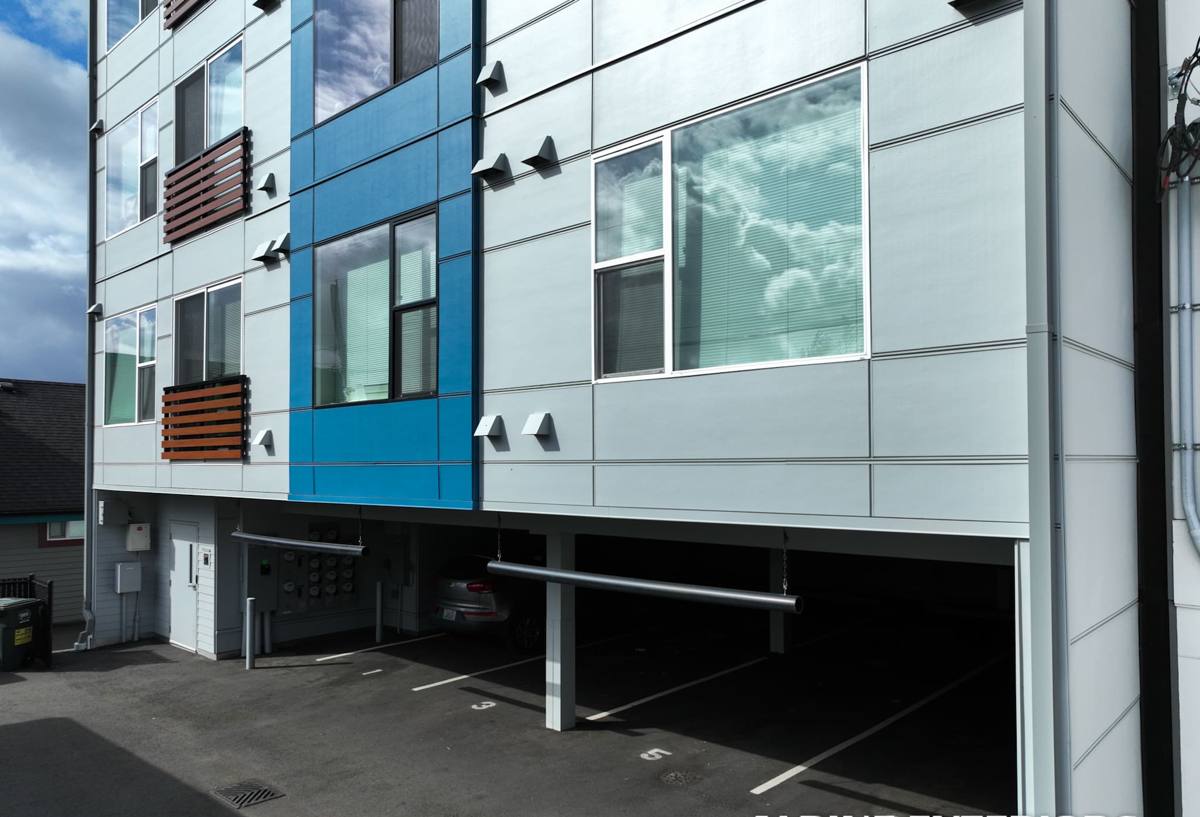
What Salt Air, Rain, and Moss Actually Do to Siding
It helps to be specific about the failure modes, because "harsh climate" is vague and homeowners deserve better than that.
Salt Air
Airborne salt is corrosive to exposed metal — fasteners, flashing edges, trim caps — and it accelerates the breakdown of coatings that aren't formulated to resist it. Paint films chalk and fade faster near the water. Any siding product with a thin or field-applied finish is working against a shortened clock from day one.
Driving Rain
Wind-driven rain doesn't just fall on a wall — it gets pushed sideways and upward into laps, joints, and butt seams. Siding systems that rely on tight-tolerance caulking or minimal overlap to stay dry are more exposed to this kind of wind-loaded moisture than they'd be in a calmer inland climate.
Moss and Algae
Moss doesn't grow because siding is old — it grows because a surface stays damp long enough, in enough shade, for spores to establish. Any siding with a porous or organic surface, or with drainage details that trap moisture at the bottom edge, gives moss a foothold faster than a smooth, factory-finished surface with a proper drainage gap behind it.
Why We Install Only James Hardie Fiber Cement in Puget
We standardized on James Hardie fiber cement siding for every job we do, and in a climate like this one the reasoning is straightforward. Fiber cement is dimensionally stable — it doesn't swell, cup, or rot the way wood-based products can when they take on repeated moisture. It's non-combustible, which matters given how dry Whatcom County summers can get between the wet seasons. And James Hardie's ColorPlus finish is baked on at the factory under controlled conditions, not brushed or sprayed on site, which gives it materially better resistance to fading and chalking in salt-exposed air than a field-applied paint job.
James Hardie also engineers its products by climate zone. The HZ5 product line used in the Pacific Northwest is formulated for a wet, moderate-temperature environment — different from the HZ10 line built for hot, humid, high-UV regions. That distinction matters more here than in most parts of the country, because the failure modes we're guarding against (moisture cycling, biological growth, coastal air) are specific to this region, not generic "weather."
We don't install vinyl, LP SmartSide, Cemplank, Allura, or primed wood siding, and we're upfront about why: each of those products asks a homeowner to accept a trade-off — thinner coatings, moisture-sensitive cores, seam-reliant water management, or shorter real-world service life near salt air — that we don't think holds up well against a Bellingham winter. Fiber cement done right avoids most of those trade-offs, which is why it's the only thing we put on a house.
What a Correct Fiber Cement Installation Actually Involves
Fiber cement siding is only as good as the installation behind it. A rushed or generic install can undercut even the best material, and in a climate this wet, installation mistakes show up faster than they would somewhere drier.
Moisture Management Comes First
Before a single piece of siding goes up, the wall needs a correctly lapped weather-resistant barrier, properly integrated window and door flashing, and a drainage plane that lets any water that gets behind the siding find its way back out. This is the part of the job that's invisible once it's finished — and the part that determines whether the siding lasts 10 years or 40.
Clearances and Fastening
James Hardie specifies minimum clearances from grade, roofing, decks, and other flashing details, along with fastener type, spacing, and placement. Skipping these specs to save time is one of the most common ways fiber cement installs fail early — usually as moisture intrusion at the bottom courses or around penetrations, exactly where driving rain concentrates.
Joints and Butt Seams
Every horizontal joint is a potential water entry point. Correct installation staggers joints, backs them properly, and seals them to manufacturer spec rather than relying on caulk alone to do the work over the long run.
- Weather-resistant barrier installed and lapped shingle-style, no gaps or reverse laps
- Flashing integrated at every window, door, and roof-to-wall transition
- Manufacturer-specified clearances maintained at grade, decks, and roofing
- Fasteners driven to correct depth and spacing, not overdriven or underdriven
- Joints staggered, backed, and sealed per James Hardie installation instructions
- Field-cut edges primed or sealed before installation, not left exposed
Our Process, Start to Finish
We keep the process straightforward because homeowners deserve to know what's happening to their house and when.
- Walkthrough and assessment. We look at the existing siding, the condition of the sheathing and trim underneath where accessible, and any problem areas — north-facing walls, low-sun corners, spots showing moss or staining.
- Written estimate. You get a clear scope of work and a price, with the product line, profile, and color specified — no vague allowances.
- Prep and tear-off. Old siding comes off, the wall is inspected for hidden moisture damage, and any compromised sheathing or framing is addressed before anything new goes on.
- Weather barrier and flashing. This is the step that determines long-term performance, and it's not skipped or rushed to hit a schedule.
- Siding installation. Installed to James Hardie spec for clearance, fastening, and joint treatment.
- Final walkthrough. We go over the finished work with you before calling the job done.
Cost Factors Homeowners Should Understand
Fiber cement siding costs vary by project, and anyone quoting a single flat number without seeing the house isn't giving you a real estimate. The factors below are what actually move the price.
| Factor | Why It Matters |
|---|---|
| Wall complexity | Multiple gables, dormers, and cutouts take more labor and material than a simple rectangular elevation |
| Tear-off condition | Hidden moisture or rot found under old siding adds repair work before new siding can go on |
| Siding profile | Lap, shingle, and panel profiles differ in material and labor cost |
| Trim and accessories | Corner boards, frieze boards, and window trim add cost but also protect the assembly |
| Access and site conditions | Multi-story walls, tight lot lines, or difficult staging affect labor time |
| Color and finish | Factory ColorPlus finishes cost more upfront than field-painted options but avoid a repaint cycle |
We walk through these factors on-site rather than guessing over the phone, because two houses of the same square footage can have very different scopes of work once you look at wall complexity and existing condition.
Why a Crew That Already Works This Area Matters
Siding installation isn't identical everywhere, and a crew that's used to a drier climate can bring assumptions that don't hold up near Bellingham Bay. Detail work around clearances, flashing laps, and joint sealing that would be adequate in a low-moisture region isn't adequate here. A crew that regularly works Puget and the surrounding Bellingham area already knows which walls take the worst of the wind-driven rain, which orientations stay damp longest and need extra attention to drainage, and how much margin to build in against a moss season that can run for months. That familiarity shows up in fewer callbacks and siding that actually performs the way it's supposed to.
Living With Fiber Cement Siding in a Wet, Salty Climate
Correctly installed James Hardie fiber cement is low-maintenance, but "low-maintenance" isn't "no-maintenance" — especially with moss pressure this consistent.
- Rinse siding periodically with a garden hose to clear salt residue and organic buildup — skip the pressure washer, which can force water behind laps and joints
- Keep gutters clean and downspouts directed away from the wall to avoid concentrated water running down siding
- Trim back vegetation and tree limbs that shade siding and keep it damp longer than open sun-exposed walls
- Watch north-facing and shaded elevations for early moss growth and address it before it spreads
- Recaulk around windows, doors, and trim joints as part of routine exterior upkeep — caulk has a shorter service life than the siding itself
- Have flashing and clearances checked periodically, especially after major storms with sustained wind-driven rain
Get a Straight Answer for Your Home
If you're weighing a siding replacement in Puget or elsewhere around Bellingham, we're glad to take a look and give you a straightforward, no-pressure estimate — what your home actually needs, what it would involve, and what it would cost. No obligation, no pressure tactics, just a clear picture based on your specific house.