 Bellingham Exterior
 Why Puget-Area Roofs Take a Different Kind of Beating
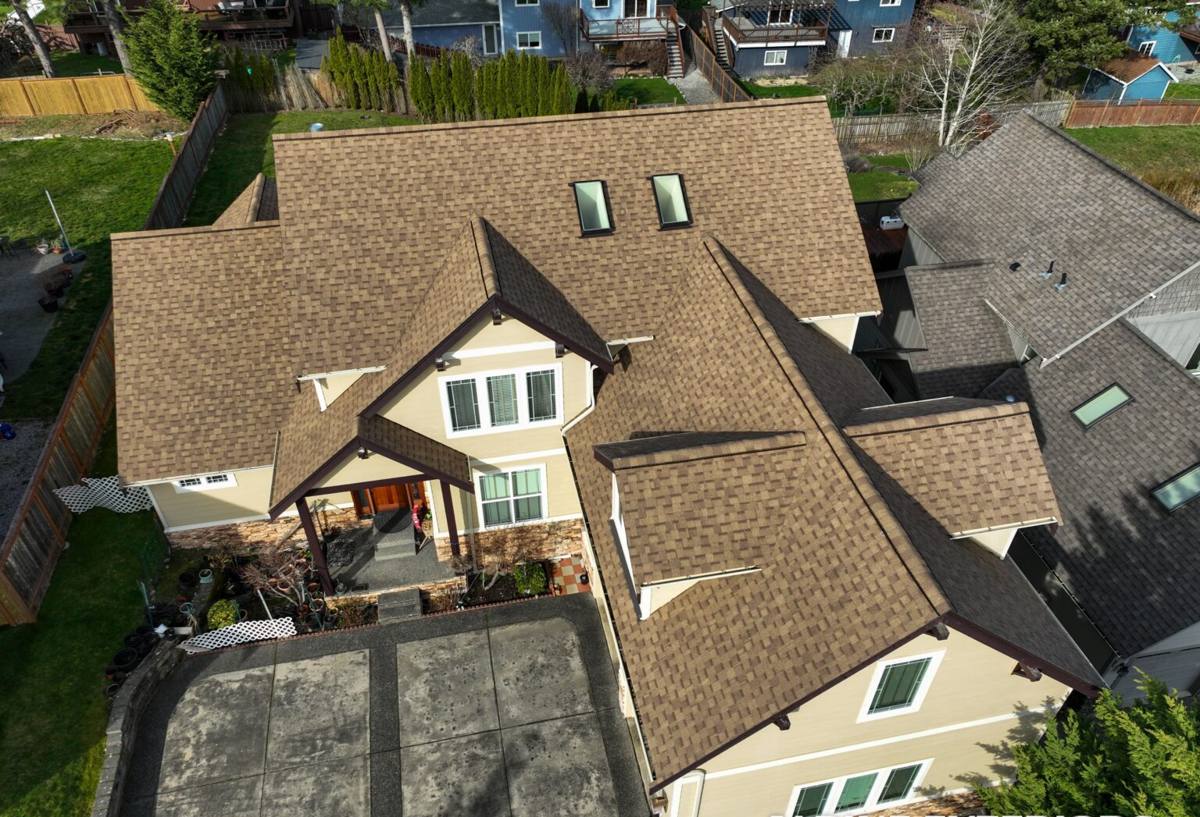
Homes in the Puget area of Bellingham sit in a climate that's harder on a roof than most homeowners realize until something starts leaking. You've got salt-laden air drifting in off the water, long stretches of driving rain that comes in sideways more often than straight down, and a moss season that can run most of the year in shaded, north-facing sections of a roof. None of these things destroy a roof overnight. They work slowly, at the seams, flashing, and fastener lines, until a small weakness turns into an active leak.
That combination is why roof repair here isn't just about patching the spot where water is showing up inside the house. It's about understanding why that spot failed in the first place, and whether the same conditions are quietly working on the rest of the roof too.
What Salt Air, Rain, and Moss Actually Do to a Roof
Salt Air and Metal Fatigue
Salt in the air accelerates corrosion on any exposed metal — nail heads, flashing, valley metal, vent boots with metal collars, and gutter hardware. On older roofs, this shows up as rust streaking, pitted flashing, or fasteners that have backed out or corroded enough to lose their seal. It's a slower process than in a full marine-front location, but Bellingham and the surrounding Whatcom County coastline still see enough of it that metal components deserve a closer look during any repair.
Driving Rain and Wind-Driven Moisture
Standard roofing assumes water moving straight down and off the edge. Driving rain pushes water sideways and upward under shingle tabs, around step flashing, and into any gap that wouldn't matter in a calmer climate. Repairs done without accounting for wind-driven rain often "hold" for a season or two, then fail again in the next big storm — because the underlying vulnerability to sideways-moving water was never addressed.
Moss, Shade, and Trapped Moisture
Moss doesn't just look bad. It holds moisture against the roofing material far longer than open air would allow, and as it spreads it lifts shingle edges and works its way into seams. On shaded roof sections — under tree cover or on the north side of a home — moss can establish itself within a couple of years of a roof being cleaned. Left unaddressed, it's one of the most common root causes behind repairs that keep coming back.
What a Correct Repair Actually Involves
Diagnosing the Real Cause, Not Just the Symptom
A ceiling stain rarely sits directly under the point where water is entering the roof. Water travels along rafters, sheathing, and underlayment before it shows up as a stain, so a repair that just patches the visible spot often misses the actual entry point. A correct repair starts with tracing the water back to its source — checking flashing, penetrations, and shingle condition uphill from the stain, not just the ceiling below it.
Matching Materials and Method
Repairs should use materials compatible with what's already on the roof — matching shingle profile and weight where possible, or being upfront when an exact match isn't available and a near-match is the honest option. Mixing incompatible materials or using the wrong fastener type for coastal conditions can create new weak points even while fixing the original one.
Flashing and Penetrations Get Priority
The majority of roof leaks trace back to flashing — around chimneys, skylights, vent pipes, and roof-to-wall transitions — rather than the field of the shingles themselves. Any repair worth doing checks these areas even if they weren't the reported problem, because a flashing failure in one spot is often a sign of aging flashing elsewhere on the same roof.
Common Roof Problems We See on Puget-Area Homes
| What Homeowners Notice | Likely Root Cause | What a Proper Fix Involves |
|---|---|---|
| Ceiling stain after heavy storms | Wind-driven rain past aged flashing or lifted shingle tabs | Trace water path uphill, reseal or replace flashing, secure or replace affected shingles |
| Dark streaks or thick green growth | Moss and moisture retention in shaded areas | Careful moss removal, treatment, and inspection underneath for shingle damage |
| Rust stains near vents or valleys | Salt-air corrosion on metal flashing or fasteners | Replace corroded metal components, not just spot-treat rust |
| Granules collecting in gutters | Normal aging accelerated by sun and moisture cycling | Assess remaining shingle life; localized repair vs. planning ahead for replacement |
| Soft or spongy spots underfoot | Sustained moisture intrusion into sheathing | Deck-level inspection; repair may require replacing wet sheathing, not just surface shingles |
Repair vs. Replacement: How We Help You Decide
Not every roof problem in the Puget area needs a full replacement, and we don't push one when a repair will genuinely hold. But we also won't recommend a repair that's likely to fail again within a season or two just because it's the cheaper conversation to have. The honest answer usually depends on a few factors:
| Factor | Leans Toward Repair | Leans Toward Replacement |
|---|---|---|
| Age of roof | Under roughly two-thirds of its expected lifespan | Nearing or past expected lifespan for the material |
| Extent of damage | Localized — one flashing detail, one section | Multiple areas showing wear, moss, or granule loss |
| Underlying deck condition | Sheathing is dry and sound | Sheathing shows soft spots or repeated moisture exposure |
| Repair history | First repair, or an isolated issue | Same area has needed repair more than once |
We'll walk you through where your roof falls on that spectrum in plain terms, including what happens if you wait, so you can make the call with real information instead of a sales pitch.
Our Repair Process
Inspection
We start on the roof itself, not just at the ceiling stain inside. That means checking flashing, penetrations, shaded and moss-prone sections, and the general condition of the roofing material — walking the whole roof, not just the reported trouble spot, since Bellingham's climate tends to work on a roof's weak points all at once rather than in isolation.
Assessment and Options
Once we know what's actually going on, we explain it — what's causing the problem, what a repair involves, and what it will and won't fix long-term. If there's a decision to make between a targeted repair and a larger scope of work, that's laid out clearly, with reasoning tied to your specific roof rather than a generic recommendation.
The Repair
Work is done to match the existing roofing system as closely as possible, with particular attention to flashing, fastening, and sealing details suited to wind-driven rain and salt-air exposure rather than a generic patch job.
Cleanup and Follow-Up
We clear debris, old materials, and displaced moss from the site, and we're straightforward about what to watch for afterward — including any secondary issues (like a moss-prone area elsewhere on the roof) that weren't part of the original repair but are worth keeping an eye on.
Materials and Products We Use
We choose roofing materials and flashing metals based on how they hold up to sustained moisture and coastal air, not just upfront cost. That sometimes means favoring a slightly more durable flashing metal or a shingle line with a track record in wetter Pacific Northwest conditions over a cheaper option that looks the same on day one but shows corrosion or granule loss sooner in this climate. We're happy to explain the trade-offs of any material we recommend — including where a lower-cost option is genuinely fine for your situation and where it isn't.
Why a Crew That Already Works the Puget Area Matters
Roofing conditions vary block to block depending on tree cover, sun exposure, and how close a home sits to open water. A crew that regularly works in the Puget area of Bellingham has already seen how moss establishes on similarly shaded lots nearby, how driving rain behaves against certain roof orientations in this part of Whatcom County, and which flashing details tend to fail first in this specific combination of salt air and rainfall. That local pattern recognition shortens the diagnosis and reduces the odds of a repair that misses the real cause.
It also means we're realistic about timing. Roof repair work in this climate goes better in drier windows, and a crew working the area regularly can plan around that instead of rushing a repair between rain systems.
Homeowner Checklist: Signs Your Roof Needs a Closer Look
- Ceiling stains or discoloration that appear or worsen after heavy rain or wind events
- Visible moss, especially on shaded or north-facing roof sections
- Granules building up in gutters or at the base of downspouts
- Rust streaking near vents, valleys, or flashing
- Shingles that look lifted, curled, or out of alignment at the edges
- Soft or spongy spots noticeable when walking near the attic access or upper floor ceilings
- Daylight visible through the roof deck from inside the attic
- Any repair that was done before but the same spot is leaking again
If any of these sound familiar, it's worth getting a look before the next storm system rather than after. We offer free, no-pressure estimates for roof repair in the Puget area of Bellingham — we'll tell you honestly what we find, what it needs, and what your options are, whether that's a straightforward repair or something bigger.