 Bellingham Exterior
 Storm Damage Roofing in Happy Valley: What's Different Here
Happy Valley sits close enough to Bellingham Bay that roofs in this neighborhood deal with a combination most inland homes don't: salt-laden air off the water, wind-driven rain that comes in sideways during winter storms, and a moss season that runs longer than almost anywhere else in the Lower 48. None of these factors are dramatic on their own. Together, over years, they're exactly what turns a small storm-related weakness into a leak.
When we're called out to a storm-damaged roof in this part of Bellingham, we're rarely looking at a single obvious hole. More often it's a lifted shingle tab, a cracked pipe boot, or flashing that pulled loose just enough to let water track sideways under the roofing material before it shows up as a stain on a ceiling two rooms away. Storm damage repair here isn't just patching what broke — it's understanding how Whatcom County weather made it break, so the fix holds through the next system that rolls in off the strait.
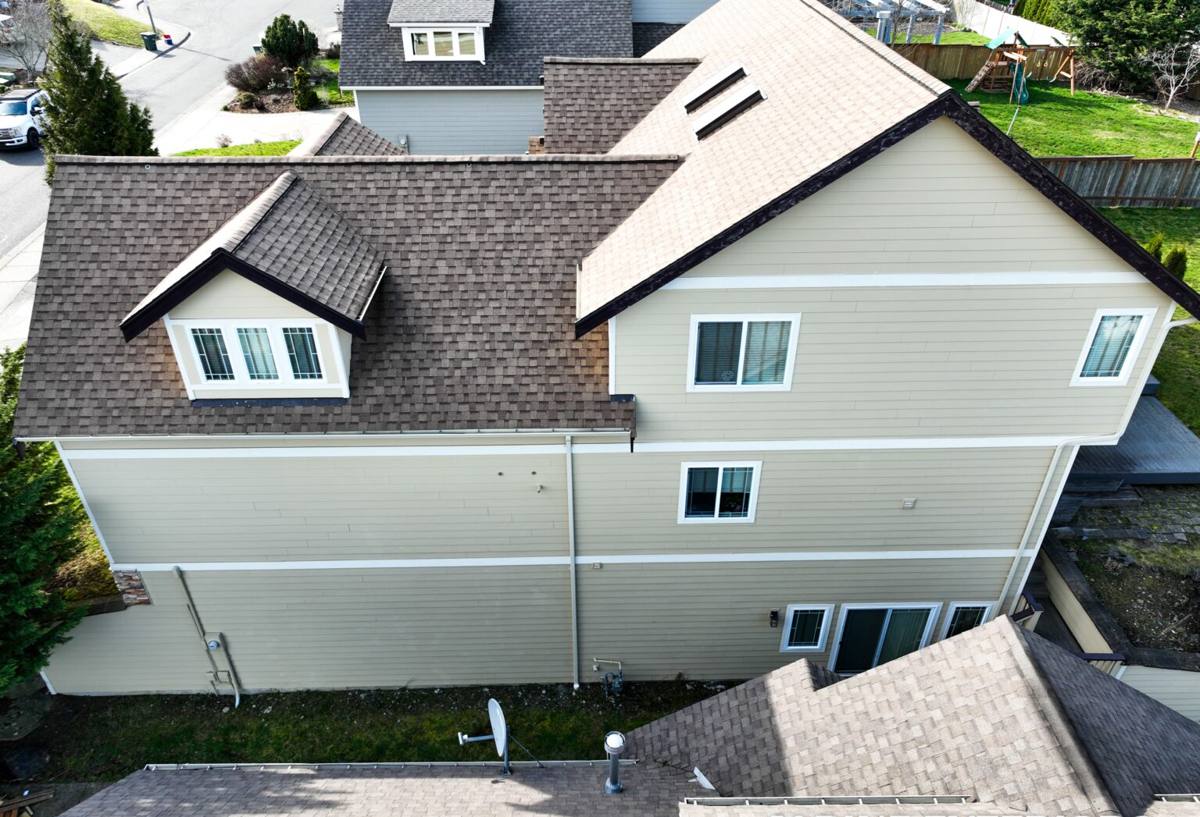
How Storms Actually Damage a Roof in This Area
Wind
Sustained wind is rarely the culprit by itself. It's wind gusts combined with rain-soaked, moss-softened shingles that lift and tear. A shingle that's been sitting under a layer of moss holds moisture longer, which weakens the seal strip underneath it. Add a gust from the wrong angle and that shingle peels back or tears off entirely, exposing the underlayment beneath.
Wind-Driven Rain
Bellingham storms frequently push rain nearly horizontal for a few hours at a time. Roofing systems are designed to shed water moving downward, not water being forced sideways and upward under laps and around penetrations. This is where marginal flashing details — around chimneys, skylights, vent pipes, and roof-to-wall transitions — get exposed. A flashing detail that's held up fine for years can suddenly leak during one storm because the wind direction and rain volume finally found its weak point.
Debris Impact
Mature trees are common around Happy Valley, and falling branches or wind-thrown debris can crack shingles, dent metal flashing, or puncture roofing material outright. Even a glancing hit can bruise a shingle in a way that isn't visible from the ground but will fail months later.
Signs of Storm Damage Homeowners Often Miss
Not all storm damage announces itself with an interior leak right away. Some of the most common signs we find during a post-storm inspection are easy to overlook from the ground:
- Granules collecting in gutters or at downspout outlets — a sign of shingle surface wear or impact damage
- Shingles that look slightly out of alignment or "wavy" compared to the surrounding field
- Lifted or missing ridge cap shingles along the peak of the roof
- Soft or discolored soffit and fascia boards near roof edges
- Flashing that looks bent, separated, or has visible gaps at the seams
- Moss buildup concentrated at damaged spots, since a compromised shingle holds moisture and grows moss faster than the surrounding area
- A musty smell in the attic, which often shows up well before a visible ceiling stain
Why Salt Air and Long Moss Seasons Change the Repair
A storm repair done without accounting for local conditions tends to fail again faster than it should. Two things matter specifically here:
Salt air accelerates corrosion on exposed metal — flashing, fasteners, gutter hardware — especially on roof faces that get direct exposure off the bay. We use fasteners and flashing rated for coastal exposure on repair work in this area rather than standard-grade hardware, because the cost difference is small and the failure difference is not.
Moss isn't just cosmetic. In Whatcom County's damp, mild climate, moss can establish itself on a roof within a single wet season and keep growing nearly year-round. When moss gets under a lifted or torn shingle edge, it holds water against the roofing material and the underlayment, which slows drying and speeds up rot in the decking below. Any storm repair on a roof with existing moss needs to address the moss at the repair site — not just patch over it — or the same spot fails again within a year or two.
What a Correct Storm Damage Repair Involves
A proper repair is more than swapping out the shingles that are obviously missing. Here's what we check and address on every storm repair call:
- Full-slope inspection, not just the damaged spot. Wind and rain rarely damage just one area. We check the whole roof plane, not only where the visible problem is, since related damage is often a few feet away.
- Underlayment and decking check. If water has been getting under the roofing material, we look at whether the underlayment and the wood decking beneath it have absorbed moisture or started to soften. Replacing shingles over compromised decking doesn't solve anything.
- Flashing repair or replacement. Bent or separated flashing gets replaced, not just re-sealed with caulk. Sealant is a short-term patch; proper flashing geometry is the actual fix.
- Matching materials where possible. We try to match existing shingle style, color, and weight so a repair doesn't stand out as a visibly different patch, though some color variation is normal with older roofs that have weathered and faded.
- Moss and debris clearing at the repair site. Any moss, needles, or debris trapped near the repaired area gets cleared so the new work isn't sitting under moisture-holding material from day one.
- Attic-side check when there's been an active leak. If water made it inside, we look at insulation and framing near the leak point to flag any moisture that needs to dry out or be addressed separately.
Repair or Replace? What Actually Drives That Decision
Storm damage doesn't automatically mean a full re-roof, and it doesn't automatically mean a small patch either. The right call depends on a few factors:
| Factor | Leans Toward Repair | Leans Toward Replacement |
|---|---|---|
| Extent of damage | Isolated to one section or a few shingles | Spread across multiple roof planes |
| Roof age | Roof has significant remaining service life | Roof is already near or past its expected lifespan |
| Decking condition | Decking is dry and sound | Decking shows rot or soft spots in multiple areas |
| Shingle matchability | Matching shingles are available | Existing shingle is discontinued or badly faded |
| Moss/moisture history | Minimal prior moss or leak issues | Long-term moss buildup or repeat leak history |
We'll always tell you honestly which side of that table your roof falls on. A repair that's likely to fail again within a couple of years isn't a good use of your money, and we'll say so rather than sell it to you anyway.
Our Process, Start to Finish
For Happy Valley storm calls, the process is straightforward:
- Inspection. We walk the roof (or use elevated tools when walking isn't safe) and document what we find, including photos of the damage and surrounding areas.
- Honest assessment. We explain what caused the damage, what needs to happen to fix it correctly, and what it will cost — in plain terms, not upsell language.
- Insurance documentation, if needed. If you're filing a storm damage claim, we provide the documentation your insurer typically asks for. We don't handle the claim itself, but we make sure the paperwork on the roofing side is complete and accurate.
- The repair. Done to the standard described above — not a quick patch, but a repair meant to hold through the next storm season.
- Cleanup. Debris, old materials, and stray fasteners are cleared from the property, including a magnetic sweep of the ground near the work area.
After a Storm: A Quick Homeowner Checklist
If a storm has just come through Bellingham and you're not sure whether your roof needs attention, this covers the basics:
- Check the attic for damp insulation, water stains, or a musty smell
- Look at ceilings and around light fixtures for new discoloration
- Check gutters and the ground below roof edges for shingle granules or shingle pieces
- Note any branches or debris that landed on the roof, even if they've since rolled off
- Avoid climbing onto the roof yourself, especially on wet or moss-covered surfaces — it's not worth the fall risk
- Call for an inspection sooner rather than later; a small leak addressed early is a much smaller job than one that's had weeks to spread
Why Local Experience in Happy Valley Matters
A roofer who works this specific part of Bellingham regularly knows which roof orientations take the worst of the wind-driven rain, which materials hold up to the salt air coming off the bay, and how aggressive the moss growth typically is on shade-exposed roof faces in this neighborhood. That's not something a crew coming from outside the county picks up on a single job. It shows up in small decisions — which fastener grade to use, how tight to seal a valley, whether a shingle match is close enough to hold up visually — that add up to a repair that actually lasts through Whatcom County's wet season instead of needing a callback.
If a recent storm left you with damage, or you're just not sure whether what you're seeing on your roof needs attention, we're glad to take a look. The estimate is free, there's no pressure, and you'll get a straight answer about what's actually going on — use the form below to get started.