 Bellingham Exterior
 Custom Decks Built for Birch Bay's Waterfront Conditions
Birch Bay sits right up against the water, and that changes what a deck has to deal with compared to a deck built a few miles inland. Homes here catch a steadier dose of salt-laden air off the bay, take wind-driven rain more directly, and hold onto shade and dampness longer on north- and water-facing exposures — which adds up to a moss season that runs longer than most homeowners expect. A deck is one of the most exposed structures on a property. It has no roof overhead, it takes weather from every angle, and the fasteners, framing, and surface material are all working outdoors, year-round, without a break. Building one that lasts in Birch Bay isn't about a different look than a deck anywhere else — it's about different decisions underneath the surface: fastener material, flashing at the house connection, drainage under the boards, and footing depth for this specific soil and exposure.
This page covers what a correctly built custom deck actually involves in Birch Bay specifically, the material and hardware trade-offs that matter most this close to the water, and how we approach a project here from first walkthrough to final walkthrough.
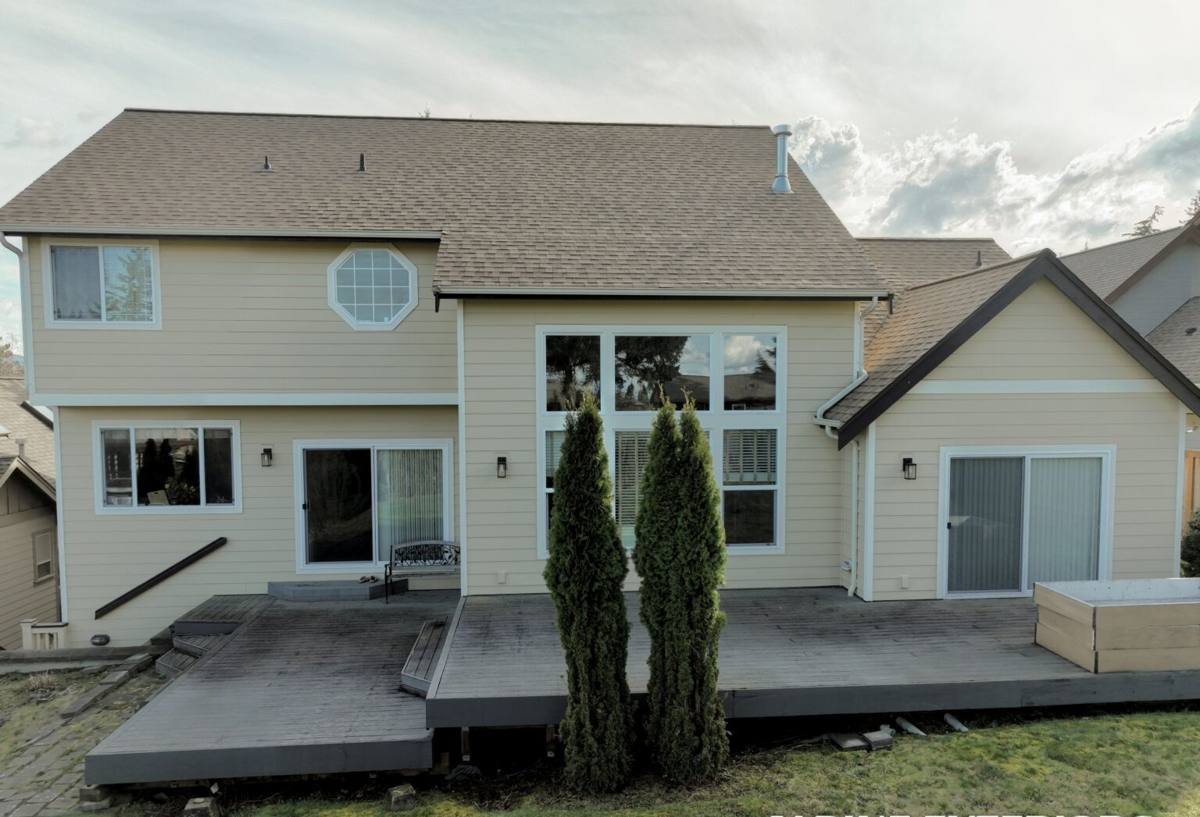
What Birch Bay's Climate Does to a Deck
Salt Air and Corrosion at Every Connection Point
A deck is held together by hundreds of fasteners — joist hangers, structural screws, ledger bolts, railing hardware — and every one of them is exposed to the same salt-tinged marine air that the siding and roofing on the house deal with. Standard fasteners corrode faster this close to the water, and a corroding fastener in a structural connection isn't a cosmetic problem; it's a slow failure of the thing holding the deck together. This gets more complicated with modern pressure-treated lumber, which uses a copper-based preservative that actively corrodes standard galvanized steel. Fasteners and connectors have to be rated for both the treated lumber and the coastal exposure, not just one or the other.
Wind-Driven Rain and Where Water Actually Goes
Rain in Birch Bay rarely falls straight down — wind off the water pushes it sideways and up under railings, against ledger boards, and into any gap that isn't properly flashed or sealed. On an attached deck, the ledger board bolted to the house is the single most common point of hidden rot in the entire structure, because water that gets behind it has nowhere to go and no way to be seen until the damage is already done. A deck built without a ledger flashing detail suited to this kind of weather is carrying a hidden liability from day one.
Moss, Algae, and a Long, Slow-Drying Season
Shaded and water-facing decks in Birch Bay hold moisture longer than sun-exposed ones, and that's exactly the condition moss and algae need to establish. Beyond the cosmetic issue, moss and algae on a deck surface hold water against the boards and create a genuinely slippery walking surface — a real safety concern on stairs and near railings, not just a maintenance annoyance.
Choosing the Right Decking Material for This Location
There's no single "correct" decking material for every project, but in a marine, high-moisture environment like Birch Bay, some materials carry more maintenance burden and moisture risk than others. We walk homeowners through the real trade-offs rather than steering everyone toward the highest-margin option.
| Material | Behavior in Salt Air & Moisture | Maintenance in This Climate | Realistic Lifespan |
|---|---|---|---|
| Pressure-treated lumber | Resists rot with proper fasteners; absorbs moisture at cut ends and fastener holes without sealing | Higher; needs re-sealing on a recurring cycle and regular cleaning to slow moss growth | 15-25 years with consistent upkeep |
| Cedar | Naturally moisture-resistant but still absorbs water over time; graying and moss are common without upkeep | Higher; periodic cleaning and refinishing to hold color and shed water | 15-20 years with consistent upkeep |
| Composite decking | Doesn't absorb water into the board itself; more stable across wet-dry cycles | Low; periodic washing to keep surface film and algae from building up | 25-30+ years, manufacturer-dependent |
| PVC decking | Fully synthetic; essentially unaffected by moisture absorption | Low; occasional washing | 25-30+ years, manufacturer-dependent |
Wood decking isn't a wrong choice — plenty of Birch Bay homeowners want the look and are willing to keep up with the maintenance it takes. What matters is going in with accurate expectations. If low maintenance is the priority given how much moisture and shade a particular deck will see, composite or PVC decking usually makes more sense here than it would in a drier inland location. If real wood is the priority, we build in the sealing and cleaning schedule that this specific climate actually requires, not a generic one.
What a Correctly Built Deck Actually Involves
The visible parts of a deck — decking boards, railings, stairs — are only part of the job. Most of what determines whether a deck lasts is underneath, out of sight once the project is finished:
- Footings set to the correct depth for local soil and frost conditions, not poured shallow to save time
- A ledger board (on attached decks) properly flashed and sealed where it meets the house, so wind-driven rain can't get behind it
- Joist tape or an equivalent moisture barrier over framing lumber, so standing water doesn't sit directly against exposed wood
- Fasteners and structural connectors rated for both treated lumber's chemical makeup and coastal salt exposure — stainless steel or a compatible coated hardware system, not generic galvanized
- Proper spacing between decking boards for drainage and airflow, so water and debris don't sit and hold moss growth
- Railings and stair connections built to current structural code, since these take direct wind and rain exposure and see repeated stress from use
- Grading and drainage under the deck itself so water sheds away from the house foundation instead of pooling underneath
Skip any of these and the deck can still look finished and solid for the first season or two. The failures that come from cutting these corners — a soft ledger connection, corroding hardware, a joist that's been sitting in standing water — take a few wet seasons to show themselves, which is exactly why they're easy to miss on a rushed or corner-cutting build until the homeowner is the one dealing with the repair.
Our Process for a Birch Bay Deck Project
Site Walkthrough and Assessment
We start by looking at the actual site — sun and shade exposure, proximity to the water, existing drainage patterns, and, on a rebuild, the condition of the ledger connection and any framing that's already in place. A deck on a shaded, water-facing lot needs different attention than one on a sunnier, more protected part of the same property.
Design and Material Selection
We talk through decking material, railing style, and layout against how the space will actually be used and how much maintenance the homeowner wants to take on long-term. This is also where we flag anything about the specific lot — some Birch Bay properties close to the water fall under county shoreline or setback rules that can affect deck size or placement, and that's worth knowing before a design is finalized, not after.
Permitting
Deck construction typically requires a permit, and we handle that process as part of the job rather than leaving it to the homeowner to sort out. Skipping permitting on a structural project like a deck isn't a shortcut worth taking — it can create real problems later at resale or insurance time.
Construction
Framing, flashing, and fastening are done to the standards this climate requires, not a generic minimum. We inspect our own structural work — footings, ledger connection, framing — before decking goes down, since that's the point where it's still easy to fix anything that isn't right.
Final Walkthrough
We walk the finished deck with you, cover what maintenance actually looks like for the material you chose, and make sure you know what to check on periodically so small issues get caught early instead of turning into structural ones.
Railing, Fastener, and Hardware Choices for Salt Exposure
Hardware is where a lot of decks quietly fail in a coastal environment, because a corroding bolt or bracket is hard to spot until it's already compromised. We spec stainless steel or coastal-rated coated fasteners and structural connectors for Birch Bay projects specifically because standard galvanized hardware corrodes faster here than it would further inland, and because treated lumber's copper content accelerates corrosion on hardware that isn't rated to handle it. The same logic applies to railing systems — cable rail, metal balusters, and other hardware-heavy railing styles need components rated for marine exposure, or they become a maintenance and safety issue well before the decking itself needs attention.
Maintenance a Birch Bay Deck Actually Needs
Every deck needs some upkeep; how much depends heavily on material choice and exposure. In this climate, the maintenance items that matter most are the ones tied directly to moisture and salt, not general wear:
- Periodic cleaning to remove moss, algae, and organic debris before it holds moisture against the surface
- Checking the ledger flashing and house connection annually for any sign of water intrusion
- Re-sealing or refinishing wood decking on the schedule the material actually needs in this climate, not a generic national one
- Keeping gutters and downspouts near the deck clear, since overflow water often ends up draining directly onto or under the deck
- Watching for early corrosion at visible hardware — railing brackets, stair connectors — as an early signal worth addressing before it spreads
Why Hire a Crew That Already Works Birch Bay
A deck built to a generic inland spec can look identical to one built for this climate on the day it's finished. The difference shows up years later, in how well the ledger connection has held up, whether the hardware is still sound, and whether the framing underneath is dry or slowly rotting from trapped moisture. A crew that's built decks across Birch Bay through multiple wet seasons has already seen which orientations need extra drainage attention because of shade and water exposure, which fastener systems actually hold up to this level of salt exposure versus what a generic hardware aisle offers, and where a shoreline-adjacent lot is likely to need extra permitting attention. That judgment doesn't show up on a materials list, and it's the difference between a deck that's still structurally sound in twenty years and one that needs framing repairs in five.
Cost Factors for Custom Decks in Birch Bay
Deck pricing varies by size, material, and site conditions, so a fair estimate has to be based on the actual property rather than a flat per-square-foot number. A few things move the price on a given Birch Bay project:
| Factor | Why It Matters |
|---|---|
| Decking material | Composite and PVC cost more upfront than treated lumber but less in long-term maintenance |
| Deck height and footing depth | Taller decks and certain soil conditions require more substantial footings and framing |
| Attached vs. freestanding design | Attached decks need ledger flashing and structural tie-in work that freestanding decks don't |
| Railing style and hardware | Cable rail and metal systems cost more than standard wood or composite railing |
| Proximity to the water and permitting requirements | Shoreline-adjacent lots can involve additional permitting steps that affect timeline and design |
| Site access | Difficult access or a sloped lot can add labor time for material staging and footing work |
We'll walk your specific lot and give you real numbers based on what your property actually needs, rather than a rough estimate off square footage alone — two decks the same size in Birch Bay can have very different costs depending on how many of these factors are in play.
Getting It Right the First Time
A deck is a structural project sitting entirely outdoors in one of the more demanding exposures on the property. Fixing a deck that was built wrong usually means tearing into framing and connections that are supposed to be permanent, which costs far more than getting the footings, flashing, and hardware right during the original build. That's why we treat the parts nobody sees — footings, ledger flashing, fastener specification — with the same seriousness as the finished decking and railings on top.
If you're planning a new deck or replacing one that's showing its age in Birch Bay, we're happy to walk the property, talk through what your specific site and exposure need, and give you a straightforward, no-pressure estimate. There's a form below — reach out and we'll set up a time to take a look.