 Bellingham Exterior
 Why Ferndale Decks Wear Out Faster Than the Brochures Suggest
Ferndale sits close enough to the water and open farmland that decks here take on a specific combination of punishment: salt-tinged air drifting in off Bellingham Bay and the Strait, driving rain that comes in sideways during fall and winter storms, and a moss and algae season that can run eight or nine months out of the year. None of that is unusual for Whatcom County, but it adds up differently on a deck than it does on siding or roofing, because a deck is a horizontal surface people actually walk on, sits low to grade, and traps moisture underneath where nobody looks until something gives.
We repair decks all over Ferndale and the surrounding areas, and the pattern is consistent: the problems aren't usually dramatic. They're slow — a soft spot here, a rust streak there, a railing that's started to wiggle — and by the time a homeowner calls, the damage has usually been building for a season or two longer than they realized.
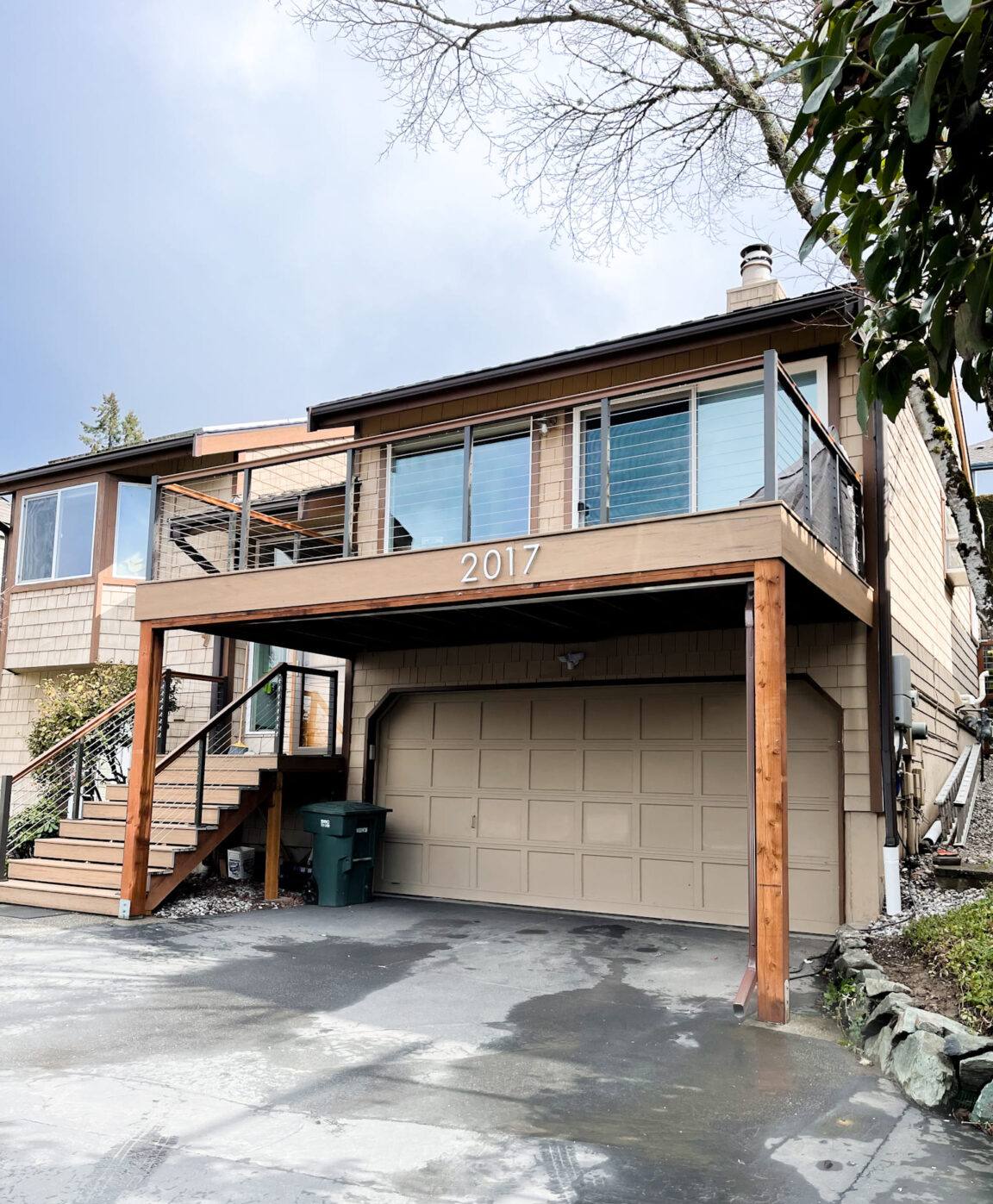
What Ferndale's Climate Actually Does to a Deck
Moisture That Never Fully Leaves
Whatcom County's rain isn't just frequent, it's prolonged — weeks of low-intensity drizzle that soak into end grain, fastener holes, and any spot where two boards meet. Wood dries out slower here than in drier parts of the state, which means untreated or poorly sealed cuts stay damp longer and start to break down faster.
Moss and Algae Buildup
Shaded decks, north-facing decks, and anything under tree cover develop a moss film that holds water against the wood surface like a sponge. Beyond making the deck slippery, that moss layer keeps boards from drying between rain events, which accelerates rot in exactly the spots you'd want to stay dry.
Salt Air and Fastener Corrosion
Properties closer to the water deal with airborne salt that speeds up corrosion on screws, joist hangers, and structural brackets — especially older galvanized hardware that wasn't rated for coastal exposure. Once a fastener starts rusting, it loses holding strength well before it looks obviously bad.
Signs You Need a Repair — And Signs You've Waited Too Long
Most deck problems fall into one of two categories: things that are still a repair, and things that have crossed into replacement territory. Catching issues early is the difference between fixing a few boards and rebuilding a structure.
- Boards that feel spongy, springy, or noticeably softer than the boards around them
- Gaps opening up between decking boards or around fastener heads
- Railings or posts that move when pushed, even slightly
- Rust streaks running down from screws, bolts, or metal connectors
- Stairs that feel less solid than they used to, or treads with visible cupping
- Persistent green or black film that doesn't clear up between dry spells
- Any point where the deck meets the house showing gaps, staining, or soft trim
A single soft board is usually a straightforward repair. Soft framing underneath, a ledger board pulling away from the house, or multiple structural members showing decay is a different conversation — one we'll always have honestly with you before quoting anything.
What a Correct Deck Repair Actually Involves
A repair that only addresses what's visible on top tends to fail again within a season or two, because the surface damage is usually a symptom of something happening underneath. We approach deck repair in Ferndale with that in mind:
1. Inspection From Below, Not Just Above
Whenever we can get underneath — through a crawlspace access, from the yard, or by pulling a few boards — we check joists, beams, posts, and the ledger connection to the house. Surface repairs on top of rotted framing are a waste of your money.
2. Identifying the Moisture Source
Rot doesn't happen without a moisture path. Sometimes it's a missing or failed ledger flashing, sometimes it's poor drainage underneath, sometimes it's just standing water from a low spot in the decking. We fix the cause, not just the symptom, or the same spot rots again.
3. Matching Structural Repairs to Code
Any framing member we replace — joists, beams, ledger connections — gets rebuilt to current structural standards, not just patched to match what was there. This matters most on older Ferndale decks that were built before current fastening and flashing requirements.
4. Hardware Rated for the Environment
Given the salt air exposure common in this part of Whatcom County, we use corrosion-resistant fasteners and connectors rated for coastal or wet-climate exposure rather than standard-grade hardware that may already be rated adequately elsewhere in the state but underperforms here.
Common Repairs We Handle
| Issue | What's Usually Happening | Typical Fix |
|---|---|---|
| Soft or spongy decking boards | Water intrusion at fastener holes or board edges | Replace affected boards; check adjacent boards and framing |
| Loose or wobbly railings | Post connections loosened or post base rotted | Re-secure or rebuild post connections to current bracing standards |
| Rust stains near fasteners | Corroding screws or brackets, often original hardware | Replace with coastal-rated stainless or hot-dip galvanized hardware |
| Gap or separation at the house wall | Failed ledger flashing or ledger fastening | Remove and rebuild ledger connection with proper flashing |
| Persistent moss or slick surface | Poor drying conditions, often shaded or low-airflow areas | Clean, treat, and address underlying drainage/airflow where possible |
| Stair tread cupping or softness | Standing water on horizontal tread surfaces | Replace treads; improve slope/drainage where the design allows |
Repair vs. Replace: How We Help You Decide
We don't default to recommending a full rebuild — most of what we see in Ferndale is repairable. But there are points where a rebuild genuinely saves money over time compared to patching a structure that keeps needing attention.
- Repair makes sense when the framing underneath is sound and the damage is isolated to specific boards, railings, or hardware.
- Repair makes sense when the deck is structurally younger and the issues trace back to one identifiable moisture source that can be corrected.
- Replacement is the honest recommendation when multiple structural members show decay, when the ledger connection has failed in more than one spot, or when the deck has been repaired multiple times already for the same underlying issue.
- Replacement is the honest recommendation when the deck predates current fastening and flashing standards to the point that bringing it up to code piecemeal costs close to what a rebuild would.
We'll walk the deck with you, show you what we're seeing, and give you a straight answer either way — including telling you when a repair is genuinely the right call and a full rebuild isn't necessary.
Our Repair Process
- On-site inspection — we look at the deck surface, framing (where accessible), railings, stairs, and the ledger connection to your home.
- Straight assessment — we explain what we found, what's causing it, and whether it's a repair or a larger conversation.
- Written estimate — scope, materials, and hardware spelled out before any work starts.
- The repair itself — framing fixed first if needed, then decking, railings, and hardware, using fasteners suited to Whatcom County's coastal exposure.
- Final walkthrough — we check the work with you and flag anything worth watching going forward.
Materials and Hardware: Why the Details Matter Here
On a lot of decks, the decking material itself isn't what fails first — the fasteners and connectors are. That's why our standard is to match hardware to the exposure the deck actually faces rather than defaulting to whatever's cheapest. For a deck within reach of salt air off the water, that generally means stainless steel or coastal-rated hot-dip galvanized fasteners and structural connectors, even if the original build used standard-grade hardware.
Where wood decking is being repaired or replaced, we also pay attention to how boards are gapped and fastened. Tight gapping looks clean on install day but gives wood nowhere to expand and shed water in a climate that stays damp as long as ours does — a small detail that has an outsized effect on how long a repair lasts.
Homeowner Maintenance Checklist
A repaired deck holds up longer when it's looked after between visits from us. A few habits go a long way in this climate:
- Sweep leaves and debris off the deck regularly, especially in fall — trapped organic matter holds moisture and feeds moss growth
- Rinse off moss and algae film before it builds up thick, rather than waiting for it to become slippery
- Check railings and stair treads a couple times a year by hand — a wobble you catch early is a quick fix
- Keep gutters and downspouts clear so roof runoff isn't draining onto or under the deck
- Look underneath the deck once a year if you can access it, checking for standing water or obviously soft framing
- Reseal or refinish wood decking on the schedule the product calls for — skipping a cycle in this climate shows up fast
Why a Crew That Already Works Ferndale Makes a Difference
A deck repair contractor who works this specific area regularly has already seen how Ferndale's mix of coastal exposure, tree cover, and rain patterns plays out on real decks — which framing details tend to fail first, which hardware holds up and which doesn't, and where drainage problems show up again and again. That's not something you get from a crew that treats every job the same regardless of region. We're a Bellingham-based exterior company that works throughout Whatcom County, and Ferndale's decks get the same climate-specific approach as everything else we build and repair.
If you've got a deck showing any of the signs above, or you just want an honest read on where it stands, we're happy to take a look. Reach out using the form below for a free, no-pressure estimate.