 Bellingham Exterior
 Ferndale Homes Take a Different Kind of Beating
Ferndale sits closer to the water than most of inland Whatcom County, and that changes what siding has to survive. Salt-laced air off the coast works its way into fastener heads and cut edges. Driving rain off Puget Sound drives moisture sideways into joints and butt seams that never see direct sun. And because so many Ferndale lots carry mature fir and cedar cover, homes here get a long moss and algae season that stretches well past what you'd see further inland. None of that is dramatic on its own. It's the accumulation, year after year, that turns small siding problems into big ones.
We repair fiber cement siding across Whatcom County, but Ferndale calls for a slightly different eye. A crack that would be cosmetic in a dry, sun-exposed neighborhood can be a moisture entry point here. A caulk joint that's failed for six months in a shaded, damp corner has usually already let water behind the plank. Repair work in this town means treating every job as a moisture inspection first and a cosmetic fix second.
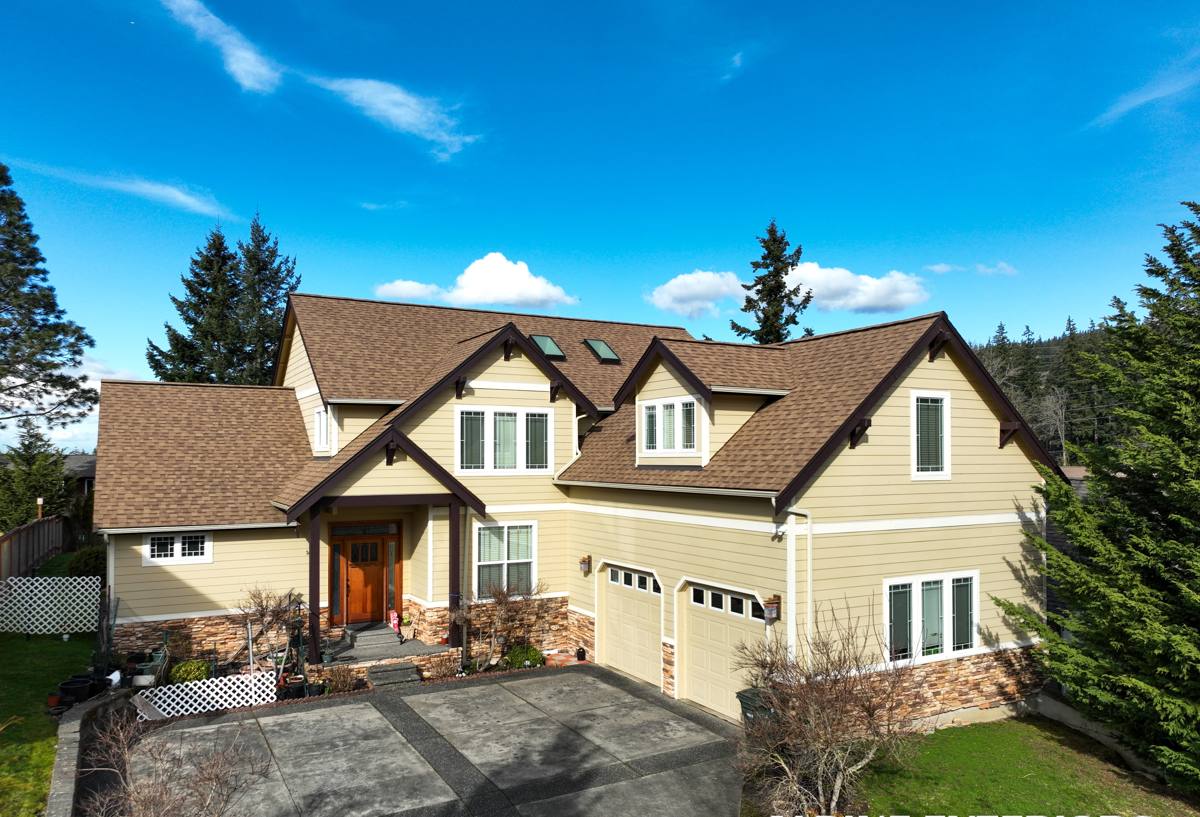
Signs Your Siding Needs Attention
Most siding damage doesn't announce itself. Homeowners usually notice it during a pressure wash, a paint estimate, or after a storm knocks something loose. Here's what we're actually looking for when we walk a property in Ferndale:
- Hairline cracks running along a plank, especially near corners or where two pieces butt together
- Soft, dark, or bubbling paint film — often a sign of moisture trapped underneath, not just an aging finish
- Nail heads that have backed out or left visible dimples ("nail pops")
- Gaps or shrinkage in caulk joints at trim, windows, and corner boards
- Green or black staining that keeps coming back within weeks of cleaning
- Impact damage — a chip or hole from a dropped ladder, a thrown rock, or storm debris
- Visible warping or a section that no longer sits flush against the wall
Any one of these on its own is usually a quick fix. Several of them clustered in the same area — especially low on the wall, near a downspout, or under a roofline without much overhang — is worth a closer look before it turns into sheathing damage.
When Repair Stops Making Sense
Fiber cement is durable, but it isn't repairable forever. If we find soft sheathing behind the siding, widespread delamination, or damage spread across multiple elevations, patching individual boards just delays a bigger job and can waste money. Part of an honest repair visit is telling you plainly when a full section — or in some cases a full re-side — is the better long-term investment, instead of stacking patch on patch.
What We Commonly Repair on Ferndale Homes
The repair calls we get in Ferndale follow a pretty consistent pattern, driven directly by the local climate:
| Issue | Typical Cause | Why It Matters Here |
|---|---|---|
| Cracked or split planks | Impact, freeze-thaw cycling, or improper original fastening | Cracks wick moisture straight into the wall assembly during driving rain |
| Failed caulk joints | UV breakdown and normal building movement over time | Salt air and humidity accelerate caulk failure faster than drier climates |
| Nail pops | Wood shrinkage behind the siding, or fasteners driven at the wrong angle | Exposed fastener holes let water track behind the plank |
| Persistent moss and algae staining | Shade, moisture, and limited airflow from tree cover | Long moss season means it returns quickly without the right cleaning approach |
| Discolored or peeling finish | Moisture trapped behind paint film, or non-factory touch-up paint | Factory ColorPlus finish resists this; field-applied paint often doesn't |
| Impact damage | Storm debris, equipment, or accidental contact | Coastal storm exposure makes this more common on wind-facing walls |
What a Correct Repair Actually Involves
A siding repair that holds up in Ferndale's climate is not just "cut out the bad piece, nail in a new one." Done right, it includes:
- Moisture check first. Before we touch a damaged board, we check what's behind it. If there's already moisture in the sheathing or framing, that gets addressed before any new siding goes back on — otherwise you're sealing a problem in, not fixing it.
- Matching the product line. James Hardie planks vary by width, texture, and exposure across their product lines. A patch cut from the wrong plank width or reveal will show as a visible seam even after painting.
- Matching the finish. Factory ColorPlus finishes are baked on and color-matched to a specific formulation. We source replacement material in the matching color line rather than field-painting a patch, which almost always reads slightly off over time as the two finishes weather differently.
- Correct fastening and clearances. Hardie's installation specs call for specific nail placement, gaps at butt joints, and clearance from grade, decks, and rooflines. A repair that ignores those specs just reintroduces the same failure a few years later.
- Proper flashing and sealant. Any seam we open back up gets flashed and sealed to manufacturer spec, not just caulked over.
Why We Only Work With James Hardie Materials
We install and repair James Hardie fiber cement exclusively — we don't carry vinyl, LP SmartSide, or other fiber cement brands as a repair material. That's a deliberate standard, not a limitation we work around. Hardie's HZ5 product line is engineered for exactly the conditions Ferndale deals with: sustained moisture exposure, temperature swings, and coastal wind-driven rain. It's non-combustible, holds its ColorPlus finish far longer than field-applied paint, and carries a strong transferable warranty when installed and maintained to spec.
That last part matters more during a repair than most homeowners realize. Hardie's warranty coverage assumes the product was installed correctly and that any subsequent repairs used compatible materials and methods. Patching a Hardie wall with a mismatched product, off-brand fastener pattern, or non-approved sealant can put warranty coverage on the rest of the wall at risk. When we repair a section, we're repairing it in a way that keeps the whole system — old and new — under the coverage it was built for.
Our Repair Process
Repair calls move faster than a full re-side, but we don't skip steps:
- Inspection and diagnosis. We look at the damaged area and the surrounding wall, check for moisture intrusion, and identify the plank profile and color line already on the house.
- Written estimate. You get a clear scope — what's being replaced, what's being cleaned, and what it costs — before any work starts.
- Material sourcing. We order matching Hardie product rather than substituting a close-enough alternative.
- Removal and moisture remediation. Damaged boards come out; any wet sheathing or framing gets dried out and repaired before new siding goes back on.
- Installation to spec. New planks go in with correct fastening, gaps, flashing, and sealant per Hardie's installation guidelines.
- Cleanup and walkthrough. We walk the repair with you so you know exactly what was done and what to watch going forward.
What Repair Costs Depend On
| Factor | Why It Changes the Price |
|---|---|
| Extent of damage | A single cracked plank costs far less than a section with hidden moisture damage behind it |
| Color and profile matching | Discontinued or custom colors can take longer to source than current standard lines |
| Accessibility | Second-story work, tight side yards, or areas near landscaping take more time and equipment |
| Hidden sheathing damage | If water has already reached the wall structure, that repair adds to the scope |
| Number of separate areas | Several small repairs across different elevations take more setup time than one contained area |
We won't quote a firm number without seeing the damage in person — anyone who does is either guessing or leaving out the moisture check. What we can tell you is that most single-area repairs are handled in one visit, and the estimate is always in writing before we start.
Why It Matters That We Already Work in Ferndale
A crew that only shows up in Ferndale occasionally doesn't have a feel for which walls take the worst of the weather, how fast moss comes back on shaded north-facing siding here, or how quickly a small caulk failure turns into a moisture problem in this particular climate. We work throughout Whatcom County regularly, which means we're not learning the local conditions on your job — we're applying what we already know from repairing siding on homes with the same coastal exposure, the same rain patterns, and the same tree cover. That translates into faster, more accurate diagnosis and repairs that account for what's actually going to hit that wall next winter, not just what's wrong with it today.
Get an Honest Look at Your Siding
If you're seeing cracked boards, failed caulk, recurring moss, or discoloration on your Ferndale home, it's worth having someone look before the next round of storms. We'll give you a straight answer on what's repairable, what it involves, and what it costs — no pressure, no upsell. Reach out below for a free estimate.