 Bellingham Exterior
 Siding That Has to Work Year-Round in Whatcom County
Lynden sits in the farm country northeast of Bellingham, close enough to the Nooksack River valley and the Canadian border that the weather pattern is unmistakably Pacific Northwest: long wet stretches from fall through spring, humidity that lingers in low-lying areas, and enough temperature swing between summer and winter to stress whatever material is bolted to the outside of a house. Add the salt air that drifts inland off Bellingham Bay and the Salish Sea, and you have a climate that is quietly hard on exterior materials even when nothing dramatic ever happens. There's rarely a single storm that destroys siding here. It's the accumulation — one more wet season, one more freeze-thaw cycle, one more year of moss creeping up from the ground — that eventually shows up as soft spots, peeling paint, or siding that just looks tired.
Moisture Is the Constant Enemy
Whatcom County doesn't get the heaviest rainfall in the state, but it gets a lot of low-intensity, long-duration rain, and that's actually worse for siding than the occasional downpour. Water doesn't just run off — it sits against surfaces, wicks into seams, and gets pulled up into any material that isn't dimensionally stable. Wood-based siding products absorb that moisture and swell; when they dry out, they shrink, and that repeated movement is what eventually cracks caulk lines, loosens fasteners, and opens gaps for the next round of water to get in.
Moss and Mildew Have a Long Season Here
Because Lynden's wet season runs so long and shade is common under mature trees and along north-facing walls, moss and mildew get more time to establish than they would in a drier climate. On siding that holds moisture at the surface, that growth doesn't just look bad — it holds water against the material even longer, compounding the problem. Siding that sheds water cleanly and doesn't feed organic growth is a real, practical advantage here, not a marketing point.
Why We Install James Hardie Fiber Cement — and Nothing Else
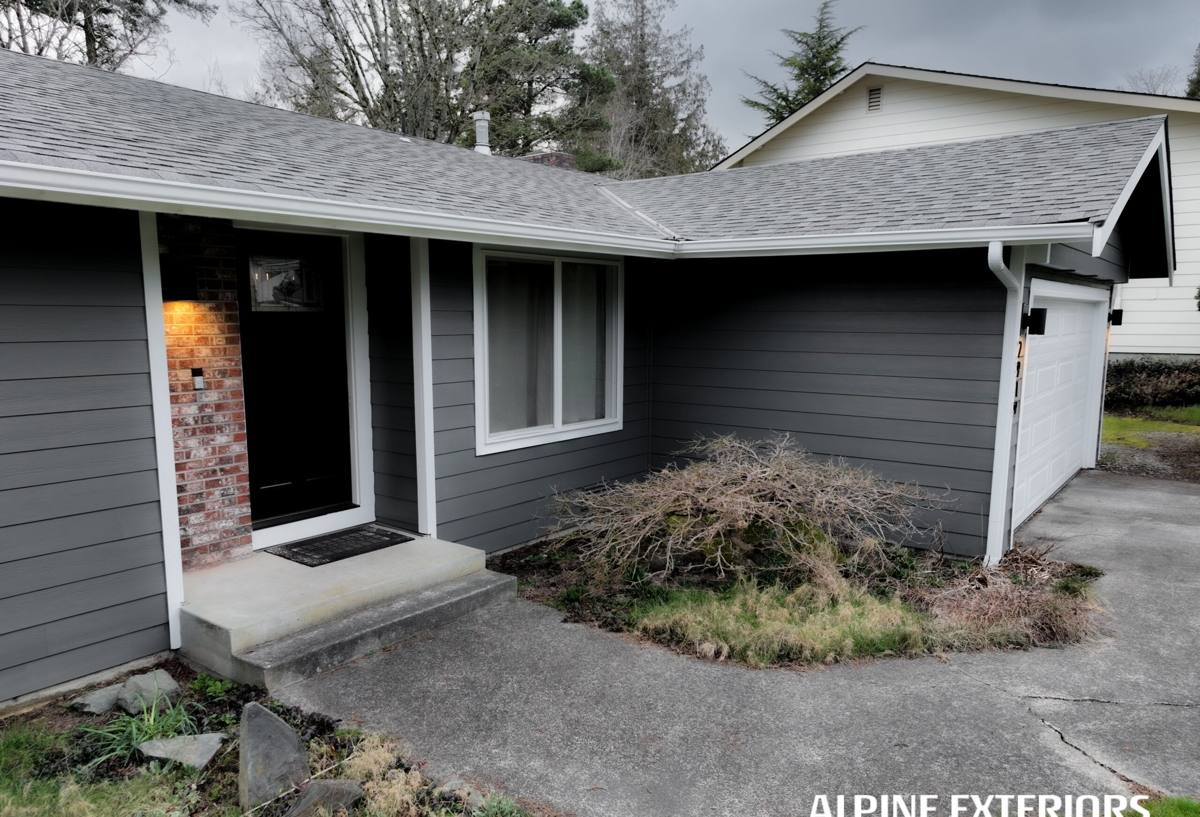
Bellingham Exterior Company installs one siding product: James Hardie fiber cement. We don't install vinyl, LP SmartSide, Cemplank, Allura, primed spruce, or cedar, and that's a deliberate standard, not an oversight. Fiber cement itself — a blend of cement, sand, and cellulose fibers — is inherently more dimensionally stable than wood-based products, which means it doesn't swell and shrink with every wet-dry cycle the way engineered wood siding does. It's also non-combustible, which matters to a lot of homeowners regardless of climate.
Within fiber cement, we standardized on James Hardie specifically because of how the product is engineered and finished. Hardie's HZ5 product line is formulated for cold, wet climates like ours, its ColorPlus finish is baked on at the factory under controlled conditions rather than field-applied, and the company backs its siding with a strong, transferable limited warranty. We've seen enough of what happens to lower-cost fiber cement and engineered wood alternatives in this climate — soft edges on OSB-based products, inconsistent field-painted finishes that fail early, warranty language that doesn't hold up — that we simply stopped installing them. We'd rather do one product exceptionally well than offer a menu of options we don't fully stand behind.
What a Correct Fiber Cement Installation Actually Involves
Fiber cement siding is only as good as the installation underneath it. The product is forgiving in a lot of ways, but it's unforgiving of shortcuts around moisture management — which is exactly the part of the job that matters most in a climate like Whatcom County's.
Water Management Behind the Siding
Before a single board goes up, the wall needs a proper weather-resistive barrier and a drainage plane that lets any moisture that does get behind the siding find its way back out instead of sitting against the sheathing. Rainscreen furring, correct house-wrap lapping, and properly integrated window and door flashing all matter more than the siding itself in terms of long-term wall performance.
Fastening and Clearances
James Hardie publishes specific fastener patterns, nail types, and minimum clearances — from grade, from roof lines, from decks and patios — and those specs exist for a reason. Fastening too tight, using the wrong nail, or skipping clearance requirements is exactly the kind of shortcut that shows up as problems two or three winters later, not on day one.
Joints, Caulking, and Finish
Butt joints, corners, and penetrations need to be treated correctly — some manufacturer-approved systems avoid caulking at butt joints altogether, which removes a common failure point. Where caulk is used, it needs to be a quality, paintable, flexible sealant applied to a clean, dry surface. Touch-up paint at cut edges should match the factory ColorPlus finish closely enough that it isn't a visible patchwork a year later.
Signs Your Siding Is Telling You Something
Most Lynden homeowners don't call about siding until something visible prompts it. Here's what we'd actually want you to watch for between now and then:
- Paint that's peeling, bubbling, or chalking, especially on wood or engineered wood siding
- Soft or spongy spots when you press on a wall, particularly near the bottom courses or under windows
- Visible gaps opening at butt joints, corners, or trim where caulk has cracked or pulled away
- Persistent moss or dark streaking that keeps returning even after cleaning
- Warping, buckling, or boards that no longer sit flat against the wall
- Rising energy bills that could point to a wall system that's no longer sealing properly
None of these mean the whole house needs new siding tomorrow. But they're worth a second look, especially if the current siding is an engineered wood or vinyl product nearing the end of a realistic service life.
James Hardie Product Lines for a Lynden Home
Hardie makes several product profiles, and the right one depends on the style of the house and how it's currently detailed. We'll walk through the actual options during an in-person estimate, but here's the general shape of the lineup:
| Product | Look | Best fit |
|---|---|---|
| HardiePlank lap siding | Traditional horizontal lap, smooth or woodgrain texture | Most farmhouse, craftsman, and traditional homes in the area |
| HardiePanel vertical siding | Clean vertical panels, often with battens | Board-and-batten looks, gables, accent walls |
| HardieShingle siding | Staggered or straight-edge shingle profile | Craftsman and cottage-style homes wanting a shingle look without cedar's upkeep |
| HardieTrim boards | Smooth or textured trim profiles | Window and door casing, corner boards, fascia |
All of these come pre-finished in James Hardie's ColorPlus technology in a range of colors engineered to resist fading, or as primed product for field painting when a custom or repainted color is needed down the road.
What Affects the Cost of a Siding Job Here
We don't quote prices without seeing the house, but the main variables that move a project up or down are consistent from job to job:
| Factor | Why it matters |
|---|---|
| Wall condition underneath | Rot or damaged sheathing found during tear-off adds repair scope before new siding goes on |
| Home size and complexity | More corners, gables, and trim detail means more labor and material waste |
| Product profile chosen | Shingle and vertical-panel work generally takes more labor than straightforward lap siding |
| Existing siding removal | Full tear-off versus siding over an existing surface (when code and conditions allow) changes labor scope |
| Trim and detail work | Window casing, corner boards, and fascia replacement add to the scope beyond field siding |
How We Approach a Lynden Siding Project
We start with an on-site walk-through, not a phone estimate — siding decisions depend on what's actually happening at the wall, and that only shows up in person. From there:
- We inspect the existing siding, sheathing, and trim to identify any hidden moisture or rot damage
- We talk through product profile, color, and any trim or detail changes you want
- We provide a written estimate scoped to what your home actually needs — not a generic package
- On installation, we address the drainage plane and flashing details first, before any siding goes up
- We follow James Hardie's published fastening, clearance, and joint specifications throughout
- We do a final walk-through with you before calling the job complete
Why It Matters to Hire a Crew That Already Works in Lynden
Siding installation isn't regionally exotic — the core techniques are the same everywhere. But a crew that already works throughout Whatcom County knows how local wall assemblies tend to be built, what moisture problems actually show up in this climate versus a drier one, and how to sequence a job around a wet-season forecast instead of getting caught mid-install by a system rolling in off the coast. That familiarity shows up in small decisions — how tear-off is scheduled, how open walls are protected overnight, how flashing details are handled around older window installations — that don't show up in a written estimate but matter to how the finished job performs over the next twenty years.
If you're weighing options for your Lynden home's siding, we're happy to take a look and walk you through what we'd actually recommend, with no pressure to move forward. The estimate is free, and the form below is the easiest way to get one started.