 Bellingham Exterior
 Why Edgemoor Roofs Age Differently Than Roofs Inland
Edgemoor sits close to Bellingham Bay, and that proximity to salt water changes what a roof has to deal with over its lifetime. Salt-laden air corrodes exposed metal faster than it would a few miles inland, wind off the water drives rain sideways under poorly lapped shingles and flashing, and the tree cover that gives the neighborhood its character also means shaded, damp roof planes that stay wet longer after every storm. Add in Whatcom County's long moss season — realistically most of the fall through spring stretch here — and you have a roofing environment that punishes shortcuts a lot faster than a drier climate would.
None of that means an Edgemoor roof needs to be exotic or overbuilt. It means the details that are easy to skip on an easier job — fastener choice, flashing metal, ventilation balance, underlayment coverage — are exactly the details that determine whether a new roof lasts its full rated life or starts showing problems in year eight instead of year twenty-five.
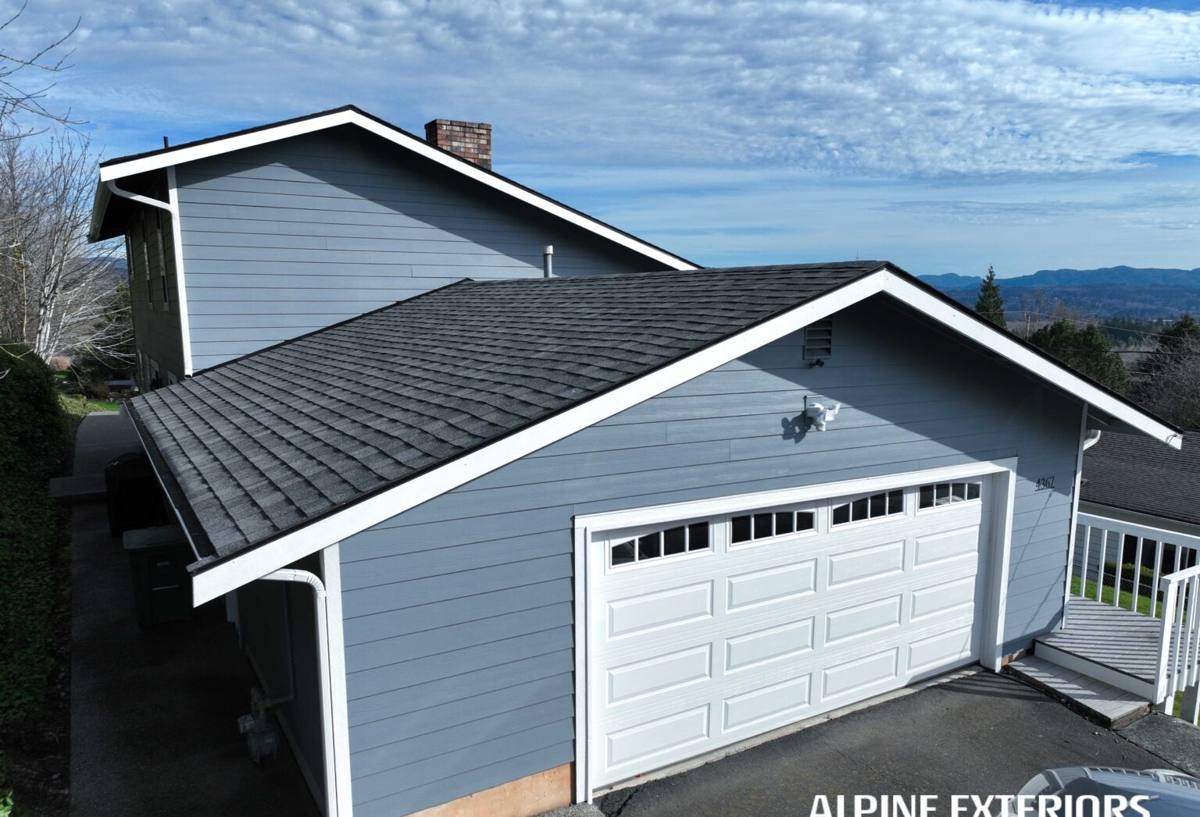
What Coastal Exposure and Moss Actually Do to a Roof
Salt Air and Metal
Standard electro-galvanized fasteners and thin-gauge flashing can start showing surface corrosion within a few years this close to the water. Once a fastener head rusts through its coating, it's a slow leak waiting to happen — often invisible from the ground until there's staining in the attic or on a ceiling below.
Driving Rain
Wind-driven rain off the bay doesn't just fall on a roof, it pushes sideways and works its way up under shingle tabs, around chimneys, and along wall-to-roof transitions. A roof that would perform fine in a calmer inland setting can leak at exactly those transition points if the flashing and underlayment detailing wasn't built for wind-driven exposure.
Moss and Shade
Tree cover keeps roof surfaces cooler and damper for longer stretches after rain, which is ideal growing conditions for moss and algae. Moss isn't just cosmetic — as it establishes in the shingle granules and along butt joints, it holds moisture against the roofing material and can lift shingle edges over time, giving wind and rain an easier path underneath.
Signs an Edgemoor Roof Needs Replacement, Not Another Repair
- Granule loss heavy enough that you're finding grit in gutters every season, not just after a big storm
- Curling, cupping, or cracked shingles across multiple roof planes rather than one isolated spot
- Moss or algae that comes back within months of cleaning, even after treatment
- Soft spots underfoot on the roof deck, or staining on interior ceilings near exterior walls
- Flashing around chimneys, skylights, or vents that's visibly rusted, separated, or was never properly step-flashed to begin with
- A roof already past 20-25 years old with multiple prior repairs — patch-on-patch rarely holds up as well as a clean, correctly installed system
If a roof is showing one or two of these in isolation, a repair can still make sense. Once several show up together, or the roof is old enough that you're chasing leaks in different spots every year, full replacement is usually the more honest recommendation — repeated repairs on a failing roof end up costing more over time than doing it right once.
What a Correct New Roof Installation Involves
A new roof is more than laying shingles over what's there. On an Edgemoor property, we treat every layer as part of the weather barrier, not just the visible surface.
Tear-Off and Deck Inspection
We remove the existing roofing down to the deck rather than layering over it. That's the only way to actually see the condition of the sheathing — soft, delaminated, or water-stained plywood gets replaced before anything new goes down. Covering over a compromised deck just hides the problem under a new roof.
Underlayment
Given the rain exposure here, we don't treat underlayment as an afterthought. Full synthetic underlayment coverage, with self-adhered ice-and-water membrane at eaves, valleys, and any low-slope transitions, gives the roof a real second line of defense if wind-driven rain gets past the shingles themselves.
Flashing
This is where most leaks on coastal roofs actually originate — not the field of the roof, but the transitions: chimneys, skylights, sidewalls, and valleys. We use corrosion-resistant flashing metal and proper step-and-counter-flashing details rather than relying on caulk or roof cement to bridge gaps that should be mechanically flashed.
Ventilation
Balanced intake and exhaust ventilation keeps the attic and roof deck at a consistent temperature and moisture level. In a shaded, damp neighborhood like Edgemoor, poor ventilation traps moisture under the roof deck, which accelerates rot and can void a shingle manufacturer's warranty entirely — regardless of how well the shingles themselves were installed.
Fasteners
We use corrosion-resistant nails appropriate for coastal exposure, and we hand-nail or gun-nail to the manufacturer's exact pattern and pressure specs. Overdriven or underdriven nails are one of the most common causes of early shingle failure, and it's a detail that's invisible once the roof is finished — which is exactly why it matters who's doing the work.
Comparing Roofing Material Options for a Coastal, Shaded Property
| Material | Coastal/Moss Performance | Maintenance | Typical Lifespan |
|---|---|---|---|
| Architectural asphalt shingle | Good with proper ventilation and algae-resistant granules; most common local choice | Periodic moss/debris removal in shaded areas | 25-30 years |
| Standing seam metal | Excellent water shedding on steep pitches; needs marine-grade fasteners and coatings near the bay | Low; occasional fastener and sealant checks | 40-50+ years |
| Cedar shake | Traditional look but holds moisture longer under tree cover; higher moss and rot risk here | Higher; regular treatment and inspection needed | 20-30 years with upkeep |
| Synthetic/composite shingle | Good moisture and impact resistance; less prone to algae staining | Low | 30-50 years |
We're not going to tell you cedar shake is a bad material — it isn't, and plenty of homes wear it well. But on a shaded, moisture-prone Edgemoor lot, we'll be honest that it demands more upkeep to perform the same way it would somewhere drier, and we'll walk through that trade-off with you rather than let it be a surprise two years in.
How Our Installation Process Works
- On-site assessment — we inspect the existing roof, deck condition, ventilation setup, and any problem areas (valleys, chimney flashing, tree-shaded planes) before quoting anything.
- Written estimate — materials, scope, and price laid out clearly, with the reasoning behind any Edgemoor-specific details (upgraded underlayment, flashing metal, fastener spec) explained, not buried in fine print.
- Permitting — we handle the City of Bellingham or Whatcom County permit process as required for the scope of work.
- Tear-off and deck repair — full removal, deck inspection, and replacement of any compromised sheathing before new materials go down.
- Underlayment, flashing, and ventilation install — the layers that determine long-term performance, done to spec rather than rushed to get to the visible shingle layer.
- Shingle or material installation — installed to manufacturer nailing and exposure specifications to keep warranty coverage intact.
- Final walkthrough — cleanup, magnetic sweep for stray fasteners, and a walk-through so you know exactly what was done and what to expect going forward.
Why It Matters That Our Crew Already Works Edgemoor
Roofing crews that mostly work inland or in drier regions sometimes under-spec coastal jobs — standard fasteners instead of corrosion-resistant ones, underlayment coverage sized for a drier climate, ventilation calculations that don't account for heavy tree shade. It's not usually intentional; it's just not what they build for every day.
A crew that regularly works Edgemoor and similar Bellingham neighborhoods near the water already knows which details need upgrading for salt exposure and driving rain, has seen how moss actually behaves on local roof pitches and orientations, and isn't guessing at what Whatcom County's permitting and inspection process requires. That familiarity shows up less in what you can see from the curb and more in whether the roof is still performing correctly ten and twenty years out.
Cost Factors for an Edgemoor Roof Replacement
We won't quote a number without seeing the roof, but the honest cost drivers on a job like this are consistent:
- Roof size and pitch — steeper, more complex rooflines take longer and use more material
- Number of valleys, chimneys, skylights, and other flashing-heavy transitions
- Deck condition — hidden rot or delamination found at tear-off adds material and labor
- Material choice — asphalt shingle, metal, and synthetic/composite options land at different price points, as shown above
- Access — tree-heavy lots and tight setbacks (common in Edgemoor) can affect staging and disposal logistics
- Ventilation and underlayment upgrades needed to meet coastal exposure and manufacturer warranty requirements
Questions to Ask Before You Hire a Roofing Contractor Here
- Are you licensed and insured to work in Washington State, and can you provide proof?
- What underlayment and flashing metal do you use, and why, given how close this property is to the water?
- How do you handle attic and roof ventilation on shaded lots?
- What's included in the manufacturer's warranty, and what voids it?
- Will you inspect and replace deck sheathing as needed, or just roof over what's there?
- Do you pull the required Bellingham or Whatcom County permits yourself?
A contractor who answers these plainly, without hedging or pushing you toward the most expensive option first, is generally a good sign. One who won't put warranty terms or scope in writing is worth walking away from, regardless of the price quoted.
Getting Started
If your Edgemoor roof is showing its age — moss that won't stay gone, granules collecting in the gutters, or a repair history that's starting to add up — it's worth having someone take an honest look before you decide between another patch and a full replacement. We're happy to walk the roof, explain what we find, and put together a straightforward estimate with no pressure attached. Use the form below to get a free estimate scheduled.